On this page
How to identify it
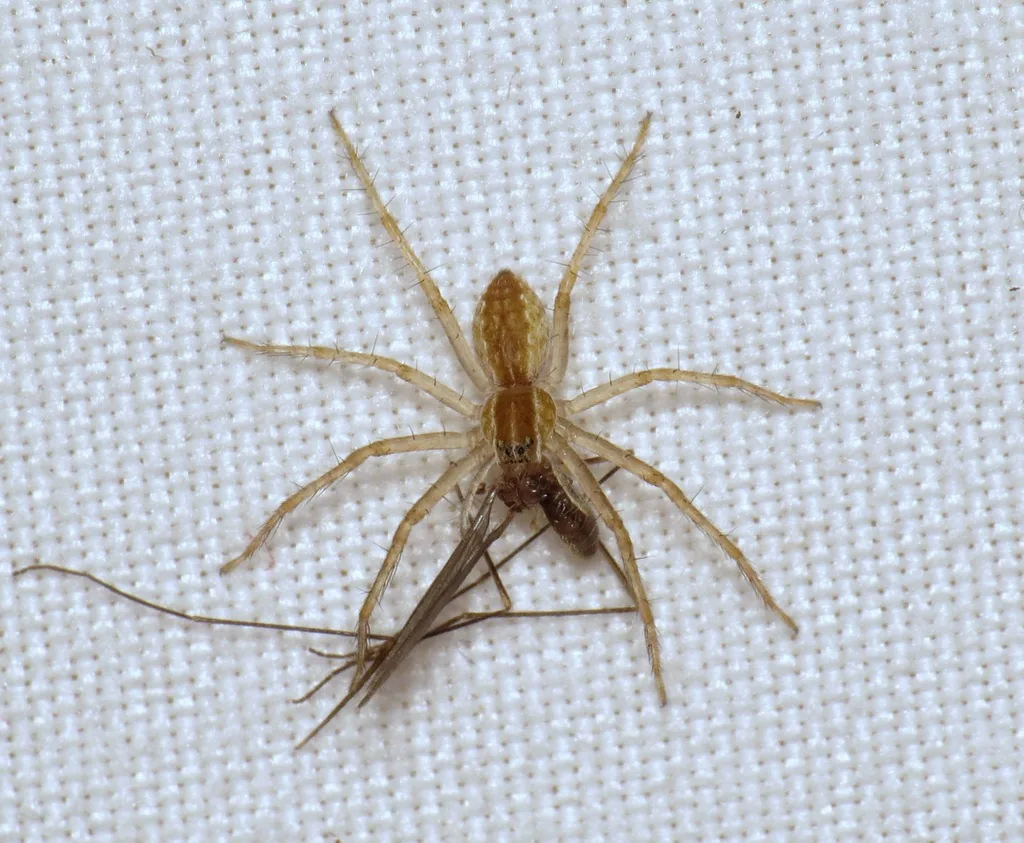
- Body length, not counting legs, is about 1/2 to 3/4 inch, and males are smaller; the leg span can reach about 3 inches.[2][3]
- Nursery web spiders are streamlined, with long legs, a slender body and often lengthwise stripes. Color runs from blackish to brown, tan, rusty, grayish or yellowish, and the hairs give a suede-like look.[2][3]
- At rest they often stretch their legs out in front and behind along a stem or grass blade, with the front two pairs held together.[2]
- Females carry the egg sac in their jaws until the eggs are close to hatching.[2][3]
Look-alikes
| Look-alike | How to tell them apart |
|---|---|
| Wolf spiders | Wolf spiders carry their egg sacs attached to the spinnerets at the rear, while a nursery web spider holds hers in her jaws. Wolf spiders have two noticeably larger eyes, nursery web spiders have eight eyes of about the same size, and wolf spiders are usually on the ground while nursery web spiders are up on plants.[2][3] |
| Fishing spiders | Fishing spiders (Dolomedes) were once placed in the same family and share the habit of carrying the egg sac in the jaws; many nursery web spiders can also run across water when they need to.[2] |
Where it lives
The UW-Milwaukee Field Station gives a range from the Atlantic coast into the Great Plains, in tall grass, wooded edges and shrubs, and sometimes houses. The Missouri Department of Conservation lists nursery web spiders statewide in grasslands, woodland borders, fencerows, roadsides, parks and gardens. GBIF holds about 26,500 US records since 1990 from 36 states, counting the District of Columbia, most from Massachusetts, Texas and Virginia.[3][2][5]
Biology and life cycle
When the eggs are near hatching, the female hides the sac among leaves, often well off the ground on a plant such as milkweed, folds a leaf or ropes vegetation together with silk to make a tent, and stands guard until the young disperse.[2][3]
It hunts insects rather than catching them in a web, either walking about and grabbing prey or waiting motionless for it to come by.[2][3]
Before and during mating the male wraps the female's legs with silk; in experiments, males that could do this were less likely to be eaten during or after mating, and larger, longer-legged males were more likely to mate.[4][3]
They spend the winter as young spiders and are full grown by late spring or early summer.[3]
Damage and signs
- It does no damage. Nursery web spiders eat garden pests and other insects.[2]
Health risk
The Missouri Department of Conservation says nursery web spiders are harmless to humans. The UW-Milwaukee Field Station says their venom is strong enough to kill prey but not strong enough to endanger people or pets.[2][3]
Control
Prevention
Trim plants back from the house so spiders don't settle against it and then move indoors.[1]
Traps and physical control
No control is needed outdoors. Spiders seen in the open during the day are unlikely to bite; one that wanders inside can be vacuumed up, which soft-bodied spiders usually don't survive.[1][2]
Where sources disagree
Cannibalism: the UW-Milwaukee Field Station notes that some sources say female nursery web spiders aren't known for eating males while others call the species cannibalistic. A 2016 study describes it as sexually cannibalistic and found that silk wrapping helps males avoid being eaten.[3][4]
Common questions
- Is the nursery web spider dangerous?
- No. The Missouri Department of Conservation calls it harmless to humans, and the UW-Milwaukee Field Station says its venom isn't strong enough to endanger people or pets.[2][3]
- Why is a spider carrying a big white ball in its jaws?
- Female nursery web spiders carry their egg sac in their jaws until it's nearly ready to hatch, then tuck it into a silk tent and guard it.[2][3]
- Is it a wolf spider?
- Check where the egg sac is and where the spider sits. Wolf spiders tow the sac from the rear and run on the ground; nursery web spiders hold it in their jaws and rest on plants.[2][3]
Sources
- University of California Statewide IPM Program, “Spiders (Pest Notes, Home and Landscape).” ipm.ucanr.edu/home-and-landscape/spiders/ (accessed 2026-11-11)
- Missouri Department of Conservation, “Nursery Web Spiders (field guide).” mdc.mo.gov/discover-nature/field-guide/nursery-web-spiders (accessed 2026-11-11)
- University of Wisconsin-Milwaukee Field Station, “Nursery Web Spider (Family Pisauridae), Bug of the Week (K. Redmond, 'the BugLady').” uwm.edu/field-station/bug-of-the-week/nursery-web-spider/ (accessed 2026-11-11). University field station's natural-history column
- Biology Letters, via PubMed, “Benefits of size dimorphism and copulatory silk wrapping in the sexually cannibalistic nursery web spider, Pisaurina mira (Anderson and Hebets 2016).” pubmed.ncbi.nlm.nih.gov/26911340/ (accessed 2026-11-11). Cited from the PubMed abstract.
- Global Biodiversity Information Facility (GBIF), “Pisaurina mira: US occurrence records since 1990 by state (GBIF occurrence search API).” api.gbif.org/v1/occurrence/search?taxonKey=2150992&country=US&hasGeospatialIssue=false&occurrenceStatus=PRESENT&year=1990%2C2026&facet=stateProvince&facetLimit=400&limit=0 (accessed 2026-11-11). State counts are records reported (iNaturalist research-grade, museum specimens, surveys), not abundance.
- iNaturalist, “Pisaurina mira taxon page (order and family).” www.inaturalist.org/taxa/84109 (accessed 2026-11-11)