On this page
How to identify it
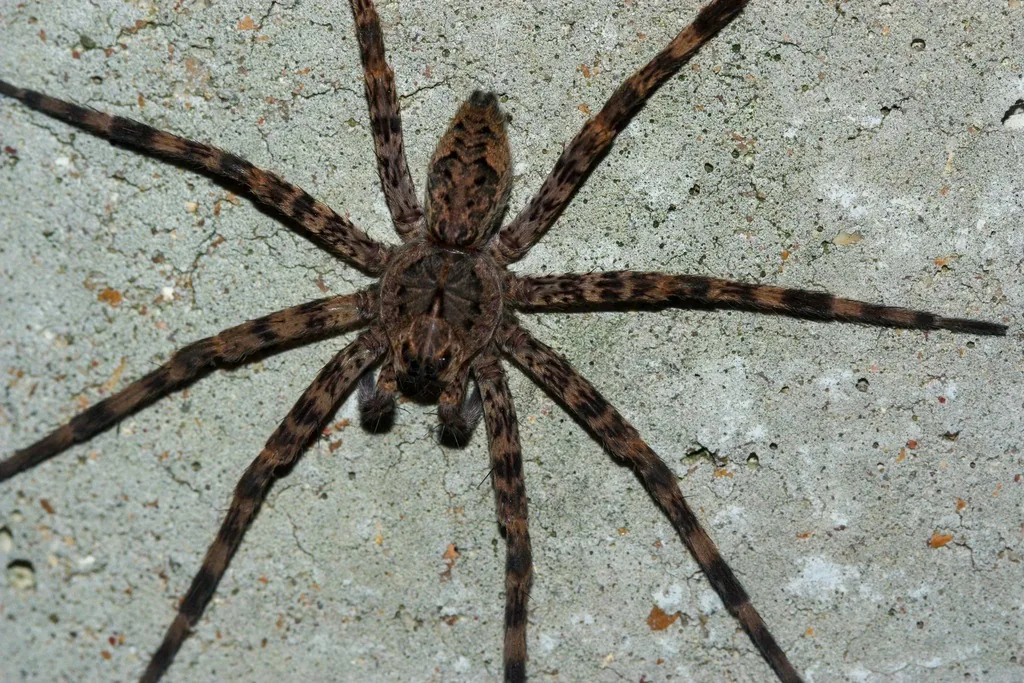
- Dark fishing spider females are about 5/8 to 1 inch long, with a leg span that can top 3 inches; males are roughly half that size (1/4 to 1/2 inch, Missouri says).[1][3][5]
- The body is brownish gray to dark brown with black and lighter brown markings, including dark W-shaped marks on top of the abdomen, and the legs are banded light and dark and usually held almost straight out.[1][3][5]
- Fishing spiders don't spin webs to catch prey; they stalk or ambush it, mostly at night, often resting head-down on tree trunks or upside down on wood or stone by day.[3][5]
- With a hand lens, you can see that in the front four eyes, the outer two sit higher than the inner two.[2]
- Missouri places them in their own family, Dolomedidae; they used to be grouped with the nursery web spiders (Pisauridae), as NC State still does.[5][2]
Look-alikes
| Look-alike | How to tell them apart |
|---|---|
| Wolf spider | Wolf spiders have the front four eyes in a straight row facing forward, and two eyes noticeably larger than the rest. Females carry the egg sac on their spinnerets and then carry their young on their backs, while fishing spiders carry the sac in their jaws and guard the young in a leaf nursery.[2][7] |
| Striped fishing spider | A close relative that looks very similar but has white W-shaped marks running unbroken across the rear of the abdomen, and lives mostly right at the water's edge.[1][5][3] |
| Nursery web spider | Smaller and slimmer (about 1/2 to 3/4 inch), often with lengthwise stripes, and usually seen among the foliage of plants rather than walking on the ground.[7] |
Where it lives
The dark fishing spider ranges from New England and Canada south to Florida and Texas, and Missouri reports it statewide. Other Dolomedes species live along ponds, streams and wetlands across the same region. GBIF's 1990-2026 U.S. records for the genus (about 51,700) come from 40 states on the map, most from Virginia, Ohio and North Carolina.[1][5][3][13]
Biology and life cycle
Despite the name, the dark fishing spider is more of a tree-dwelling spider and is often found far from water in wooded settings; in yards it turns up around logs and stumps.[1][3][5]
Insects make up most of the diet. Species living near water also catch small fish, tadpoles and frogs, can stay underwater for a short time when chased, and around ponds feed largely on insects at the water surface.[2][3][11]
Fish catching is real: a review of more than 80 cases worldwide found most involved Dolomedes and related spiders, and in the southeastern U.S. the usual catch is mosquitofish, often longer than the spider itself.[10]
Spiders spend the winter not quite mature under stones, loose bark, tree cavities or in buildings, then mature in spring; adults are seen from early May through September.[1]
Females carry the egg sac in their jaws, then tie leaves into a nursery web where they guard 1,000 or more spiderlings.[1][2][6]
Accounts of mating differ. Mississippi State says females often eat males after mating, and sometimes before; studies of the dark fishing spider found males die on their own during their single mating and are then eaten, which increased the number, size and survival of the offspring.[3][8][9]
Damage and signs
- They do not feed on plants; the only effect on landscapes is the look of their nursery webs and the debris caught in them.[2]
- They sometimes rest on decks, patios and house walls and occasionally wander indoors, where their size alarms people; boathouses and other buildings near water often have them.[3][6]
Health risk
Bites are rare because these spiders are shy and run from people. MedlinePlus says most spider bites are harmless and look like a bee sting, with redness, pain and swelling; wash the bite with soap and water, use an ice pack, and get care for small children or anyone with severe symptoms, since spider bites occasionally cause allergic reactions.[1][3][12]
Control
Traps and physical control
A fishing spider that wanders into a garage or basement can be coaxed into a jar or other container and released outside.[2]
Pesticides
They are not household pests, so spraying is not needed; a stray spider can be swatted or treated with a common household aerosol if it causes real distress.[2]
Common questions
- Are fishing spiders dangerous?
- No. They are shy, run from people and rarely bite even when grabbed. MedlinePlus says most spider bites are harmless and feel like a bee sting.[1][3][12]
- Why is there a fishing spider in my house if I don't live near water?
- The dark fishing spider is a woodland species that often lives well away from water. It commonly wanders into homes in wooded areas.[1][3][5]
- Can fishing spiders really catch fish?
- Yes. They can walk on water and dive, and species near ponds and streams catch minnows, mosquitofish and tadpoles, though insects make up most of their diet.[2][3][10]
Sources
- Penn State Extension, “Fishing Spider (updated January 19, 2026).” extension.psu.edu/fishing-spider (accessed 2026-11-11)
- NC State Extension, “Fishing Spiders and Wolf Spiders (PDIC Factsheet, reviewed June 15, 2022).” content.ces.ncsu.edu/fishing-spiders-and-wolf-spiders (accessed 2026-11-11)
- Mississippi State University Extension Service, “Dark Fishing Spider (Bug's Eye View, Vol. 8, No. 25).” extension.msstate.edu/newsletters/bugs-eye-view/2022/dark-fishing-spider-vol-8-no-25 (accessed 2026-11-11)
- iNaturalist, “Dolomedes tenebrosus taxon page (order and family).” www.inaturalist.org/taxa/82117 (accessed 2026-11-11)
- Missouri Department of Conservation, “Dark Fishing Spider (Field Guide).” mdc.mo.gov/discover-nature/field-guide/dark-fishing-spider (accessed 2026-11-11)
- The Connecticut Agricultural Experiment Station, “Spiders Found in the House (K. Dugas).” portal.ct.gov/-/media/caes/documents/publications/fact_sheets/entomology/spiders_in_the_house.pdf (accessed 2026-11-11)
- Missouri Department of Conservation, “Nursery Web Spiders (Field Guide).” mdc.mo.gov/discover-nature/field-guide/nursery-web-spiders (accessed 2026-11-11)
- Biology Letters, via PubMed, “Schwartz SK, Wagner WE Jr, Hebets EA (2013), Spontaneous male death and monogyny in the dark fishing spider, Biology Letters 9(4):20130113.” pubmed.ncbi.nlm.nih.gov/23784928/ (accessed 2026-11-11). Cited from the PubMed abstract.
- Current Biology, via PubMed, “Schwartz SK, Wagner WE Jr, Hebets EA (2016), Males can benefit from sexual cannibalism facilitated by self-sacrifice, Current Biology 26(20):2794-2799.” pubmed.ncbi.nlm.nih.gov/27720621/ (accessed 2026-11-11). Cited from the PubMed abstract.
- PLoS One, via PubMed, “Nyffeler M, Pusey BJ (2014), Fish predation by semi-aquatic spiders: a global pattern, PLoS One 9(6):e99459.” pubmed.ncbi.nlm.nih.gov/24940885/ (accessed 2026-11-11). Cited from the PubMed abstract.
- Oecologia, via PubMed, “Zimmermann M, Spence JR (1989), Prey use of the fishing spider Dolomedes triton (Pisauridae, Araneae): an important predator of the neuston community, Oecologia 80(2):187-194.” pubmed.ncbi.nlm.nih.gov/28313105/ (accessed 2026-11-11). Cited from the PubMed abstract.
- MedlinePlus, U.S. National Library of Medicine, “Spider Bites (health topic).” medlineplus.gov/spiderbites.html (accessed 2026-11-11)
- Global Biodiversity Information Facility (GBIF), “Dolomedes (fishing spiders): occurrence records in the U.S., 1990-2026 (GBIF occurrence search).” api.gbif.org/v1/occurrence/search?taxonKey=2150885&country=US&hasGeospatialIssue=false&occurrenceStatus=PRESENT&year=1990%2C2026&facet=stateProvince&facetLimit=400&limit=0 (accessed 2026-11-11). State counts are records reported (iNaturalist research-grade, museum specimens, surveys), not abundance.