On this page
How to identify it
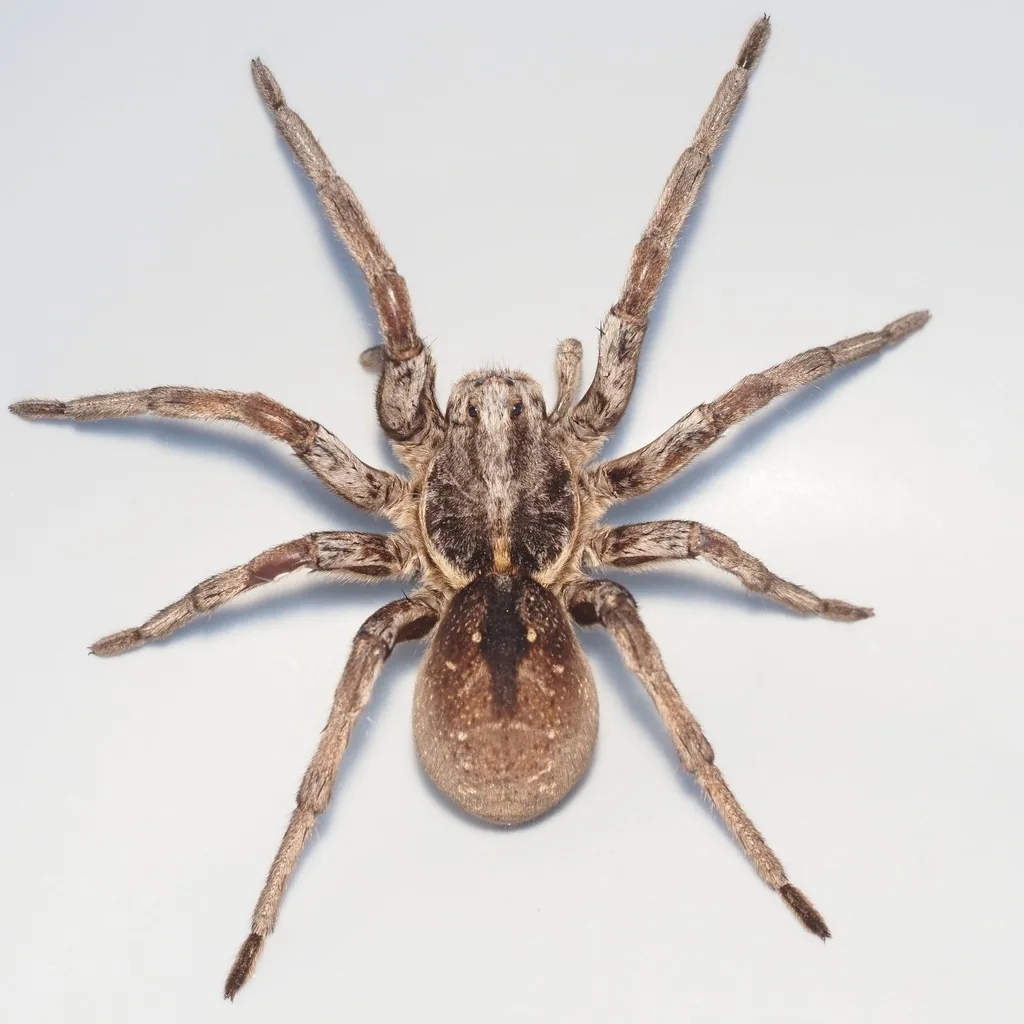
- Large and mostly dark brown with gray hairs. Penn State gives Carolina wolf spider (Hogna carolinensis) females as 22 to 35 mm long and males 18 to 20 mm, with solid-colored legs; Missouri's wolf spiders range from 1/4 inch to 1 inch, depending on species, and males are usually smaller than females.[1][4]
- Eight eyes in three rows: a row of four small eyes in front, a middle pair of much larger forward-facing eyes, and a widely spaced rear pair on top of the head. At night their eyes shine back in a flashlight beam.[3][4]
- Females carry a pea-sized egg sac attached to the spinnerets at the rear, and after hatching the spiderlings ride on her back for up to two weeks or more.[4][2][1]
- The tiger wolf spider (Tigrosa aspersa), the other big species often found in homes, is slightly smaller (females 18 to 25 mm), with a narrow line of pale yellow hairs between the eyes and legs banded lighter at the joints.[1][4]
Look-alikes
| Look-alike | How to tell them apart |
|---|---|
| Funnel weavers (grass spiders) | Similar look but have a pair of long spinnerets at the rear and live in funnel-shaped sheet webs.[2] |
| Brown recluse | Six eyes in pairs, uniformly colored legs and abdomen, and much smaller.[5] |
| Fishing spiders | Also large, dark hunting spiders, but they favor wet places, carry the egg sac in their jaws rather than on the spinnerets, and lack the two large forward-facing eyes.[4][2] |
| Jumping spiders | Similar enlarged front eyes, but jumping spiders hunt on plants by day, move in jerky starts and jump long distances; wolf spiders run smoothly over the ground and often hunt at night.[4] |
Where it lives
Found statewide across the U.S. in grassy and leaf-covered areas, stream edges and woodland litter, and in retreats in soil, under boards, stones, firewood and siding. Penn State counts about 240 U.S. species in 21 genera, UC IPM about 200 in North America, and Missouri more than 40. New houses in developments may be invaded after wolf spiders lose their outdoor homes.[2][1][3][4]
Biology and life cycle
Penn State says the big Hogna and Tigrosa species come out only at night to hunt and hide by day, while UC IPM says wolf spiders as a group hunt in the open by day and night. Males die before winter; mated females overwinter and lay eggs in May or June.[1][3]
Females can live several years after reaching maturity.[1]
Spiderlings hatch in June and July, reach only about half their full size by winter, overwinter in protected sites and finish growing the next spring and summer.[1]
They chase down ground-dwelling insects and other spiders without using webs, and are themselves eaten by small lizards, shrews and many birds.[4][3]
Damage and signs
Health risk
They bite only if mishandled or trapped against skin; Penn State says reactions are pain, redness and some swelling that usually fade within 24 hours. In a study of 45 confirmed wolf spider bites in Australia, all caused pain but none caused skin ulcers, and a Brazilian study of 515 bites found mostly mild pain and no tissue death.[1][6][7]
Control
Keep them out
Seal cracks in the foundation and gaps around windows and doors, keep screens in good repair, check plants, firewood and boxes before bringing them in, and point outdoor lights away from doors and windows so they attract fewer insects.[3][8]
Sanitation
Remove clutter, woodpiles, leaf litter and heavy vegetation near the foundation, and vacuum or sweep webs and spiders regularly; vacuumed spiders usually don't survive.[3][8]
Traps and physical control
Catch individual spiders under a jar with a sheet of paper and release them outdoors, or vacuum them.[3]
Sticky traps along walls catch wandering spiders without insecticide, if placed where pets and children can't reach them.[3]
Pesticides
Insecticides don't give long-term spider control and generally shouldn't be used outdoors. Spraying works only on a spider you see and spray directly, and is temporary without housekeeping.[3][8]
Retail spider products listed by UC IPM contain pyrethrins or pyrethroids such as resmethrin and allethrin; sorptive dusts with amorphous silica gel (silica aerogel) and pyrethrins can be left in cracks, attics and wall voids.[3]
Common questions
- Are wolf spiders poisonous?
- No. Bites usually cause only short-lived pain and redness, and studies of confirmed wolf spider bites found no skin ulcers or tissue death.[1][6][7]
- Why do wolf spiders show up indoors in fall?
- Many are mature males wandering in search of females, which get inside by accident; mated females also look for protected places to spend the winter.[3][1]
Sources
- Penn State Extension, “Wolf Spiders.” extension.psu.edu/wolf-spiders (accessed 2026-11-12)
- University of Kentucky Entomology, “ENTFACT-622: Common Spiders Found Around Homes and Buildings.” entomology.mgcafe.uky.edu/ef622 (accessed 2026-11-12)
- University of California Statewide IPM Program, “Pest Notes: Spiders, Publication 7442.” ipm.ucanr.edu/legacy_assets/PDF/PESTNOTES/pnspiders.pdf (accessed 2026-11-12)
- Missouri Department of Conservation, “Wolf Spiders (Field Guide).” mdc.mo.gov/discover-nature/field-guide/wolf-spiders (accessed 2026-11-12)
- University of California Statewide IPM Program, “Pest Notes: Brown Recluse and Other Recluse Spiders, Publication 7468 (revised November 2018).” ipm.ucanr.edu/legacy_assets/PDF/PESTNOTES/pnbrownrecluse.pdf (accessed 2026-11-12)
- J Toxicol Clin Toxicol 2004;42(2):153-161, via PubMed, “Australian wolf spider bites (Lycosidae): clinical effects and influence of species on bite circumstances (2004).” pubmed.ncbi.nlm.nih.gov/15214620/ (accessed 2026-11-12)
- Toxicon 1990;28(6):715-717, via PubMed, “Wolf spider bites in Sao Paulo, Brazil: a clinical and epidemiological study of 515 cases (1990).” pubmed.ncbi.nlm.nih.gov/2402765/ (accessed 2026-11-12)
- University of California Statewide IPM Program, “Pest Notes: Widow Spiders and Their Relatives, Publication 74149 (revised March 2017).” ipm.ucanr.edu/legacy_assets/PDF/PESTNOTES/pnblackwidow.pdf (accessed 2026-11-12)
- iNaturalist, “Hogna carolinensis taxon page (order and family).” www.inaturalist.org/taxa/122621 (accessed 2026-11-12)