The short answer
- Bulk: a US tarantula is stocky, with a body 1 to 2 inches long; female Texas brown tarantulas average about 2 inches. Most wolf spiders are 1/4 inch to 1 inch long in the body, and the largest Pennsylvania species reach 22 to 35 millimeters.[8][2][3][4][5]
- Markings: tarantulas in the eastern part of their range are evenly dark chocolate brown on body and legs. Wolf spiders are usually gray, brown, black or tan with darker stripes or spots, often a stripe down the middle of the abdomen.[2][3][4][7]
- Fangs: tarantulas belong to the group whose fangs point downward and strike in a stabbing motion. Wolf spiders, like most spiders, have fangs that pinch together sideways.[10]
- Where you live: wolf spiders are common across the country, with about 240 species in the United States. Tarantulas in the US are limited to the Southwest, the southern Plains and parts of Missouri, Arkansas and Louisiana; the Mississippi River marks their eastern edge.[4][5][14][3]
Profiles on this site
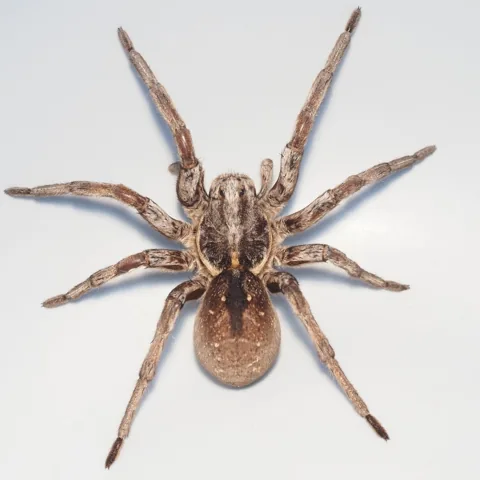 Carolina Wolf Spider
Hogna carolinensis
Wolf spiders are large hunting spiders that don't use webs; they wander into homes by accident, especially males searching for mates, and they don't persist indoors.
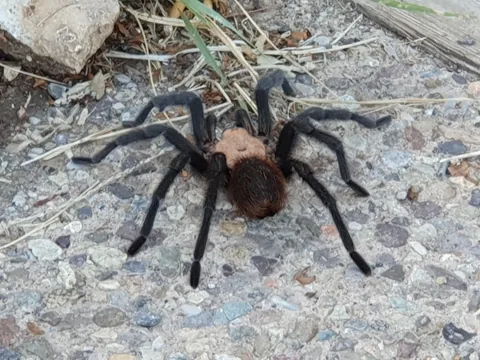 Tarantulas
Aphonopelma species (e.g., Texas brown tarantula, A. hentzi)
Tarantulas are the largest spiders in the world and alarm people with their size and hairiness, but bites of native species are generally no worse than a bee sting. Texas A&M AgriLife says they are not pests and don't warrant control.
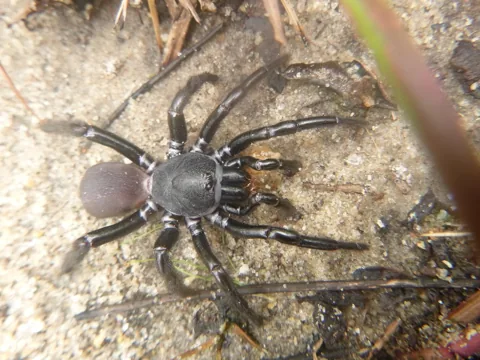 Trapdoor Spiders (cork-lid trapdoor spiders)
Ummidia species (e.g., Ummidia audouini)
Trapdoor spiders are chunky relatives of tarantulas that spend their lives in silk-lined burrows hidden under a hinged lid. They are rarely seen, and their bite, while it can hurt, is not considered dangerous.
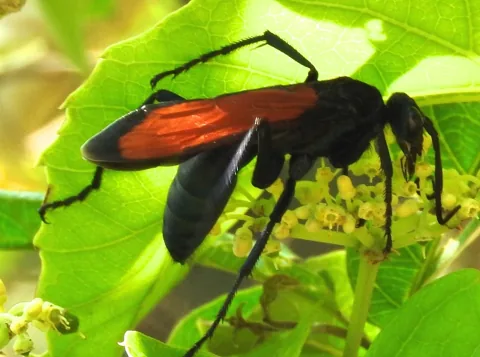 Tarantula Hawks
Pepsis species (e.g., Pepsis thisbe)
Tarantula hawks are big spider wasps, up to about 2 inches long, with metallic blue-black bodies and bright orange wings. Females paralyze tarantulas to feed their young, and their sting is among the most painful of any insect, but they are docile, sting only when strongly provoked, and their venom has very low lethality. No control is recommended: leave them alone and they will leave you alone.
Side by side: wolf spiders and tarantulas
Each line gives the wolf spider first, then the tarantula.[4][2]
- Family: wolf spiders are Lycosidae, with about 240 species in the United States (Missouri counts nearly 250 north of Mexico). Tarantulas are Theraphosidae; the US species covered by a 2016 revision all belong to the genus Aphonopelma.[5][4][2][14]
- Size: wolf spider bodies run from 1/4 inch to 1 inch in Missouri, and Penn State gives Carolina wolf spider females as 22 to 35 millimeters and males 18 to 20. Tarantula bodies are 1 to 2 inches in California; in Missouri and Arkansas females average 2 inches and males about 1-1/2 inches.[4][5][8][2][3]
- Build: wolf spiders are athletic, long-legged runners. Tarantulas are stocky and heavy-bodied; Missouri calls its tarantula the state's largest spider.[4][2]
- Hair and color: wolf spiders have long hairy legs and bodies patterned in gray, brown, black or tan with darker stripes. The Texas brown tarantula is uniformly dark chocolate brown on body and legs, with reddish hairs on the carapace.[8][4][2][3]
- Defensive hairs: tarantulas in North and South America can flick hairs off the abdomen at an attacker. The hairs cause itching and burning on skin.[1][12]
- Fangs: tarantulas and their relatives the trapdoor spiders have fangs that point downward and stab, rather than the sideways, pinching fangs of more advanced spiders such as wolf spiders.[10]
- Eyes: a wolf spider has four small eyes in a straight row in front, a larger middle pair facing forward and a widely spaced rear pair on top of the head, and its eyes shine back in a flashlight beam.[8][4][9]
- Home: some wolf spiders dig burrows or use cavities under rocks and logs, some build retreats under boards, firewood or siding, and some have no home at all. A tarantula lives alone in a silk-lined burrow, often an old rodent or reptile tunnel, waiting at the entrance at night for passing prey.[4][5][1][2][3][8]
- Eggs and young: a female wolf spider drags her egg sac attached to her spinnerets and then carries the spiderlings on her back. A female tarantula keeps her egg sac in the burrow and guards it; the young stay near her for about a week before dispersing.[4][9][5][2][3]
- Lifespan: some wolf spiders survive for nearly two years, and Penn State says females of the large species may live several years past maturity. Female tarantulas can live for decades: Missouri says more than 30 years, and Arkansas notes 25 years in captivity.[4][5][2][3]
- Indoors: wolf spiders often wander into homes but do not persist there. Tarantulas sometimes venture indoors, usually mature males that wandered in by accident.[6][7][8][1]
Where each one lives in the US
Wolf spiders are everywhere. Missouri finds them statewide, Kentucky lists them among its most common spiders, and Penn State says two large species turn up in Pennsylvania homes.[4][7][5]
Tarantulas are not. A 2016 revision of the US tarantulas recognized 29 species in the genus Aphonopelma. The most widespread, Aphonopelma hentzi, is bounded on the east by the Mississippi River and found in all or parts of Missouri, Arkansas, Louisiana, Kansas, Oklahoma, Texas, Colorado, New Mexico and Arizona. Other species range through California, Nevada, Utah, Arizona and New Mexico.[14]
In Missouri the tarantula lives mainly in the south and center of the state; the Missouri River apparently keeps it out of the north, and it prefers dry, rocky glades. In Arkansas it occurs through most of the state but apparently not the Mississippi delta.[2][3]
East of the Mississippi, a big hairy spider is not a tarantula. NC State says North Carolina has no true tarantulas, only a few of their trapdoor-spider relatives, and Mississippi State says trapdoor spiders are the closest thing to tarantulas there.[11][10][14]
Species counts differ by source and by how old the count is. Missouri says there are more than 50 tarantula species in North America, Texas A&M says fifteen in Texas, and the 2016 revision reduced the 55 names in use for the United States to 29 species.[2][1][14]
Fall wanderers: why both show up at once
UC IPM says the rather large hunting spiders found in homes or garages are often mature wolf spider or tarantula males searching for females. While wandering, one or more may get indoors by accident, and that new housing developments can be invaded by wolf spiders that have lost their outdoor living places.[8]
Wolf spiders: in the large Pennsylvania species, mating happens in autumn and the males die before winter, while mated females overwinter in protected places, sometimes buildings.[5]
Tarantulas: in Arkansas males wander in late summer and fall, August through November, and are often seen crossing roads; Missouri reports the same in the southern part of the state. Texas A&M says the so-called tarantula migrations are males searching for mates, not a move to a new area.[3][2][1]
Timing varies by species. The 2016 revision notes that Aphonopelma hentzi can breed in spring and summer (April to August) or in fall (September to October), sometimes in the same place, and that males of the southern Arizona species Aphonopelma chalcodes leave their burrows in summer, generally July to September, during the monsoon.[14]
Bites and hairs
Wolf spiders: in a study of 45 confirmed wolf spider bites in Australia, every bite was painful but none caused a necrotic ulcer, and a Brazilian review of 515 bites found mostly mild pain and no local necrosis.[15][16]
Tarantulas: the Arizona Poison and Drug Information Center says a provoked tarantula can leave painful puncture wounds but the bite is unlikely to cause problems beyond pain at the site. A medical review found no evidence that tarantula bites are dangerous, but warned that the hairs of many species can cause skin irritation and serious eye inflammation.[12][17]
The hairs are the bigger risk. Arizona's poison center says skin contact causes itching and a rash, and case reports describe hairs from pet tarantulas embedded in the cornea after handling, in one case needing eye surgery, with authors urging eye protection when handling tarantulas.[12][18][19]
First aid from the Arizona poison center: clean a bite with soap and water, make sure tetanus vaccination is current, and remove hairs from skin with tape. Call Poison Control at 1-800-222-1222 for advice.[12]
How to confirm which one you have
Start with location. East of the Mississippi River, a wild spider is not a tarantula. In Missouri, Arkansas and the southern Plains, a heavy, evenly dark brown spider with no stripes is the Texas brown tarantula; a slimmer runner with stripes or spots is a wolf spider.[14][11][2][4]
Check the eyes with a flashlight held beside your head at night: a wolf spider's eyes shine back like a cat's. In daylight look for the two large forward-facing eyes above a row of four small ones.[4][8][9]
A spider carrying a round egg sac at the rear, or a back covered in spiderlings, is a wolf spider.[4][9]
Take a photo rather than picking the spider up, especially a tarantula, whose hairs irritate skin and eyes. For a name, ask your county extension office; Texas A&M's Travis County IPM program, for example, offers identification help.[12][1]
Why the difference matters
Neither needs pest control. Texas A&M says tarantulas that come indoors are not a pest and do not warrant control; Kentucky calls wolf spiders accidental invaders that do not persist indoors, and Missouri notes they eat many insect pests.[1][6][4]
Collecting rules apply to tarantulas in some places. In Missouri it is illegal to collect tarantulas from public land without a permit.[2]
The difference matters most for pets. The Merck Veterinary Manual says US tarantula species are harmless and not aggressive, but their fine hairs can lodge in an animal's cornea or irritate skin and mucous membranes, and severe eye damage is possible.[13]
What to do for each
Wolf spider indoors: trap it under a jar and release it outside, or vacuum it up. UC IPM says insecticides do not give long-term spider control and generally should not be used outdoors.[8]
- Tarantula indoors: Texas A&M says the best approach is to keep tarantulas outside where they belong by excluding them from the home. Because of the hairs, keep it away from your face and from pets rather than handling it.[1][12][13][18]
- Keep both outside: seal cracks in the foundation and gaps around windows and doors, and check that screens fit well.[8][1]
- Outdoors: a tarantula crossing a road or yard in late summer or fall is most likely a male searching for a female, and Texas A&M says tarantulas are not a pest.[3][1][2]
Common questions
- Are there tarantulas east of the Mississippi?
- Not native ones. The 2016 revision puts the eastern limit of the most widespread US tarantula at the Mississippi River, and NC State says North Carolina has no true tarantulas, only trapdoor-spider relatives.[14][11]
- Can a wolf spider get as big as a tarantula?
- Not in body size. The biggest wolf spiders in Pennsylvania reach 22 to 35 millimeters, while female tarantulas average about 2 inches in the body and are much heavier.[5][2][3][4]
- Is a tarantula bite dangerous?
- US tarantula bites are painful but unlikely to cause problems beyond pain at the site, according to the Arizona poison center. The flicked hairs cause itching and rash and can injure eyes.[12][17]
- Why do I see tarantulas crossing the road in fall?
- They are mature males searching for females. In Arkansas this happens from August through November.[3][1]
- Is the big spider with babies on its back a tarantula?
- No. Carrying spiderlings on the back is a wolf spider habit; tarantula mothers guard their eggs in the burrow.[4][9][2]
Photo credits
- Carolina Wolf Spider: (c) Russell Pfau, some rights reserved (CC BY) — via iNaturalist, CC BY 4.0
- Tarantulas: (c) Lien Decuypere, some rights reserved (CC BY) — via iNaturalist, CC BY 4.0
- Trapdoor Spiders (cork-lid trapdoor spiders): cwarneke, public domain (CC0), via iNaturalist
- Tarantula Hawks: (c) Francisco Farriols Sarabia, some rights reserved (CC BY) — via iNaturalist, CC BY 4.0
Sources
- Texas A&M AgriLife Extension, Travis County, “Texas Tarantulas.” travis-tx.tamu.edu/2023/10/25/texas-tarantulas-by-wizzie-brown/ (accessed 2026-11-14)
- Missouri Department of Conservation, “Texas Brown Tarantula.” mdc.mo.gov/discover-nature/field-guide/texas-brown-tarantula (accessed 2026-11-14)
- University of Arkansas Arthropod Museum, “Tarantula.” arthropod.uark.edu/tarantula/ (accessed 2026-11-14)
- Missouri Department of Conservation, “Wolf Spiders.” mdc.mo.gov/discover-nature/field-guide/wolf-spiders (accessed 2026-11-14)
- Penn State Extension, “Wolf Spiders.” extension.psu.edu/wolf-spiders (accessed 2026-11-14)
- University of Kentucky Entomology, “Common Spiders Found Around Homes and Buildings (ENTFACT-622).” entomology.mgcafe.uky.edu/ef622 (accessed 2026-11-14)
- University of Kentucky Entomology, “Urban Spider Chart.” entomology.mgcafe.uky.edu/spider-chart (accessed 2026-11-14)
- University of California Statewide IPM Program, “Pest Notes: Spiders.” ipm.ucanr.edu/home-and-landscape/spiders/ (accessed 2026-11-14)
- NC State Extension, “Fishing Spiders and Wolf Spiders.” content.ces.ncsu.edu/fishing-spiders-and-wolf-spiders (accessed 2026-11-14)
- Mississippi State University Extension, “Trapdoor Spider (Bug's Eye View Vol. 7, No. 28).” extension.msstate.edu/newsletters/bugs-eye-view/2021/trapdoor-spider-vol-7-no-28 (accessed 2026-11-14)
- NC State Plant Disease and Insect Clinic, “Local Spiders Confused for Deadly Relatives.” pdic.ces.ncsu.edu/news/local-spiders-confused-for-deadly-relatives/ (accessed 2026-11-14)
- Arizona Poison and Drug Information Center (University of Arizona), “Arthropods: bees, spiders and other bugs.” azpoison.com/venom/bees-spiders-other-bugs (accessed 2026-11-14)
- Merck Veterinary Manual, “Spider and Scorpion Bites and Stings to Animals.” www.merckvetmanual.com/toxicology/venomous-arthropods/spiders-and-scorpions (accessed 2026-11-14)
- ZooKeys (PMC4768370), “Hamilton CA, Hendrixson BE, Bond JE. 2016. Taxonomic revision of the tarantula genus Aphonopelma Pocock, 1901 within the United States. ZooKeys 560:1-340.” pmc.ncbi.nlm.nih.gov/articles/PMC4768370/ (accessed 2026-11-14)
- PubMed (peer-reviewed), “Isbister GK, Framenau VW. 2004. Australian wolf spider bites (Lycosidae): clinical effects and influence of species on bite circumstances. J Toxicol Clin Toxicol 42(2):153-161.” pubmed.ncbi.nlm.nih.gov/15214620/ (accessed 2026-11-14)
- PubMed (peer-reviewed), “Ribeiro LA et al. 1990. Wolf spider bites in Sao Paulo, Brazil: a clinical and epidemiological study of 515 cases. Toxicon 28(6):715-717.” pubmed.ncbi.nlm.nih.gov/2402765/ (accessed 2026-11-14)
- PubMed (peer-reviewed), “Rein JO. 2002. Exotic invertebrates: a health problem? Tidsskr Nor Laegeforen 122(30):2896-2901.” pubmed.ncbi.nlm.nih.gov/12569717/ (accessed 2026-11-14)
- PubMed (peer-reviewed), “McAnena L, Murphy C, O'Connor J. 2013. 'Tarantula keratitis': a case report. Ir J Med Sci 182(3):349-350.” pubmed.ncbi.nlm.nih.gov/23212648/ (accessed 2026-11-14)
- PubMed (peer-reviewed), “Hom-Choudhury A et al. 2012. A hairy affair: tarantula setae-induced panuveitis requiring pars plana vitrectomy. Int Ophthalmol 32(2):161-163.” pubmed.ncbi.nlm.nih.gov/22222718/ (accessed 2026-11-14)