On this page
How to identify it
- Females are 7.5 to 11.5 mm long and males 6 to 9 mm.[1]
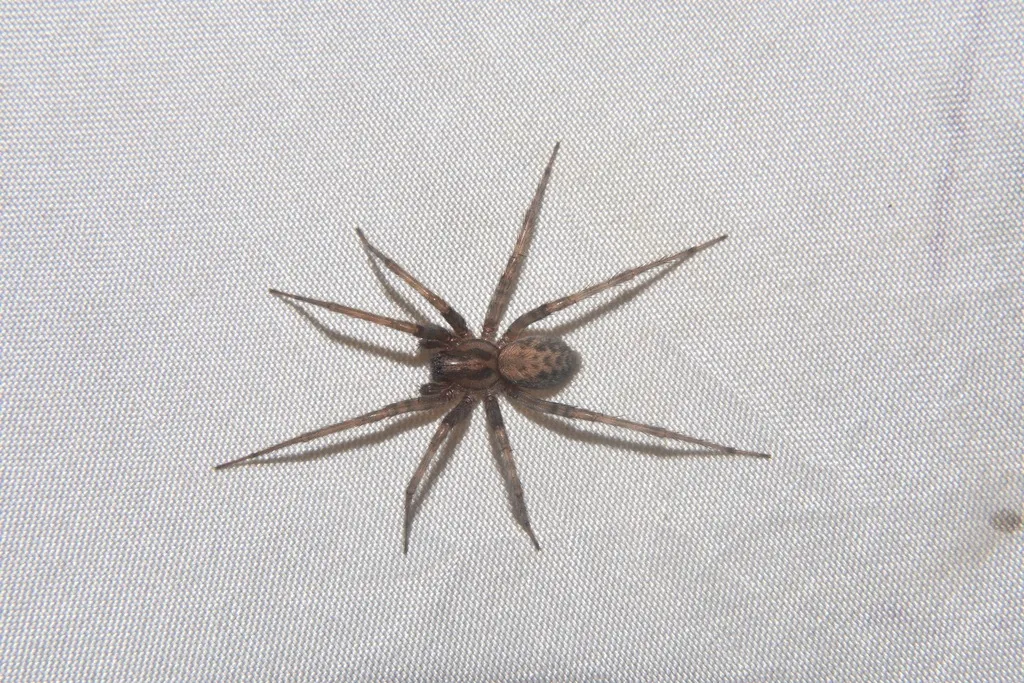
- The front body section is red-brown with pale yellow hairs and two pale gray stripes; the abdomen is pinkish to pale with gray to black patches.[1]
- The legs are spiny, with very pale gray rings at the ends of the femurs.[1]
- Look for two dark lines down the back beginning at the eyes, often with a thin dark line between them on the head, and a light chevron pattern down the abdomen.[4]
Look-alikes
| Look-alike | How to tell them apart |
|---|---|
| Grass spiders | Their sheet webs are larger, with the retreat off to one side; the barn funnel weaver's retreat sits within the web sheet.[1] |
Where it lives
It's found throughout most of the United States, though it isn't commonly seen in some areas.[1]
Biology and life cycle
It lives in sheds and barns, in and around door crevices, in cracks of rock faces and under rocks and boards.[1]
Barn funnel weavers have been reported to live as long as seven years and to make upward of nine egg sacs, often hung on silk above the web.[1]
Males share webs with females during the May to July mating season.[1]
It is native to Europe but now widespread; in a Colorado survey of spiders caught indoors on sticky panels, over 37% were funnel weavers and the barn funnel weaver was the single most common species.[5]
Its webs are usually not sticky. The spider sits in its funnel, darts out to grab insects that hit the sheet, and often has a rear exit for escape.[4]
Fun fact: in a lab study, native web silk of this spider slowed the growth of the bacterium Bacillus subtilis, though not of E. coli.[9]
Damage and signs
- Penn State Extension mentions no damage; it's most often seen in sheds and barns and around doors.[1]
Health risk
No bites from barn funnel weavers are documented; Penn State expects any bite would be no worse than a grass spider's. Its close relative the hobo spider was once blamed for skin wounds, but medical reviews found such lesions are often wrongly blamed on spiders, and a diagnosis of spider bite should be made only when the spider is caught biting. MedlinePlus notes most spider bites are harmless. One 2005 report described an occupational allergy (IgE-mediated) to this spider.[1][7][6][10][8]
Control
Keep them out
Seal cracks and gaps around doors and windows, and keep screens tight.[2]
Sanitation
Clean up clutter in garages, sheds, basements and storage areas, wearing gloves to avoid accidental bites.[2]
Traps and physical control
Vacuum spiders and webs from corners and seldom-used areas, and sweep or hose webs off buildings.[2]
Remove webs from the outside of the house with a broom or high-pressure hose.[2]
Pesticides
UC IPM says insecticide sprays give only temporary control unless paired with housekeeping, and crushing or vacuuming a spider is just as easy.[2]
If you do spray, retail spider products contain pyrethrins or pyrethroids such as resmethrin or allethrin, and they work mainly when sprayed directly on a spider you can see.[2]
Common questions
- What spider builds a small sheet web with a funnel in my shed?
- It may be a barn funnel weaver; its retreat sits within the web sheet.[1]
- How long do barn funnel weavers live?
- They have been reported to live as long as seven years.[1]
- Is the barn funnel weaver a hobo spider?
- No, though they are relatives and look alike. Colorado State notes the hobo spider, once linked to skin wounds, is now considered harmless to humans, and medical researchers have questioned that it causes skin wounds.[5][6]
- Is a barn funnel weaver dangerous?
- No bites have been documented, and MedlinePlus notes most spider bites are harmless. Call 911 or the local emergency number for trouble breathing, swelling of the face or mouth, or throat tightness after any bite or sting.[1][10]
Sources
- Penn State Extension, “Barn Funnel Weaver Spider.” extension.psu.edu/barn-funnel-weaver-spider (accessed 2026-11-12)
- University of California Statewide IPM Program, “Spiders (Pest Notes, Home and Landscape).” ipm.ucanr.edu/home-and-landscape/spiders/ (accessed 2026-11-12)
- iNaturalist, “Tegenaria domestica taxon page (order and family).” www.inaturalist.org/taxa/153507 (accessed 2026-11-12)
- Ohio State University Extension, “ENT-76: Ohio's Natural Enemies: Funnel Weaver Spiders.” ohioline.osu.edu/factsheet/ent-76 (accessed 2026-11-12)
- Colorado State University Extension, “Funnel Weaver Spiders (W. Cranshaw).” cmg.extension.colostate.edu/wp-content/uploads/sites/14/2017/03/FunnelWeaverSpiders.pdf (accessed 2026-11-12)
- Annals of Emergency Medicine, via PubMed, “Do hobo spider bites cause dermonecrotic injuries? (Vetter and Isbister 2004).” pubmed.ncbi.nlm.nih.gov/15573036/ (accessed 2026-11-12). Cited from the PubMed record (title only).
- Canadian Family Physician, via PubMed, “An approach to spider bites: erroneous attribution of dermonecrotic lesions to brown recluse or hobo spider bites in Canada (Bennett and Vetter 2004).” pubmed.ncbi.nlm.nih.gov/15455808/ (accessed 2026-11-12). Cited from the PubMed abstract.
- Allergy, via PubMed, “Occupational IgE-mediated allergy to a common house spider (Tegenaria domestica) (Hasan et al. 2005).” pubmed.ncbi.nlm.nih.gov/16197485/ (accessed 2026-11-12). Cited from the PubMed record (title only).
- BMC Research Notes, via PubMed, “Evidence for antimicrobial activity associated with common house spider silk (Wright and Goodacre 2012).” pubmed.ncbi.nlm.nih.gov/22731829/ (accessed 2026-11-12). Cited from the PubMed abstract.
- MedlinePlus, U.S. National Library of Medicine, “Insect bites and stings (Medical Encyclopedia).” medlineplus.gov/ency/article/000033.htm (accessed 2026-11-12)