On this page
How to identify it
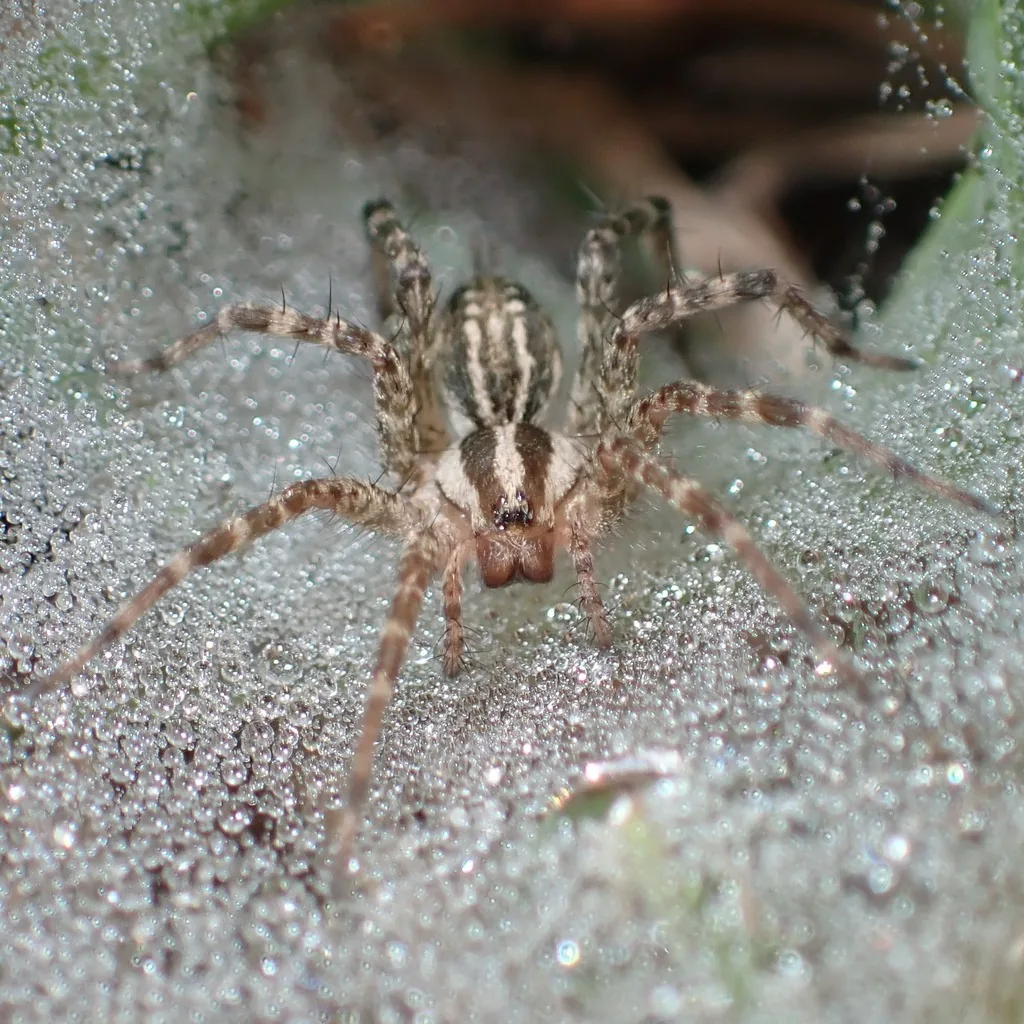
- The web is the best clue: a large, mostly flat, non-sticky sheet with a funnel retreat to one side, easiest to see when covered with morning dew. Missouri Department of Conservation says the sheet is usually smaller but can reach 3 feet wide, with a funnel over a foot long.[1][2][4][6]
- Look for two long spinnerets, finger-like silk tubes sticking out from the tip of the abdomen.[1][2][6]
- Size figures vary: Penn State gives 10 to 20 millimeters for females and 9 to 18 millimeters for males, Missouri Department of Conservation about ½ to ¾ inch for females, and Utah State's hobo and grass spider page adult bodies up to 3/8 inch.[1][6][3]
- The front body section is yellow-brown to brown with two darker lengthwise bands.[1][6]
- The abdomen is usually darker, with a lighter center stripe that can have scalloped edges, and the legs are often faintly banded.[1]
- The species look alike: Missouri Department of Conservation counts 14 Agelenopsis species in North America north of Mexico and says experts need a microscope to tell them apart.[6]
Look-alikes
| Look-alike | How to tell them apart |
|---|---|
| Hobo spider | Another funnel weaver, found in the Pacific Northwest and Intermountain West, with a herringbone or chevron pattern on the abdomen. Many funnel weavers look alike, so have Extension confirm the identification.[4][3] |
| Wolf spider | Wolf spiders look similar but hunt without webs; grass spiders sit in sheet webs and have long spinnerets at the rear.[2] |
Where it lives
North America has about 300 species of funnel weavers, and 14 of them north of Mexico are grass spiders (genus Agelenopsis). Grass spiders are common in lawns; Penn State calls them very common in Pennsylvania, Missouri lists three common species, and the University of Kentucky includes funnel web (grass) spiders among common Kentucky spiders.[4][6][1][2]
Biology and life cycle
Webs are built on grass, weeds and ground covers such as ivy and pachysandra, in fencerows, bushes and brush piles, and in the window wells of outbuildings, often several inches above the ground.[1][6]
Insects that hit the threads above the sheet fall onto it, and the spider rushes out from its funnel to grab them. Missouri Department of Conservation lists beetles, harvestmen, moths and small butterflies as frequent prey.[1][4][6]
Females lay a lens-shaped white egg sac in late summer or fall; eggs hatch in spring and spiders mature by late summer.[1]
Adults don't survive the winter, even though many wander into buildings in fall; outdoors they generally die when it freezes, and the egg sacs carry the species through winter.[1][6]
Damage and signs
Health risk
Bites are rare because grass spiders are fast and shy. In an Oregon study of 33 verified spider bites, 10 came from three genera of funnel weavers (family Agelenidae, the grass spider's family), and none of the 33 bites caused significant medical symptoms or skin necrosis.[1][7]
Control
Prevention
Spiders should be considered beneficial; outdoors, grass spider webs can simply be left alone.[3][6]
Keep them out
Seal exterior cracks and crevices, and install tight-fitting door sweeps on all exterior doors.[3]
Outdoor lights draw the insects spiders feed on: Utah State suggests sodium vapor bulbs, and UC IPM suggests keeping fixtures off the house and away from doors and windows.[3][4]
Sanitation
Reduce hiding spots near the house, such as rocks, logs and other debris around the foundation.[3]
Traps and physical control
Vacuum spiders that come indoors, or catch them in a jar and release them outside.[3][4]
Sticky monitoring traps along walls can catch wandering spiders, especially from August to October.[3]
Common questions
- What are the funnel-shaped webs in my lawn?
- Most likely grass spider webs: flat sheets with a funnel at one side, most visible on dewy mornings.[1][2][6]
- Is a grass spider a hobo spider?
- Many funnel weavers look alike. UC IPM says the hobo spider is common in the northwestern United States and has spread to northern Utah, Wyoming and Colorado. Utah State suggests having Extension confirm any funnel weaver identification.[4][3]
- Do grass spiders bite?
- Rarely. They are shy and dash back into the funnel when disturbed, and verified funnel weaver bites in an Oregon study caused no significant symptoms.[1][6][7]
Sources
- Penn State Extension, “Grass Spiders (updated September 8, 2025).” extension.psu.edu/grass-spiders (accessed 2026-11-11)
- University of Kentucky Entomology, “ENTFACT-622: Common Spiders Found Around Homes and Buildings.” entomology.mgcafe.uky.edu/ef622 (accessed 2026-11-11)
- Utah State University Extension, “Hobo and Grass Spiders (IPM for nuisance pests).” extension.usu.edu/planthealth/ipm/notes_nuisance/hobo-grass-spiders (accessed 2026-11-11)
- University of California Statewide IPM Program, “Spiders (Pest Notes, Home and Landscape).” ipm.ucanr.edu/home-and-landscape/spiders/ (accessed 2026-11-11)
- iNaturalist, “Agelenopsis taxon page (order and family).” www.inaturalist.org/taxa/82116 (accessed 2026-11-11)
- Missouri Department of Conservation, “Grass Spiders (Field Guide).” mdc.mo.gov/discover-nature/field-guide/grass-spiders (accessed 2026-11-11)
- Toxicon, via PubMed, “McKeown N, Vetter RS, Hendrickson RG (2014), Verified spider bites in Oregon (USA) with the intent to assess hobo spider venom toxicity, Toxicon 84:51-55.” pubmed.ncbi.nlm.nih.gov/24726469/ (accessed 2026-11-11). Cited from the PubMed abstract.