The short answer
- Size: the giant house spider is the big one, with a body of about 1/2 inch to 1 inch and a leg span that can reach 4 inches on large adults. A hobo's body is about 1/2 to 5/8 inch, or 1 to 1 3/4 inches with legs. The barn funnel weaver is smaller, about 1/4 to 1/2 inch.[3][1][2]
- Legs: Utah State says hobo spiders, unlike many look-alikes, have no dark bands on their legs. Penn State describes pale gray rings near the ends of the thigh segments (femurs) on barn funnel weavers.[5][8]
- Male palps: under magnification, the hobo's palp has a two-pronged structure (the conductor) and the giant house spider's and barn funnel weaver's have one prong.[5][7]
- Underside: on the giant house spider there are usually pairs of pale spots on the sternum (the plate between the legs) and dark spots on all the leg bases; the hobo has no pale sternum spots and dark spots usually only on the last pair of leg bases. This mark comes from one illustrated fact sheet.[7]
Spiders on this page
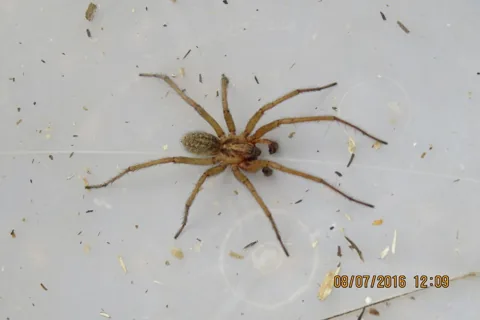 Hobo Spider
Eratigena agrestis
The hobo spider is a European funnel weaver that was labeled potentially toxic in the 1980s. Later research questioned that, and UC IPM says it is no longer considered of probable medical importance.
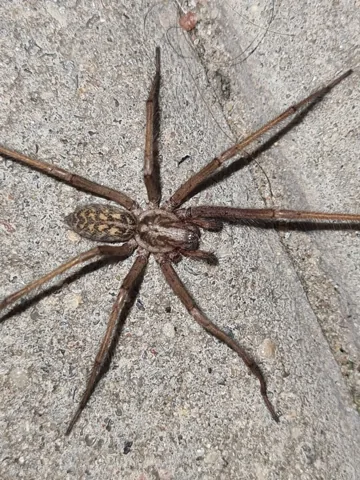 Giant House Spider
Eratigena atrica (formerly Tegenaria gigantea and T. duellica)
The giant house spider is one of the largest spiders in the Pacific Northwest, with a leg span that can reach 4 inches. It is common in and around homes west of the Cascades and is often mistaken for the hobo spider, but its bite is not known to threaten people.
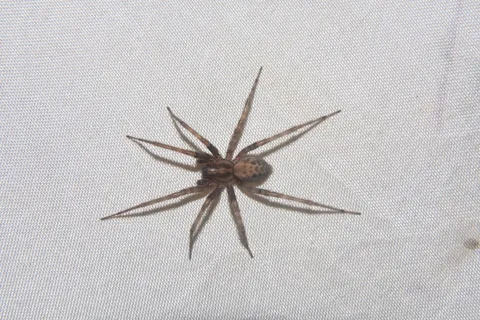 Barn Funnel Weaver
Tegenaria domestica
The barn funnel weaver, also called the house funnel weaver, is a fast, shy, light brown spider that builds a flat sheet web with a funnel retreat in basements, barns, sheds and door crevices, where it can survive indoors for years. No bites have been documented, and Penn State expects any bite would be mild. To get rid of it, vacuum spiders and webs, clear clutter, and seal cracks and gaps; sprays alone give only temporary control.
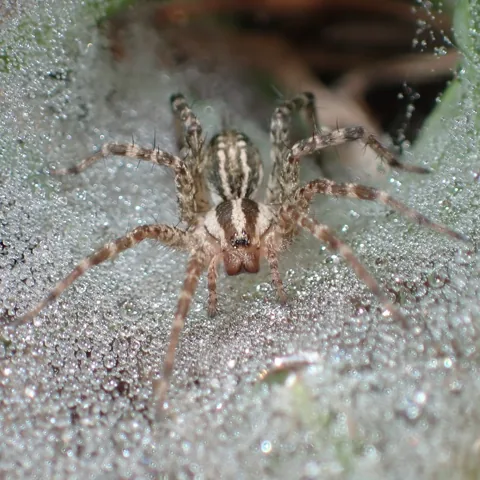 Grass Spiders (Funnel Weavers)
Agelenopsis species
Grass spiders are common funnel weavers whose flat, sheet-like webs with a funnel off to one side show up in lawns, ground covers and shrubs. They are fast and shy, often wander indoors in fall, and are considered beneficial.
Side by side
All three are long-legged, fast brown spiders in the funnel weaver family (Agelenidae) that build a flat sheet web leading back to a retreat. Utah State and Washington State both warn that color, markings and size vary too much to identify them by eye.[5][3][4]
- Names: hobo spider is Eratigena agrestis, formerly Tegenaria agrestis. Washington State University calls the giant house spider Eratigena atrica, formerly Tegenaria gigantea and T. duellica; older research papers use Tegenaria duellica. The barn funnel weaver, or house funnel weaver, is Tegenaria domestica.[2][3][12][8]
- Hobo size: Utah State gives 9.5–16.5 mm (3/8–5/8 in.) for mature females and 7–13.5 mm (9/32–9/16 in.) for males, not counting legs. UC IPM gives about 1/2 to 5/8 inch.[5][1]
- Giant house spider size: about 1/2 inch to 1 inch of body, with a leg span up to 4 inches on large adults. A British Columbia recovery team fact sheet gives leg spans of 35-95 mm for giant house spiders and 27-45 mm for hobos.[3][7]
- Barn funnel weaver size: Penn State gives 7.5 to 11.5 millimeters for females and 6 to 9 millimeters for males; UC IPM gives about 1/4 to 1/2 inch.[8][1]
- Hobo color: a brown front body with darker brown markings, brown legs, and a pattern of yellowish chevrons on a grey abdomen that is often hard to see without a hand lens and clearer on young spiders. No dark leg bands.[5]
- Giant house spider color: brown to grayish brown, somewhat hairy and not shiny, with markings that range from barely visible to very distinct. Washington State says none of these features is reliable for identifying it.[3]
- Barn funnel weaver color: a red-brown front body with pale yellow hairs and two pale gray lines, a pinkish to pale flesh-colored abdomen with gray to black patches, and spiny legs with pale gray rings near the ends of the femurs.[8]
- Pattern shared by the two big ones: the British Columbia fact sheet describes both the hobo and the giant house spider as greyish brown with a more or less conspicuous herringbone pattern on the abdomen.[7]
- Eyes: all three have eight eyes in two rows of four. Many other funnel weavers, including grass spiders, have rows curved so strongly they look like three rows (a 2-4-2 pattern).[1][5][7]
- Male palps: adult males have enlarged palps near the mouth that look like boxing gloves or short legs. The hobo's has two prongs; the giant house spider's and the domestic house spider's have one.[5][7][4]
- Female genital opening (underside of the abdomen): longer than wide and bracketed by two large, stout spurs on the giant house spider; wider than long with pale margins and tiny spurs on the hobo.[7]
- Habits indoors: giant house spiders are poor climbers and usually turn up on the floor or trapped in sinks and bathtubs. Hobos also end up in tubs and basements because they can't climb slick surfaces, though they climb fabric and carpet.[3][5]
- Season: hobos are most common indoors from August through October, when males wander in search of mates. Giant house spiders show up mostly mid-summer to early fall. Barn funnel weavers can be found in buildings any time of year.[5][6][3][8]
- Life span: Penn State says barn funnel weavers have been reported to live as long as seven years. Utah State suspects hobos take about 2 years to become adults, and males die after mating.[8][5]
The field marks that need a hand lens or microscope
UC IPM says that until someone has examined the reproductive features of dozens of hobos and related species, a hobo is unlikely to be identified correctly with the naked eye, and that pest control operators misidentify them too. Utah State says the only sure way is to compare reproductive structures.[1][5]
A hand lens can still rule a spider out. If its eyes sit in the 2-4-2 pattern, it is not a hobo, giant house spider or barn funnel weaver. If it lacks plumose setae, the fine, nearly clear, feather-like hairs that lie flat on the legs of every funnel weaver, it is not a hobo. The British Columbia sheet says those hairs show at 40–50x.[1][5][7]
- Plumose setae: present on all funnel weavers, so they confirm the family, not the species.[5][7]
- Palp prongs on adult males: two on the hobo, one on the giant house spider and the domestic house spider.[5][7]
- Chelicerae: Utah State counts six to eight teeth on the back margin of the hobo's jaw, a mark that means removing the jaw under a microscope.[5]
- Sternum and leg bases: paired pale spots on the sternum and dark spots on all the leg bases point to the giant house spider; no pale sternum spots and dark spots mostly on the last pair point to the hobo.[7]
Where each one lives
Both big species came from Europe. Utah State says the hobo was detected in the Pacific Northwest in 1936, and Washington State's spider guide says it was established in Seattle in the 1930s.[5][4][12]
- Hobo spider: a 2003 study of 1,232 hobos and 395 giant house spiders mapped it in southern British Columbia, Washington, Oregon, Idaho, northern Utah, the western half of Montana, western Wyoming, and two small, isolated populations in Colorado. UC IPM gives a similar range; the British Columbia sheet extends it east to central Montana.[12][1][7]
- Giant house spider: mostly west of the Cascade and Coastal ranges, from southern British Columbia to central Oregon in the 2003 study (southern Oregon in the British Columbia sheet). Washington State says it is not found east of the Cascades in Washington.[12][7][3]
- Where both live: in large cities the giant house spider is usually more common. Washington State says it outnumbers the hobo in the Puget Sound region, and UC IPM says it has displaced the once-common hobo in Seattle. The hobo is generally rare west of the coastal ranges and common inland.[12][3][1][7]
- Washington: the state Department of Health says hobo spiders can be found throughout Washington, while WSU Extension describes them as among the most common funnel weavers in some parts of the state.[9][2]
- Barn funnel weaver: found through most of the United States and around the world, carried by commerce, so it is the one of the three you may find outside the Northwest.[8][1]
- California: UC IPM says the hobo is not known to live there and that there have been no verified records, even in the far north, so a California "hobo" is almost certainly something else.[1]
Funnel webs and hiding places
The typical funnel weaver web is a flat, non-sticky sheet that narrows into a funnel or hole where the spider waits for prey to land on the sheet.[4][1]
- Hobo: Washington State says it builds its funnel web in dark, moist places, often basements. UC IPM says its webs are almost always hidden under objects and not noticeably funnel-like; Utah State lists wood and rock piles, retaining walls, tall grass and foundation cracks.[2][1][5]
- Giant house spider: sheets of webbing with a funnel-like hole in the center, in dark spots such as garages and basements, outdoors in firewood or in gaps between bricks or stones.[3]
- Both big species: the British Columbia sheet says they build messy funnel webs on the underside of objects on the ground, with oval entrances wider than high, while grass spiders put round entrances in grass and shrubs in the open.[7]
- Barn funnel weaver: webs like a grass spider's but smaller, with the retreat inside the sheet rather than off to one side, in sheds, barns, door crevices, rock cracks and under boards. Egg sacs often hang above the web on silk lines.[8]
What the research says about hobo spider bites
In 1996 the CDC's MMWR summarized three cases of bites attributed to the hobo spider in Idaho, Oregon and Washington and urged physicians in the Northwest to consider it as a cause of toxic spider bites.[11]
Later work did not hold that up. A 2001 venom study found no venom components unique to U.S. hobos compared with European ones, where the spider is considered harmless. A 2004 review in Canadian Family Physician concluded that hobo spiders have not been reliably implicated in skin necrosis. A 2014 Oregon study of 33 verified spider bites found no dermonecrosis; its one hobo bite caused pain, redness and calf twitching that resolved in 12 h.[13][14][15]
The Washington State Department of Health says hobo spiders are not considered dangerous as previously thought, are shy and reluctant biters, and that there is no evidence their venom has caused necrotic wounds in people. WSU Extension says recent research has not shown the hobo to be harmful to humans.[9][2]
The CDC NIOSH Venomous Spiders page names the black widow and the brown recluse as the venomous spiders found in the United States, and Utah State notes that the CDC does not list hobo spiders among them.[10][5]
The giant house spider's bite is not known to pose any threat to people, and Penn State knows of no documented barn funnel weaver bites. Utah State says hobos bite only in defense, causing mild pain and redness.[3][8][5]
A wound labeled a spider bite should be treated as one only when the spider was caught in the act or otherwise reliably tied to it; other, more likely causes of a necrotic sore should come first. If you are bitten, keep the spider for an expert to identify and see a doctor if you are concerned.[14][3][2]
How to confirm which one you have
Most homeowners can get as far as funnel weaver, and a hand lens on the eyes and leg hairs helps rule spiders out. Naming the species takes the spider itself in the hands of someone trained to read the palps and genital structures.[1][5]
- Catch it whole: trap the spider in a jar or on a sticky trap. The British Columbia sheet suggests 75% ethyl or isopropyl alcohol to preserve spiders for later identification by an expert.[5][7]
- Photos: a picture shows color and pattern, which vary too much to confirm a hobo or a giant house spider, so treat any ID from a photo as a guess and keep the spider itself.[5][3][1]
- Ask an expert: Utah State's lab asks people to verify funnel weaver IDs with USU Extension, and WSU suggests taking the spider to an expert. Your local extension office can tell you where to send one.[6][3][2]
- Sticky traps along baseboards show where spiders are coming in and how many; fold them and keep them away from children and pets.[5][1]
What to do about each
Because none of the three is considered a medical threat, the advice is the same for all of them: keep them out and remove the ones that get in. Washington State calls the giant house spider beneficial and says outdoor control is neither recommended nor realistic.[3][2][5]
- Seal the way in: tight door sweeps, weather stripping, caulked foundation cracks and window screens in good repair.[5][2]
- Remove them by hand: vacuum, use a jar to catch and release, or use sticky traps, especially from August to October.[5][6][3][1]
- Cut hiding places: clear rocks, logs, rubble and clutter near the house, and handle firewood with gloves since spiders ride in on it.[6][1][2]
- Sprays: WSU says pesticides are a temporary fix unless spiders are kept from getting in and that spraying outdoors for these spiders is not usually advised. See our house spider guide before using any product.[2]
Common questions
- Is every big brown spider in a Seattle basement a hobo?
- No. In the Puget Sound region giant house spiders outnumber hobos, and the smaller males are often mistaken for them.[3][1]
- Can I tell a hobo spider by the chevrons on its back?
- Not reliably. The chevron or herringbone pattern shows on both the hobo and the giant house spider, and Utah State says color can't identify a hobo.[5][7]
- Are hobo spider bites dangerous?
- Current evidence says no. Verified hobo bites have caused only mild pain and redness, and the Washington State Department of Health says there is no evidence hobo venom has caused necrotic wounds in people.[15][9][5]
- Why is it called the aggressive house spider?
- Utah State says the old name came from misreading the species name agrestis, which means of the field. The spider is shy and tries to escape when disturbed.[5][9]
- Do giant house spiders eat hobo spiders?
- Washington State's spider guide says the giant house spider is reported to prey on hobos, and UC IPM says it has competitively displaced the hobo in Seattle.[4][1]
Photo credits
- Hobo Spider: Steve Wells, public domain (CC0), via iNaturalist
- Giant House Spider: (c) Marcin Jasiński, some rights reserved (CC BY) — via iNaturalist, CC BY 4.0
- Barn Funnel Weaver: (c) Sebastian Serna Muñoz, some rights reserved (CC BY) — via iNaturalist, CC BY 4.0
- Grass Spiders (Funnel Weavers): (c) dhasdf, some rights reserved (CC BY) — via iNaturalist, CC BY 4.0
Sources
- University of California Statewide IPM Program, “Pest Notes: Hobo Spider.” ipm.ucanr.edu/home-and-landscape/hobo-spider/ (accessed 2026-11-14)
- Washington State University Extension, “Hobo spider (Pestsense fact sheet).” pestsense.cahnrs.wsu.edu/fact-sheet/hobo-spider/ (accessed 2026-11-14)
- Washington State University Extension, “Giant house spider (Pestsense fact sheet).” pestsense.cahnrs.wsu.edu/fact-sheet/giant-house-spider/ (accessed 2026-11-14)
- Washington State University Extension, “EM113E: Common Spiders of Washington.” wpcdn.web.wsu.edu/wp-ecommerce/uploads/sites/2/product-3454-sku-EM113E.pdf (accessed 2026-11-14)
- Utah State University Extension, “Hobo Spider (fact sheet, April 2023).” extension.usu.edu/planthealth/research/hobo-spiders (accessed 2026-11-14)
- Utah State University Extension, “Hobo and Grass Spiders.” extension.usu.edu/planthealth/ipm/notes_nuisance/hobo-grass-spiders (accessed 2026-11-14)
- Garry Oak Ecosystems Recovery Team, hosted by Utah State University Extension, “Invasive Species in Garry Oak and Associated Ecosystems in British Columbia: Tegenaria duellica and Tegenaria agrestis (2003; illustrations by Robb Bennett).” extension.usu.edu/planthealth/uppdl/files/factsheet/InvFS_tegenaria.pdf (accessed 2026-11-14)
- Penn State Extension, “Barn Funnel Weaver Spider.” extension.psu.edu/barn-funnel-weaver-spider (accessed 2026-11-14)
- Washington State Department of Health, “Spiders.” doh.wa.gov/community-and-environment/pests/spiders (accessed 2026-11-14)
- CDC National Institute for Occupational Safety and Health (NIOSH), “Venomous Spiders at Work.” www.cdc.gov/niosh/outdoor-workers/about/venomous-spiders.html (accessed 2026-11-14)
- Centers for Disease Control and Prevention, via PubMed, “CDC. 1996. Necrotic arachnidism--Pacific Northwest, 1988-1996. MMWR 45(21):433-6.” pubmed.ncbi.nlm.nih.gov/8618542/ (accessed 2026-11-14). Cited from the PubMed abstract.
- Journal of Medical Entomology, via PubMed, “Vetter RS et al. 2003. Distribution of the medically-implicated hobo spider (Araneae: Agelenidae) and a benign congener, Tegenaria duellica, in the United States and Canada. J Med Entomol 40(2):159-64.” pubmed.ncbi.nlm.nih.gov/12693843/ (accessed 2026-11-14). Cited from the PubMed abstract.
- Toxicon, via PubMed, “Binford GJ. 2001. An analysis of geographic and intersexual chemical variation in venoms of the spider Tegenaria agrestis (Agelenidae). Toxicon 39(7):955-68.” pubmed.ncbi.nlm.nih.gov/11223084/ (accessed 2026-11-14). Cited from the PubMed abstract.
- Canadian Family Physician, via PubMed, “Bennett RG, Vetter RS. 2004. An approach to spider bites. Erroneous attribution of dermonecrotic lesions to brown recluse or hobo spider bites in Canada. Can Fam Physician 50:1098-101.” pubmed.ncbi.nlm.nih.gov/15455808/ (accessed 2026-11-14). Cited from the PubMed abstract.
- Toxicon, via PubMed, “McKeown N, Vetter RS, Hendrickson RG. 2014. Verified spider bites in Oregon (USA) with the intent to assess hobo spider venom toxicity. Toxicon 84:51-5.” pubmed.ncbi.nlm.nih.gov/24726469/ (accessed 2026-11-14). Cited from the PubMed abstract.