The short answer
- Color: an adult female black widow is shiny jet black all over her body and legs. A brown widow is usually a mottled mix of tan, brown and gray with brown, white and black patterns on top of the abdomen.[1][4][3]
- Hourglass: on a black widow it is red (orange to red in the southern black widow); on a brown widow it is usually orange, and its bottom half is the larger half, with a rough, fuzzy outline.[4][3][2][1]
- Egg sac: the surest sign. Brown widow sacs are covered in little silk spikes, like a big pollen grain; black widow sacs are smooth, round or pointed at the top.[2][1][3]
- Legs: a black widow's legs are black like the body. Clemson Extension describes dark brown banding on the brown widow's legs.[1][3]
Spiders on this page
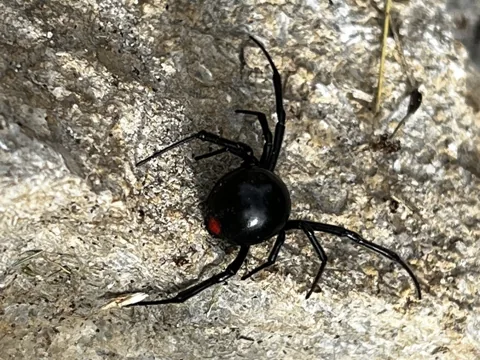 Southern Black Widow
Latrodectus mactans
Black widows are shy, web-building spiders with a neurotoxic venom; they live throughout North America and are most common in the southern and western United States. The southern black widow is found throughout states such as South Carolina.
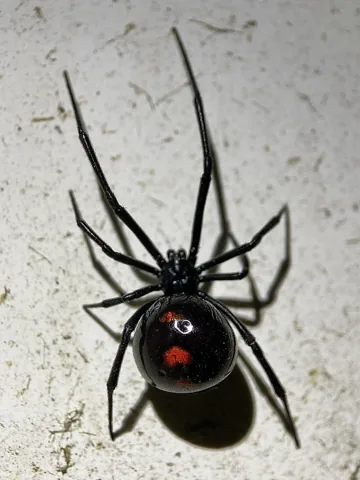 Northern Black Widow
Latrodectus variolus
The northern black widow is the most medically significant spider in the Northeast. It is timid and rarely bites, usually only when pressed against bare skin, but its venom is a neurotoxin and a bite calls for medical help right away.
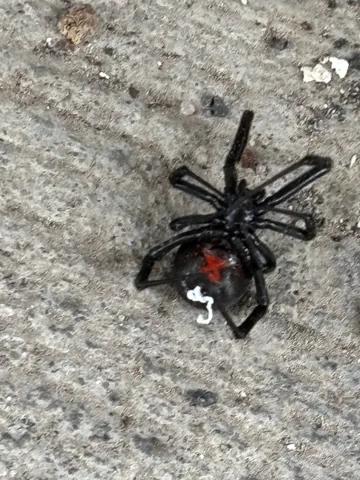 Western Black Widow
Latrodectus hesperus
The western black widow is the only black widow species in the western United States, ranging from British Columbia and Alberta to Mexico, and it is often very common around homes, barns, outbuildings and rock walls. Its bite is venomous, though NIOSH notes that spiders are usually not aggressive and most bites happen when one is trapped or touched.
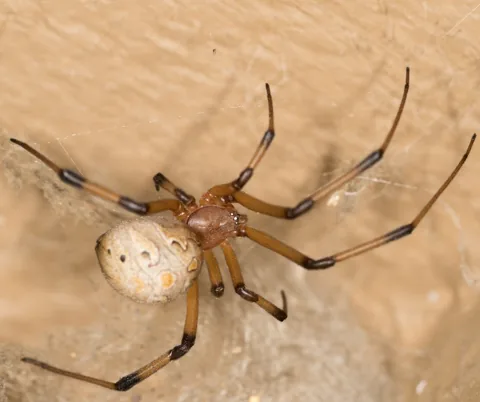 Brown Widow
Latrodectus geometricus
The brown widow is a non-native widow spider. It was found only in Florida for decades, then in the 2000s turned up from Texas along the Gulf Coast and up the Atlantic coast and became common around homes and parks in Southern California.
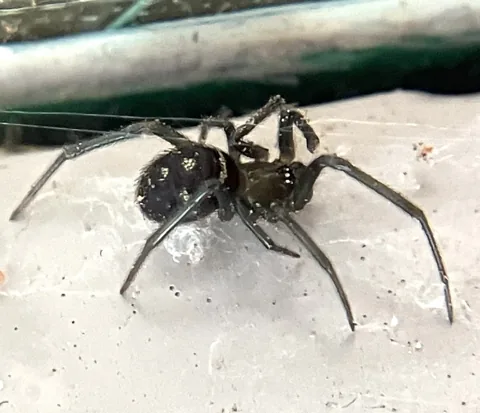 False Widow Spiders
Steatoda species (mainly S. grossa; also S. triangulosa)
False widows are Steatoda cobweb spiders, close relatives of black widows with the same round-bellied shape. The false black widow, Steatoda grossa, is common in homes and often mistaken for a black widow; its bite can hurt but is usually much milder.
Side by side
These comparisons are for adult females, the ones people usually find. Males of both species are much smaller and keep much of the color of the young spiders.[1][2]
- Size: a mature female western black widow is about 1/2 inch (13 mm) in body length, and Penn State gives 8 to 13 millimeters for the southern black widow. A mature female brown widow is smaller, about 3/8 inch (10 mm).[1][4]
- Color: black widow, shiny jet black, sometimes with a brownish or plum tinge in very well-fed females. Brown widow, a mottled collection of tan, brown and gray, though some are almost white and a few are almost black.[1][2]
- Top of the abdomen: the southern black widow is unmarked or has up to four red dots, and the northern black widow may have red or orange spots and white markings. The brown widow has a lengthwise stripe halfway up the back of the abdomen and diagonal stripes on the sides, with large, squarish black spots on those side stripes.[4][3][1][2]
- Hourglass: black widow, red, on the underside of the abdomen; complete in the southern black widow and broken or reduced to red dots in the northern black widow. Brown widow, usually orange, with the bottom half larger than the top and rough margins.[4][7][3][1][2]
- Legs: black widow, shiny black like the body. Brown widow, banded with dark brown, per Clemson. Neither widow has spines on its legs, which separates both from orb weavers people often mistake for them.[1][3][2]
- Egg sac: black widow, smooth, round or pointed at the top; the western black widow's is yellowish and teardrop-shaped, and the southern black widow's is beige and rounded with a single small point. Brown widow, tan to yellow and round, covered all over in small silk spikes.[2][1][3][6]
- Eggs per sac: Penn State gives 200 to 800 eggs for the southern black widow. UC IPM gives about 130 eggs per brown widow sac, with 20 or more sacs in a lifetime.[4][1]
- Behavior when disturbed: black widows are timid and usually flee but will bite if provoked. Brown widows typically pull their legs close to the body, drop from the web and play dead.[7][1]
The real trap: young black widows
A brown widow is easy to tell from an adult black widow. The confusion comes with half-grown black widows, which are tan with white stripes and look nothing like their mother. UC Riverside's Center for Invasive Species Research says these are frequently mistaken for brown widows.[2][1]
Look at the black spots on the diagonal side stripes. On a brown widow the light stripe looks like a finger holding a large black rectangular blotch; on a young black widow the spot at the top of the stripe is small and blobby.[2][1]
Look at the stripe down the middle of the back. On a brown widow it runs only about halfway up the abdomen from the rear, and the front spot is isolated and about twice as wide as long. On a young black widow it runs almost all the way up, and the front spot is longer than wide, like an arrowhead.[2]
Look at the front of the abdomen and the hourglass. The white lines on the front face don't meet in the middle on a brown widow but are continuous on a young black widow. A young black widow's hourglass has the larger half on top and crisp, straight margins.[2][1]
A young black widow's middle stripe can carry vivid orange or red. A brown widow can have some orange there, but never bright red.[2]
When a brown widow looks black
Some brown widows are very dark, with a red-orange hourglass, and get taken for black widows. UC Riverside notes the dark ones are flat rather than shiny and show traces of brown, and that a spiky egg sac settles it. UC IPM likewise says very dark brown widows are closer to a flat black than to a black widow's glossy black.[2][1]
Where each one lives
Black widows occur throughout North America but are most common in the southern and western United States. In the East the southern and northern black widows overlap (in Missouri both occur statewide, and in South Carolina the northern is mainly in the Piedmont and Upstate), while in the western United States the western black widow is the only species.[8][3][1][7]
The brown widow is not native. It probably came from Africa, or possibly South America, and for decades lived only in Florida. In the first decade of this century it spread from Texas along the Gulf Coast and up the Atlantic coast into South Carolina and became established in the urban areas of Los Angeles, San Diego and their suburbs.[1][2][6]
In South Carolina, Clemson says brown widows are now found throughout the state, with higher densities on the coast. Where the two overlap, researchers think the brown widow may be crowding out black widows.[3][6][1]
Where they build webs
Both make irregular, tangled cobwebs of strong silk, usually low to the ground and tied to a retreat. Black widows favor dark, sheltered spots: woodpiles, rodent burrows, holes between bricks, under rocks and logs, along foundations, and in garages, sheds and crawl spaces.[1][7][3][4]
Brown widows also use clutter and woodpiles but turn up in more exposed spots where black widows normally wouldn't, such as chain-link fences, and they are extremely common in the nooks under cheap plastic patio furniture. In garages, black widows are common but brown widows are not.[1]
In a survey of urban Los Angeles, brown widows were very common outside homes, in parks, under playground equipment and in nurseries, greatly outnumbering western black widows, which were more common in dry habitats. Neither species was found in the living space of homes.[10]
False widows: the third look-alike
False widows (Steatoda) are relatives in the same cobweb spider family with the same rounded abdomen and web habits, which is why they are mistaken for both widows. The false black widow, Steatoda grossa, is chocolate brown to purplish and never has red on its belly.[1][5]
Penn State gives 6 to 10.5 millimeters for false black widow females, and says the species is common in homes and other structures in the southern and western states. Unlike true widows, which are almost never found in living spaces, false widows thrive indoors.[5][1]
If the spider is brown, round-bellied and has no hourglass at all, a false widow is the likelier answer. Our false widow profile covers it in detail.[5][1]
How the bites compare
Widow bites usually happen when the spider is trapped or touched, for example when a hand goes into a web. CDC NIOSH says black widow venom is a neurotoxin that causes pain at the bite and then spreads to the chest, abdomen or whole body.[8]
MedlinePlus says a black widow bite often feels like a pinprick; within 15 minutes to 1 hour a dull muscle pain spreads from the bite, and severe abdominal or chest pain and cramping can follow.[9]
Brown widow venom carries the same main toxin, alpha-latrotoxin, and bites have caused symptoms like other widow bites, though documented cases are rare. Brown widow bites are generally thought of as mild, but published case reports describe moderate reactions and a previously healthy patient hospitalized with severe pain, cramps and vomiting.[13][12][11]
Treat any widow bite as a black widow bite: wash it with soap and water, put a cold cloth or wrapped ice on it, and call Poison Help at 1-800-222-1222 or get medical care. Bring the spider in a sealed container if it is safe to do; it helps with treatment.[9][8]
How to confirm what you have
- Look for egg sacs in and next to the web. A spiky sac confirms brown widows even if no spider is seen.[1][2]
- Check the underside for the hourglass shape and color, then compare the side-stripe spots and the center stripe on top. Widows often hang upside down in their webs, which shows the hourglass.[2][3]
- Search after dark with a flashlight. Widow spiders are nocturnal and sit out in their webs at night.[1]
- If you're still unsure, keep the spider whole in a sealed container and have it checked by an entomologist. UC Riverside says telling the two apart, especially half-grown spiders, takes lots of practice and many specimens.[2]
What to do for each
- Both: wear gloves when moving woodpiles, pots and stored items, and remove spiders, webs and egg sacs with a vacuum, then seal the bag and throw it away outdoors.[3][8]
- Black widows: clear clutter, woodpiles and debris near the house, and check garages, sheds and crawl spaces. Our black widow control guide has the full steps.[3][1][4]
- Brown widows: check the undersides of patio furniture, play equipment, pot rims and fence lines, and destroy the spiky sacs. Sprays often fail on egg sacs, so removing them matters.[1][10]
- False widows indoors: vacuum webs and spiders and seal gaps, as for other house spiders.[1]
Common questions
- Is a brown widow just a young black widow?
- No. They are different species. Half-grown black widows are tan with stripes and are often mistaken for brown widows, but a brown widow keeps its mottled look as an adult and lays spiky egg sacs.[2][1]
- Do brown widows have an hourglass?
- Yes. Adults have an hourglass on the underside of the abdomen, usually orange, with the bottom half larger than the top.[3][2][1]
- Is a brown widow less dangerous than a black widow?
- Its bite is generally thought of as milder, and it tends to play dead rather than bite, but its venom contains the same main toxin and case reports describe serious reactions. Get the same care you would for a black widow bite.[1][12][11][13]
- What do brown widow egg sacs look like?
- Round, tan to yellow balls covered in little silk spikes, like a large pollen grain. Black widow sacs are smooth.[2][1][3]
- Are brown widows taking over from black widows?
- In some places they seem to be. In urban Southern California brown widows greatly outnumber western black widows around homes, and researchers in Florida and South Carolina think the brown widow may be outcompeting black widows.[10][6][3]
- Is a shiny brown round spider in my house a widow?
- More often it's a false widow (Steatoda). False widows are brown to purplish with no red hourglass and are common indoors, while true widows are almost never found in living spaces.[1][5]
Photo credits
- Southern Black Widow: Carol Spence, public domain (CC0), via iNaturalist
- Northern Black Widow: Samuel Paul Galick, public domain (CC0), via iNaturalist
- Western Black Widow: (c) Chris Stahl, some rights reserved (CC BY) — via iNaturalist, CC BY 4.0
- Brown Widow: Jesse Rorabaugh, public domain (CC0), via iNaturalist
- False Widow Spiders: Ken Kneidel, public domain (CC0), via iNaturalist
Sources
- University of California Statewide IPM Program, “Pest Notes: Widow Spiders and Their Relatives.” ipm.ucanr.edu/home-and-landscape/widow-spiders-and-their-relatives/ (accessed 2026-11-14)
- Center for Invasive Species Research, University of California, Riverside, “How to identify (and misidentify) Brown Widow Spiders.” cisr.ucr.edu/invasive-species/how-identify-brown-widow-spiders (accessed 2026-11-14)
- Clemson Cooperative Extension Home & Garden Information Center, “Widow Spiders in South Carolina.” hgic.clemson.edu/factsheet/widow-spiders/ (accessed 2026-11-14)
- Penn State Extension, “Southern Black Widow Spider.” extension.psu.edu/southern-black-widow-spider (accessed 2026-11-14)
- Penn State Extension, “False Black Widow Spider.” extension.psu.edu/false-black-widow-spider (accessed 2026-11-14)
- University of Florida IFAS Extension, “Featured Creatures EENY-560/IN1000: Southern Black Widow, Latrodectus mactans.” ask.ifas.ufl.edu/publication/IN1000 (accessed 2026-11-14)
- Missouri Department of Conservation, “Black Widow Spiders (Field Guide).” mdc.mo.gov/discover-nature/field-guide/black-widow-spiders (accessed 2026-11-14)
- CDC National Institute for Occupational Safety and Health (NIOSH), “Venomous Spiders at Work.” www.cdc.gov/niosh/outdoor-workers/about/venomous-spiders.html (accessed 2026-11-14)
- MedlinePlus, U.S. National Library of Medicine, “Black widow spider (Medical Encyclopedia).” medlineplus.gov/ency/article/002858.htm (accessed 2026-11-14)
- Journal of Medical Entomology, via PubMed, “Vetter RS et al. 2012. The prevalence of brown widow and black widow spiders (Araneae: Theridiidae) in urban southern California. J Med Entomol 49(4):947-51.” pubmed.ncbi.nlm.nih.gov/22897057/ (accessed 2026-11-14). Cited from the PubMed abstract.
- Southern Medical Journal, via PubMed, “Goddard J et al. 2008. Severe reaction from envenomation by the brown widow spider, Latrodectus geometricus. South Med J 101(12):1269-70.” pubmed.ncbi.nlm.nih.gov/19005454/ (accessed 2026-11-14). Cited from the PubMed abstract.
- Cureus, via PubMed, “Earwood RC et al. 2020. A Case of Brown Widow Envenomation in Central Florida. Cureus 12(7):e9165.” pubmed.ncbi.nlm.nih.gov/32802602/ (accessed 2026-11-14). Cited from the PubMed abstract.
- Toxicon, via PubMed, “Keyler DE et al. 2020. Latrodectus geometricus envenoming: rapid resolution of symptoms following F(ab')2 antivenom therapy. Toxicon 188:76-79.” pubmed.ncbi.nlm.nih.gov/33068558/ (accessed 2026-11-14). Cited from the PubMed abstract.