On this page
How to identify it
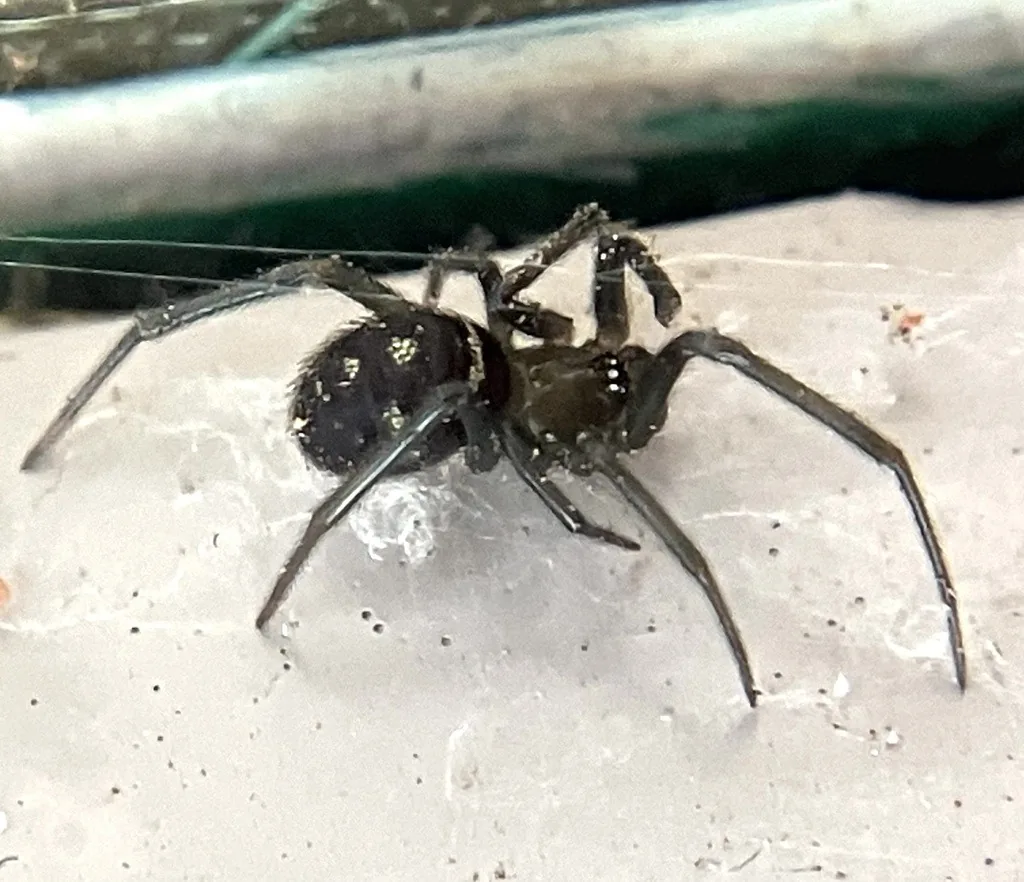
- Size figures differ: Penn State gives 6 to 10.5 millimeters for false black widow females, UC IPM a body length of 3/8 inch (10 mm), slightly smaller than a mature western black widow, and Montana State 1/5 to 5/16 inch for females of its Steatoda species. The abdomen is rounded like a black widow's but more oval.[2][1][3]
- The abdomen is chocolate brown to purplish black, often with faint pale yellow or grayish markings, and it never has red markings on the belly. The front body section is red-brown, with slightly darker legs.[1][2]
- The triangulate cobweb spider, S. triangulosa, is smaller, with a body 4 to 6 millimeters long, a brown abdomen marked by white and yellow roughly triangular spots, and yellow legs that darken at the ends.[4]
- Penn State says a close relative, S. borealis, looks similar but is slightly smaller and is the more common one in the northern states, where it also lives in houses year-round.[2]
- Like black widows, they hang upside down in tangled, irregular cobwebs.[3][4]
Look-alikes
| Look-alike | How to tell them apart |
|---|---|
| Black widow | Shiny jet black with a red hourglass under the abdomen; the false black widow is brown and never has red coloration.[1][8] |
| Western black widow | Lives mostly outdoors and in garages, while the false black widow thrives inside homes; false widow spiderlings are dark like their mothers.[1] |
| Brown widow | A mottled tan, brown and gray widow with a distinctive spiky egg sac; false widow egg sacs look like fluffy cotton balls.[1] |
Where it lives
Eight Steatoda species occur in the U.S. The false black widow is found along the Atlantic, Gulf and Pacific coasts and is extremely common in Pacific Coast homes; the triangulate cobweb spider is common in Colorado homes.[2][1][4]
Biology and life cycle
False black widows mate in spring, and females can make three or more egg sacs from May through July, each holding 200 or more eggs.[2]
Females have been reported to live up to six years. Males can live up to 18 months but die shortly after mating.[2]
Indoors they favor bathrooms, cupboards and spaces under appliances, furniture and cabinets, and all life stages can be found year-round. Outdoors they live on low plants, under bark, in rock crevices and under bridges, often with webs near the ground around rocks, logs or boards.[1][2][3]
They catch insects in their webs, and Penn State says the false black widow also preys on other spiders, including true black widows.[4][2]
The triangulate cobweb spider mates and makes egg sacs from late spring through early fall; each loosely woven white sac shows about 30 eggs, and it can breed indoors.[4]
Damage and signs
- No damage to structures; the main problem is cobwebs in corners, basements and outbuildings.[4]
Health risk
Bites are painful but usually much milder than a black widow's. In an Australian study of 23 bites by expertly identified Steatoda spiders, pain was universal, and 30% of people also had nausea, headache, lethargy or malaise.[6]
Control
Keep them out
Seal cracks and gaps around entrances and foundations, install door sweeps, and move woodpiles, rock piles and brush away from the house.[3][1]
Sanitation
Reduce clutter and keep stored items in sealed boxes off the floor and away from walls; wear gloves when cleaning storage areas.[1][3]
Traps and physical control
Regularly vacuum or sweep spiders and webs from corners, windows and storage areas; their soft bodies usually don't survive vacuuming.[1][3]
Sticky traps in crawl spaces, bathrooms and basements can catch wandering spiders.[3]
Pesticides
Pyrethroid sprays around entry points are a last resort for large numbers; insecticides don't give long-term control, and bug bombs aren't effective.[3][1]
What a false widow bite is like
In the Australian study, pain was severe in 6 of the 23 Steatoda bites (26%), got worse during the first hour in 30%, and lasted a median of 6 hours. Most people needed no treatment. Most bites happened indoors, and nearly half (48%) while the person was getting dressed.[6]
Severe cases can look almost like a black widow bite, except without sweating, and the spider is often mistaken for a black widow. In isolated severe cases in Australia, redback (widow) spider antivenom appeared to work.[6]
A 2021 report from Connecticut described a bite by the related S. borealis while the person moved books in a basement: a painful stinging bite and a red mark that was gone the next day, with no necrosis, followed by heart palpitations that night.[7]
For any spider bite, wash the area with soap and water, apply a cold, damp cloth or wrapped ice, and raise the area if you can. Keep the spider for identification if you can do so safely. Call 911 for signs of a severe allergic reaction, such as trouble breathing or swelling of the face or mouth.[8][9]
Common questions
- Is a false widow spider dangerous?
- Usually not seriously. The bite hurts, and in one study 30% of people had nausea, headache or similar whole-body effects, but most needed no treatment.[6]
- How can I tell a false widow from a black widow?
- Check the color and belly: false widows are brown to purplish with pale markings and no red, while black widows are glossy black with red coloration on the underside of the abdomen.[1][2][8]
Sources
- University of California Statewide IPM Program, “Widow Spiders and Their Relatives (Pest Notes, Home and Landscape).” ipm.ucanr.edu/home-and-landscape/widow-spiders-and-their-relatives/ (accessed 2026-11-11)
- Penn State Extension, “False Black Widow Spider (updated September 8, 2025).” extension.psu.edu/false-black-widow-spider (accessed 2026-11-11)
- Montana State University Extension, Schutter Diagnostic Lab, “Cobweb Weavers and False Widows (Steatoda spp.), November 2022.” www.montana.edu/extension/ipm/entomology/resources/fact-sheets/cob-web-weavers.html (accessed 2026-11-11)
- Colorado State University, Department of Agricultural Biology, “Triangulate Cobweb Spider (Colorado Arthropod of Interest).” webdoc.agsci.colostate.edu/bspm/InsectInformation/FactSheets/TriCobweb.pdf (accessed 2026-11-11)
- iNaturalist, “Steatoda grossa taxon page (order and family).” www.inaturalist.org/taxa/61997 (accessed 2026-11-11)
- Journal of Toxicology: Clinical Toxicology, via PubMed, “Isbister GK, Gray MR (2003), Effects of envenoming by comb-footed spiders of the genera Steatoda and Achaearanea (family Theridiidae: Araneae) in Australia, Journal of Toxicology: Clinical Toxicology 41(6):809-819.” pubmed.ncbi.nlm.nih.gov/14677791/ (accessed 2026-11-11). Cited from the PubMed abstract.
- Journal of Medical Entomology, via PubMed, “Vossbrinck CR, Krinsky WL (2021), Envenomation by Steatoda borealis (Araneae: Theridiidae) in Connecticut, USA, Journal of Medical Entomology 58(6):2538-2539.” pubmed.ncbi.nlm.nih.gov/34430975/ (accessed 2026-11-11). Cited from the PubMed abstract.
- CDC / NIOSH, “Venomous Spiders at Work.” www.cdc.gov/niosh/outdoor-workers/about/venomous-spiders.html (accessed 2026-11-11)
- MedlinePlus, U.S. National Library of Medicine, “Insect bites and stings (Medical Encyclopedia).” medlineplus.gov/ency/article/000033.htm (accessed 2026-11-11)