The short answer
- The belly: a female black widow has a red hourglass, or two red spots, on the underside of the abdomen. A false widow has no hourglass and never has red on its belly.[9][6][1][3][5]
- The color: black widow females are shiny jet black all over. False widows are chocolate brown to purplish-brown or blackish, often with pale markings on the top of the abdomen that can be faint.[1][4][3][5]
- The place: false widows thrive indoors, in bathrooms, cupboards and under appliances and furniture. Black widows can turn up in homes but usually nest outside in holes, clutter, woodpiles and garages, near the ground.[1][3][9]
- The bite: a black widow bite can cause pain that spreads through the body and needs medical help right away. False widow bites studied by doctors were painful but generally milder.[8][9][10]
Profiles on this site
 False Widow Spiders
Steatoda species (mainly S. grossa; also S. triangulosa)
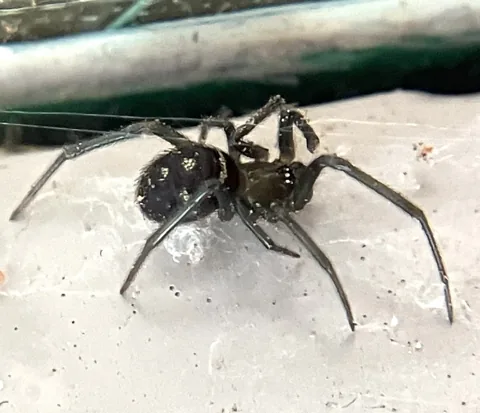
False widows are Steatoda cobweb spiders, close relatives of black widows with the same round-bellied shape. The false black widow, Steatoda grossa, is common in homes and often mistaken for a black widow; its bite can hurt but is usually much milder.
 Southern Black Widow
Latrodectus mactans
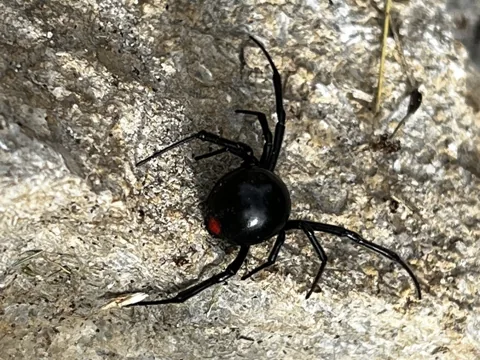
Black widows are shy, web-building spiders with a neurotoxic venom; they live throughout North America and are most common in the southern and western United States. The southern black widow is found throughout states such as South Carolina.
 Northern Black Widow
Latrodectus variolus
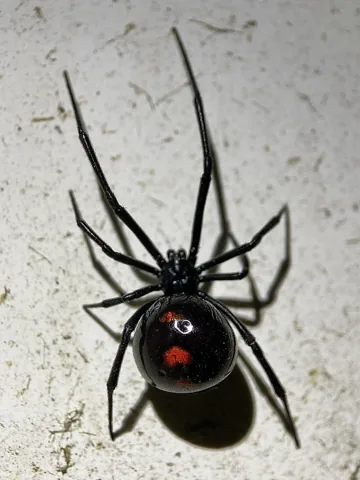
The northern black widow is the most medically significant spider in the Northeast. It is timid and rarely bites, usually only when pressed against bare skin, but its venom is a neurotoxin and a bite calls for medical help right away.
 Western Black Widow
Latrodectus hesperus
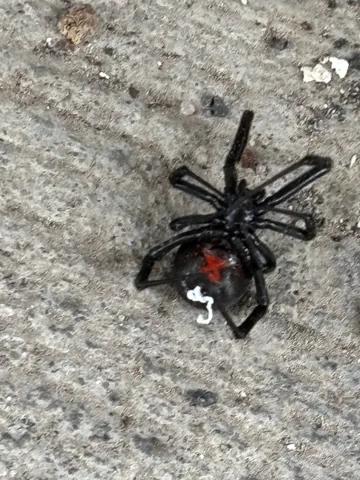
The western black widow is the only black widow species in the western United States, ranging from British Columbia and Alberta to Mexico, and it is often very common around homes, barns, outbuildings and rock walls. Its bite is venomous, though NIOSH notes that spiders are usually not aggressive and most bites happen when one is trapped or touched.
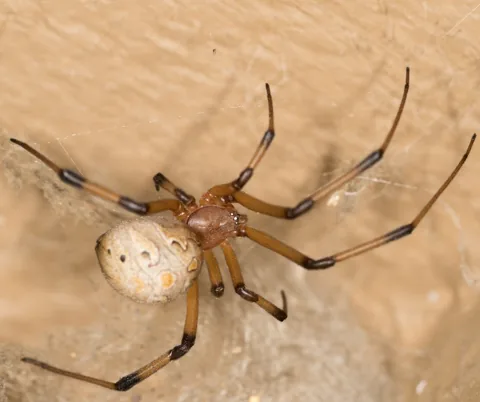 Brown Widow
Latrodectus geometricus
The brown widow is a non-native widow spider. It was found only in Florida for decades, then in the 2000s turned up from Texas along the Gulf Coast and up the Atlantic coast and became common around homes and parks in Southern California.
Side by side: false widow and black widow
Each line gives the false widows first (Steatoda, mainly the false black widow, Steatoda grossa), then the black widows (Latrodectus, such as the southern, northern and western black widows). Both are in the cobweb spider family, Theridiidae.[3][1][7][4]
- Size of a female: Penn State gives 6 to 10.5 millimeters for the false black widow and UC IPM about 3/8 inch (10 mm), slightly smaller than a mature western black widow. Black widow females are 8 to 13 millimeters in body length (Penn State) or about 1/2 inch (13 mm) (UC IPM); Clemson says up to 1 ½ inches in total length with the legs.[3][1][4][6]
- Body color: chocolate brown (UC IPM), or purplish-brown to black with light, pale-yellow to grayish markings that may be faded (Penn State); the cephalothorax is red-brown. The female black widow is shiny and jet black, legs included.[1][3][4]
- Belly mark: none. UC IPM says the false black widow never has red coloration on its belly, and Penn State and Montana State note it lacks the hourglass. The black widow has an orange to red hourglass on the underside; northern black widows show a broken hourglass or two red spots.[1][3][5][4][6][7]
- Back of the abdomen: false widows have variable lighter markings. Black widow females are plain black on top or have up to four red dots, and northern black widows often have a row of red spots down the back.[5][3][4][7]
- Abdomen shape: both are round-bellied. Penn State says the false widow's abdomen is more oval than the true black widow's, which Clemson compares to a large pea or small marble.[3][6][5]
- Web: both spin irregular, tangled cobwebs and hang upside down in them. Black widow silk is unusually tough; UC IPM says running a finger through a large female's web makes an audible ripping sound.[5][1][6]
- Where the web is: false widows build near the ground around rocks, logs or boards, or under overhangs around furniture and buildings. Black widow webs are usually within a few feet of the ground in barns, sheds, stone walls, fences, woodpiles and porch furniture.[5][9][1]
- Indoors or out: false widows are common in homes all year. UC IPM says black widows can be found in homes but typically nest outside, around the home in holes, crevices and clutter.[3][5][1]
- Egg sac: a false black widow's sac looks like a cotton ball with indistinct margins and holds 200 or more cream-colored eggs. A black widow's sac is tough and paperlike, creamy yellow to light tan, with well-defined edges and often a small point at the top.[1][3][2][6]
- Spiderlings: false black widow spiderlings are dark like their mothers. Young black widows start out tan and white and turn darker with each molt, so they look nothing like the adult.[1][6]
- Where in the U.S.: Penn State says the false black widow lives along the Atlantic, Gulf and Pacific coasts, and UC IPM calls it extremely common in Pacific Coast homes from San Diego to British Columbia. Black widows occur throughout the United States, mostly in the South and West.[3][1][9][8]
- Bite: false widow bites cause local pain and sometimes nausea, headache or tiredness, but are milder than black widow bites. Black widow venom is a neurotoxin that causes pain spreading from the bite to the chest, abdomen or whole body.[10][8][9]
A black spider with no hourglass
Most of the time, no hourglass means no black widow. But UC IPM notes that the black widow's red mark varies: two touching triangles, two separate triangles, a triangle and a small bar, almost no red at all, or on rare occasions none.[1]
So look at more than the belly. A false widow is brown or purplish rather than glossy jet black, usually has pale marks on the top of the abdomen, and is more likely to be living inside the house.[1][3][5]
Young black widows are the other common mix-up, because they are tan and white with orange or red markings. Our black widow vs brown widow guide covers young widows in detail.[1][6]
The false widows you are likely to meet
Penn State counts eight Steatoda species in the United States. The false black widow, Steatoda grossa, is the one found most often in homes in the southern and western states; a smaller relative, Steatoda borealis, is more common in the northern states and also lives in dwellings year-round.[3]
Montana State lists Steatoda grossa and S. hespera as its most common species, with females 1/5 to 5/16 inch long.[5]
The noble false widow, Steatoda nobilis, is a larger European species found in Southern California in 2011. UC IPM says mature females reach 5/8 inch (14 mm) and usually show a light tan pattern on top of the abdomen that resembles a house with two windows and a domed roof. It is now widespread in coastal San Diego County, Monterey and the San Francisco Bay area.[1]
How the bites compare
Black widow: CDC's NIOSH says the venom is a neurotoxin that produces pain at the bite and then spreads to the chest, abdomen or entire body, and bites leave two puncture marks. MedlinePlus says the first sign is usually a pinprick-like pain, then after 15 minutes to 1 hour a dull muscle pain spreads from the bite area, with possible cramping, sweating, nausea, headache and high blood pressure.[8][9]
NIOSH notes that spiders are usually not aggressive and most bites happen when a spider is trapped or touched. Although extremely rare, death can occur in the most severe cases.[8]
False widow: in an Australian study of 23 confirmed Steatoda bites, pain was universal and severe in some cases, with a median duration of 6 hr, and some people had nausea, headache, lethargy and malaise. Unlike black widow bites, local or regional sweating did not occur. The authors concluded the effects resemble black widow bites but are less severe, and that the spiders were often mistaken for black widows.[10]
In Connecticut, a Steatoda borealis bite on a finger caused a painful sting and a red spot that was gone the next day, with no sign of necrosis, followed by heart palpitations that night.[11]
Noble false widow bites in Ireland and Great Britain caused sharp, prolonged pain, redness and swelling that subsided within 48-72 h. A later case series of 16 bites reported a wider range, from mild to severe, including black widow-like pain, tremors and nausea, bacterial skin infections such as cellulitis and some necrosis, with a few patients hospitalised.[12][13]
How to confirm which one you have
Check the belly, not the back. The hourglass is on the underside, and because widows hang upside down in their webs, the belly usually faces up and is visible from above.[7][6]
Do not pick the spider up. UC IPM suggests trapping a spider under a jar and sliding a piece of paper underneath, which lets you look at the underside and photograph it.[2][1]
Look for an egg sac in the web. A fluffy, cotton-ball sac with fuzzy edges points to a false widow; a smooth, tough, tan to yellowish sac with clear edges points to a black widow.[1][2]
Think about where it was. A round-bellied brown spider in a bathroom, cupboard or under furniture is very likely a false widow; a glossy black one in a woodpile, under a lawn chair or by a garage door is more likely a black widow.[1][3][9]
Why the difference matters
A black widow bite calls for medical help right away; MedlinePlus advises calling Poison Control for guidance. False widow bites are usually milder, though they can still hurt for hours.[9][10]
False widows are the spider to manage inside the house: they thrive indoors, and in the Australian study most false widow bites happened indoors, many while people were dressing.[1][10]
Black widow control is mostly outdoors, around the clutter, woodpiles, holes and crevices where they nest.[1][9]
What to do for each
For both: vacuum spiders, webs and egg sacs from corners, windows and storage areas; soft-bodied spiders usually do not survive the vacuum. Seal cracks and gaps around doors, windows and the foundation, and keep clutter off floors.[1][2][5]
- False widows indoors: vacuum regularly and place sticky traps along entrances and in crawl spaces, bathrooms and basements. Montana State says bug bombs do not control spiders in the home and are not recommended.[5][2]
- Black widows outdoors: wear gloves when moving wood or cleaning up clutter, stack woodpiles away from the house, keep gardening gloves in closed bags and check plastic toys, lawn chairs and plant pots with curled lips. Clemson advises sealing and disposing of the vacuum bag outdoors after removing widows or egg sacs.[1][6]
- Shake out clothing, shoes, towels and equipment before use, and wear long sleeves and gloves when handling stacked or undisturbed materials.[8]
- Insecticides are not a long-term fix: UC IPM says they do not provide lasting control and widows re-infest treated areas, so cleanup and exclusion come first.[1][2]
- If bitten: clean the area with soap and water and put a cloth-wrapped ice pack on it, 10 minutes on and 10 minutes off. For a possible black widow bite, seek medical help right away; the Poison Help line is 1-800-222-1222 and it helps to know the type of spider.[9]
Common questions
- Does a false widow have a red hourglass?
- No. False widows lack the hourglass, and UC IPM says the false black widow never has red on its belly.[1][3][5]
- Is a shiny black spider with no red a false widow?
- Often, but check more than the belly. False widows are usually brown or purplish with pale marks on top, while black widows are glossy jet black and on rare occasions lack the red mark.[1][3]
- Are false widow spiders dangerous?
- Their bites can be painful, and some people get nausea, headache or tiredness, but published case studies describe them as milder than black widow bites.[10][12]
- Which one am I more likely to find inside my house?
- The false widow. It thrives indoors year-round, while black widows usually nest outside around the home.[1][3][5]
- What is the noble false widow?
- A larger European Steatoda, up to 5/8 inch, now established in coastal California. Its bites have caused pain, swelling and, in some reported cases, skin infections.[1][13]
Photo credits
- False Widow Spiders: Ken Kneidel, public domain (CC0), via iNaturalist
- Southern Black Widow: Carol Spence, public domain (CC0), via iNaturalist
- Northern Black Widow: Samuel Paul Galick, public domain (CC0), via iNaturalist
- Western Black Widow: (c) Chris Stahl, some rights reserved (CC BY) — via iNaturalist, CC BY 4.0
- Brown Widow: Jesse Rorabaugh, public domain (CC0), via iNaturalist
Sources
- University of California Statewide IPM Program, “Widow Spiders and Their Relatives.” ipm.ucanr.edu/home-and-landscape/widow-spiders-and-their-relatives/ (accessed 2026-11-14)
- University of California Statewide IPM Program, “Pest Notes: Spiders.” ipm.ucanr.edu/home-and-landscape/spiders/ (accessed 2026-11-14)
- Penn State Extension, “False Black Widow Spider.” extension.psu.edu/false-black-widow-spider (accessed 2026-11-14)
- Penn State Extension, “Southern Black Widow Spider.” extension.psu.edu/southern-black-widow-spider (accessed 2026-11-14)
- Montana State University Extension IPM Program, “Cobweb Weavers and False Widows (Steatoda spp.).” www.montana.edu/extension/ipm/entomology/resources/fact-sheets/cob-web-weavers.html (accessed 2026-11-14)
- Clemson Cooperative Extension Home & Garden Information Center, “Widow Spiders in South Carolina.” hgic.clemson.edu/factsheet/widow-spiders/ (accessed 2026-11-14)
- Missouri Department of Conservation, “Black Widow Spiders.” mdc.mo.gov/discover-nature/field-guide/black-widow-spiders (accessed 2026-11-14)
- Centers for Disease Control and Prevention, NIOSH, “Venomous Spiders at Work.” www.cdc.gov/niosh/outdoor-workers/about/venomous-spiders.html (accessed 2026-11-14)
- MedlinePlus Medical Encyclopedia, National Library of Medicine, “Black widow spider.” medlineplus.gov/ency/article/002858.htm (accessed 2026-11-14)
- PubMed, “Isbister and Gray 2003, Effects of envenoming by comb-footed spiders of the genera Steatoda and Achaearanea in Australia, J Toxicol Clin Toxicol 41:809-819.” pubmed.ncbi.nlm.nih.gov/14677791/ (accessed 2026-11-14)
- PubMed, “Vossbrinck and Krinsky 2021, Envenomation by Steatoda borealis in Connecticut, USA, J Med Entomol 58:2538-2539.” pubmed.ncbi.nlm.nih.gov/34430975/ (accessed 2026-11-14)
- PubMed, “Dunbar et al. 2018, Envenomation by the noble false widow spider Steatoda nobilis: five new cases of steatodism from Ireland and Great Britain, Clin Toxicol 56:433-435.” pubmed.ncbi.nlm.nih.gov/29069933/ (accessed 2026-11-14)
- PubMed, “Dunbar et al. 2022, Bites by the noble false widow spider Steatoda nobilis can induce Latrodectus-like symptoms and vector-borne bacterial infections: a case series, Clin Toxicol 60:59-70.” pubmed.ncbi.nlm.nih.gov/34039122/ (accessed 2026-11-14)