On this page
How to identify it
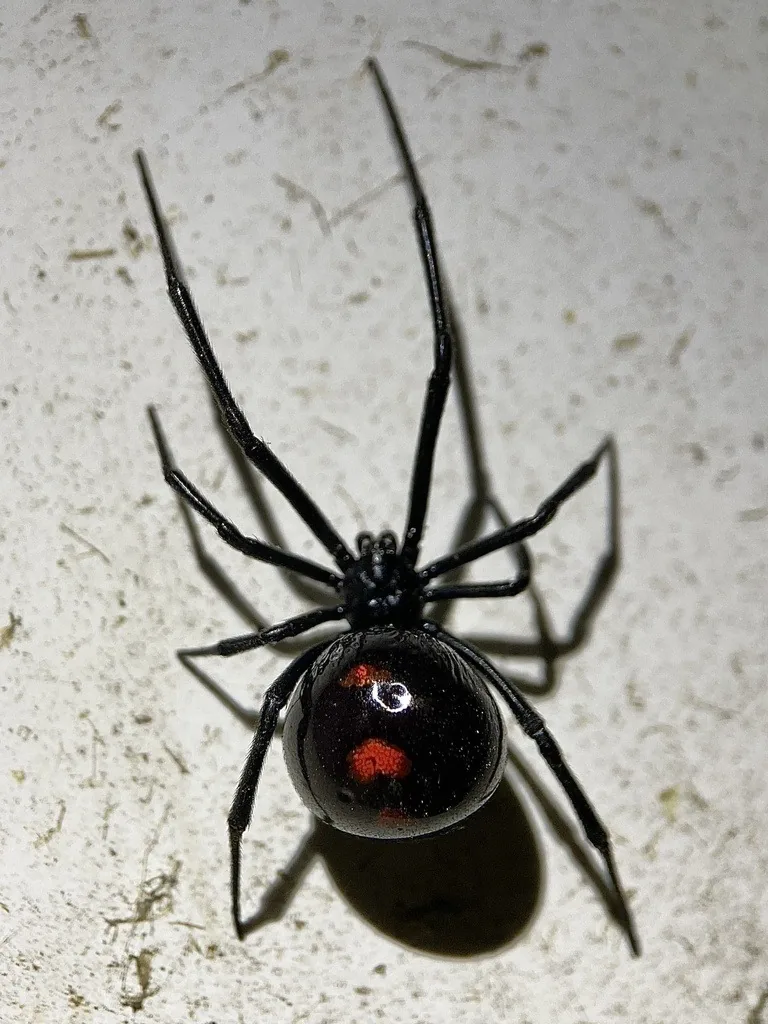
- Females have a glossy black body about 1/2 inch long, or about 1 1/2 inches including the legs.[1][5][2]
- The red hourglass on the underside of the abdomen is broken in the middle at its narrowest point, or shows as two separate red spots, unlike the complete hourglass of the southern black widow. UF/IFAS adds that the northern widow typically has the hourglass, but some individuals lack it completely.[1][5][2][6][7]
- Females usually have a row of red to orange spots down the top of the abdomen, sometimes with white markings, and the markings vary in color and shape.[5][2][6]
- Males and young spiders are smaller and paler, with brown legs, red spots along the back and whitish diagonal bands on the sides; males have much longer legs for their body size.[1][5][2]
- The pear-shaped egg sac starts out white and turns gray and papery as it matures.[5]
Look-alikes
| Look-alike | How to tell them apart |
|---|---|
| Southern black widow | The southern black widow has a complete red hourglass, a slightly smaller female body and a rounder gray egg sac with a single small point on top. In Missouri it is the more common widow in the southern counties. UF/IFAS says the southern black widow's egg sac is about 1.0 to 1.25 cm (0.4 to 0.5 in) across and typically holds around 220 eggs, and that the species lives in the Southeast and has been found as far north as Ohio and as far west as Texas.[5][2][6][7] |
| Western black widow | The only black widow in the western United States. Its hourglass is just as variable: two triangles joined or separated, a triangle and a small bar, barely visible red or, rarely, none at all. UF/IFAS likewise says the western hourglass can vary from two connected triangles to separated triangles to barely visible red blotches.[8][7] |
| Brown widow | An introduced widow, probably from Africa or possibly South America, that is mottled tan, brown and gray. Its egg sacs are covered in small spiky points, and when disturbed it usually drops from the web and plays dead. UF/IFAS says it originated in Africa, tends to curl up when disturbed rather than attack, has a higher reproductive rate than black widows and may be competing with them.[8][2][7] |
Where it lives
Found in the eastern United States from Florida to southern Canada; Connecticut sits mid-range. A 2018 mapping study found it has expanded north of its previously known range. GBIF holds about 3,600 US records since 1990 from 33 states, counting the District of Columbia, most from Virginia, Maryland, Massachusetts and North Carolina. UF/IFAS lists the northern black widow among the four widow species found in Florida, with the southern, brown and red widows.[5][9][10][7]
Biology and life cycle
It builds an irregular, three-dimensional cobweb in dark, undisturbed spots near the ground, such as stone walls, stumps, rock piles, culverts and woodpiles, and in Missouri in open woods. Writing about the southern black widow, UF/IFAS lists wood and rock piles, rodent burrows and hollow tree stumps outdoors and outhouses, garages, sheds and basements indoors, and says that although widows mostly live low, a web can be several meters off the ground.[1][5][6][7]
Indoors and around buildings it turns up in crawl spaces, basements, unused sheds, greenhouses, garages and attics.[1][5][2]
Females hide in dense silk at one side of the web by day and hang upside down in the center at night to catch beetles, cockroaches and other insects. UF/IFAS says widow prey also includes flies, crickets, grasshoppers, moths and beetles caught in the web.[5][7]
Females lay several egg sacs over the summer, averaging 164 to 200 eggs each; eggs usually hatch in about four weeks.[5]
Females can live up to 180 days after their last molt, and males about 70 days.[5]
Historically it was found mainly in woodland settings, so people rarely saw it. In South Carolina it lives mainly in the Piedmont and Upstate, while the southern black widow is statewide.[5][2]
Blue mud dauber wasps prefer to hunt young black widows to stock their nests. UF/IFAS adds that wasps, scorpions and centipedes have been known to feed on black widows.[6][7]
The name comes from the belief that females kill and eat their mates, but UF/IFAS says this was observed mainly in crowded laboratory settings; in nature, sexual cannibalism is thought to reflect a male's inability to escape rather than the female's interest in eating him.[7]
Spiderlings start out white, without the hourglass or spots, and take on adult-like colors and patterns over successive molts, UF/IFAS says.[7]
Damage and signs
Health risk
The first sign of a bite is usually a pinprick-like pain, though some people don't feel it. Within 15 minutes to an hour a dull muscle pain spreads from the bite, felt mostly in the chest after a bite on the upper body and in the abdomen after one on the lower body, and the cramping can be mistaken for appendicitis or a heart attack. Sweating, nausea and vomiting, high blood pressure, breathing difficulty and muscle spasms can follow, and pregnant women may go into labor. Death in a healthy person is very rare. In US poison center records for 2012 to 2022, about 15,300 widow exposures were reported; about half were managed outside a health care facility, 10 percent needed hospital admission and 3.4 percent received antivenom.[4][3][11]
Control
Prevention
Wear gloves when moving stone, wood or stored items, and shake out gloves, boots and clothing that have been stored before putting them on. UF/IFAS says most bites in nature happen when someone reaches under an object the spider lives in, such as a woodpile or stones, and many have happened in outhouses; it suggests gardening gloves, checking under outhouse toilet seats, and shaking out shoes that haven't been worn recently before putting them on.[1][3][7]
Remove debris and rubble from around outdoor work areas, and look before reaching into boxes or under objects. UF/IFAS adds that bites often happen while searching through old boxes, and advises caution in sheds and barns and gloves when working in basements or attics.[3][5][7]
Sanitation
Reduce clutter in storage areas, lower humidity, and regularly vacuum or sweep webs from sheds, garages and work spaces. Clemson suggests vacuuming spiders and egg sacs, then sealing the bag and throwing it out outdoors.[1][12][2]
Pesticides
The Connecticut Agricultural Experiment Station says pesticides aren't needed to control black widows in structures; sprays reduce numbers but don't guarantee control. UC IPM adds that insecticides won't give long-term control of spiders outdoors.[1][5][12]
If you are bitten
Seek medical help right away, and call Poison Control (1-800-222-1222 in the United States) for guidance.[4][3]
Wash the bite with soap and water. MedlinePlus advises ice wrapped in a cloth, 10 minutes on and 10 minutes off; NIOSH advises a cloth dampened with cold water or filled with ice, and raising the bitten area if possible.[4][3]
Keep the bitten limb still if you can, and loosen clothing and remove rings or other tight jewelry.[4]
If it can be done safely, bring the spider in a secure container, since it helps with treatment.[4][3]
Severe symptoms usually start to improve within 2 to 3 days, but milder symptoms may last for several weeks. Children, pregnant women and older people may need antivenom, which can sometimes cause serious allergic reactions.[4]
Where sources disagree
Female size: the Connecticut Agricultural Experiment Station gives a body about 1/2 inch long (9 to 11 mm), while the Missouri Department of Conservation says females reach about 3/8 inch, not counting legs.[5][6]
Do males bite? The Connecticut station says male and juvenile widows do not bite humans, and Missouri calls the male harmless; UC IPM says almost all medically important bites come from the adult female, which has stronger biting muscles and more venom.[5][6][8]
Is its range changing? The Connecticut station describes it from Florida to southern Canada. A 2018 mapping study using museum and citizen-science records found it has expanded north of its previously known range, and the authors of a 2021 New York case report say it appears to be expanding northward with climate change; a 2021 Canadian review places the black widows there along the southern border.[5][9][13][14]
Lifespan: the Connecticut Agricultural Experiment Station says northern black widow females can live up to 180 days after their last molt and males about 70 days, while UF/IFAS, writing about the southern black widow, says females live an average of 1.5 years and males two to five months.[5][7]
Brown widow origin and behavior: UC IPM says it probably came from Africa or possibly South America and usually drops from the web and plays dead when disturbed, while UF/IFAS says it originated in Africa and tends to curl up when disturbed.[8][7]
Common questions
- Is the northern black widow dangerous?
- It has extremely potent venom, but it is timid and rarely bites. Most bites happen when a spider is pressed against bare skin, such as inside a glove or boot. In poison center records most widow exposures have minor outcomes, but a bite still calls for medical advice.[1][2][11][4]
- Do male northern black widows bite?
- The Connecticut Agricultural Experiment Station says male and juvenile widows do not bite humans, and Missouri calls the small, wandering male harmless.[5][6]
- How do I tell a northern from a southern black widow?
- Check the underside: the northern widow's red hourglass is split in the middle or shows as two spots, while the southern widow's is a complete hourglass.[5][1][2]
- Do doctors in the North recognize black widow bites?
- Not always. The authors of the first report of a child bitten by a northern black widow in the northeastern US write that practitioners often fail to recognize the signs of a widow bite, which delays treatment.[13]
- Do female black widows really eat their mates?
- Not usually in the wild. UF/IFAS says mate-eating was observed mainly in crowded laboratory settings, and in nature it is thought to happen when the male can't get away.[7]
Sources
- The Connecticut Agricultural Experiment Station, “Northern Black Widow Spider (Latrodectus variolus) fact sheet, by Katherine Dugas.” portal.ct.gov/-/media/caes/documents/publications/fact_sheets/entomology/northern_black_widow_latrodectus.pdf (accessed 2026-11-11)
- Clemson Cooperative Extension, Home & Garden Information Center, “Widow Spiders in South Carolina (HGIC).” hgic.clemson.edu/factsheet/widow-spiders/ (accessed 2026-11-11)
- CDC / NIOSH, “Venomous Spiders at Work.” www.cdc.gov/niosh/outdoor-workers/about/venomous-spiders.html (accessed 2026-11-11)
- MedlinePlus, U.S. National Library of Medicine, “Black widow spider (Medical Encyclopedia).” medlineplus.gov/ency/article/002858.htm (accessed 2026-11-11)
- The Connecticut Agricultural Experiment Station, “Northern Black Widow, Southern Black Widow Spider, Latrodectus variolus, Latrodectus mactans fact sheet, by Rose Hiskes.” portal.ct.gov/-/media/caes/documents/publications/fact_sheets/entomology/black-widow-spider_northern-and-southern_fact-sheet.pdf (accessed 2026-11-11)
- Missouri Department of Conservation, “Black Widow Spiders (Field Guide).” mdc.mo.gov/discover-nature/field-guide/black-widow-spiders (accessed 2026-11-11)
- University of Florida IFAS Extension (EDIS), “Southern Black Widow, Latrodectus mactans (Fabricius), EENY 560/IN1000 (Featured Creatures; P. Kaufman and A. Eiden).” ask.ifas.ufl.edu/publication/IN1000 (accessed 2026-11-14)
- University of California Statewide IPM Program, “Widow Spiders and Their Relatives (Pest Notes).” ipm.ucanr.edu/home-and-landscape/widow-spiders-and-their-relatives/ (accessed 2026-11-11)
- PLoS One, via PubMed, “Predicting the distribution of poorly-documented species, Northern black widow (Latrodectus variolus) and Black purse-web spider (Sphodros niger), using museum specimens and citizen science data (Wang et al. 2018).” pubmed.ncbi.nlm.nih.gov/30089136/ (accessed 2026-11-11)
- Global Biodiversity Information Facility (GBIF), “Latrodectus variolus: US occurrence records since 1990 by state (GBIF occurrence search API).” api.gbif.org/v1/occurrence/search?taxonKey=2157950&country=US&hasGeospatialIssue=false&occurrenceStatus=PRESENT&year=1990%2C2026&facet=stateProvince&facetLimit=400&limit=0 (accessed 2026-11-11)
- Wilderness & Environmental Medicine, via PubMed, “Black Widow Spider Exposures: A Retrospective Review of the National Poison Data System 2012-2022 (Kerns et al. 2025).” pubmed.ncbi.nlm.nih.gov/39670790/ (accessed 2026-11-11)
- University of California Statewide IPM Program, “Spiders (Pest Notes, Home and Landscape).” ipm.ucanr.edu/home-and-landscape/spiders/ (accessed 2026-11-11)
- Toxicon, via PubMed, “A case of pediatric northern black widow spider (Latrodectus variolus) bite in New York, USA (Rochlin et al. 2021).” pubmed.ncbi.nlm.nih.gov/33610637/ (accessed 2026-11-11)
- Journal of Medical Entomology, via PubMed, “A Review of Black Widow (Araneae: Theridiidae) Envenomation, Epidemiology, and Antivenom Utilization in Canada (Curran-Sills et al. 2021).” pubmed.ncbi.nlm.nih.gov/33432350/ (accessed 2026-11-11)
- iNaturalist, “Latrodectus variolus taxon page (order and family).” www.inaturalist.org/taxa/146706 (accessed 2026-11-11)