On this page
How to identify it
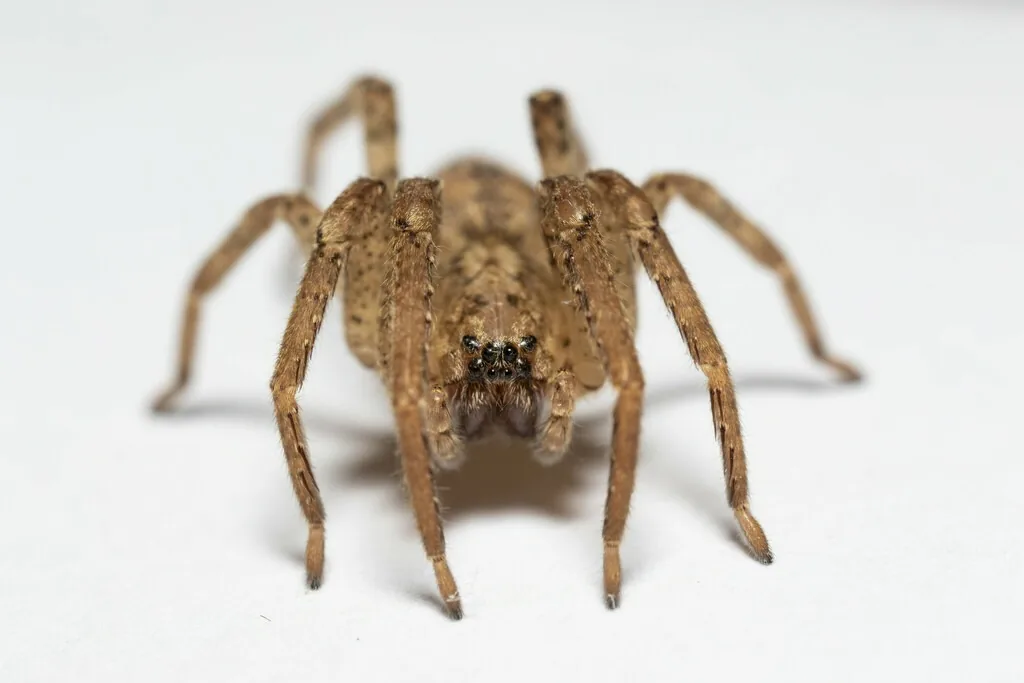
- Adults have bodies about 1/2 to 5/8 inch long and a leg span of 1 to 1-1/4 inches, brown with small black markings.[1]
- A black mark with several outward flares sits on the top front of the abdomen.[1]
- All eyes sit at the front edge of the head region, unlike wolf spiders.[1]
- Its abdomen is long and never round, and it is never found in orb webs between trees or on porches. Females have slightly larger bodies and shorter legs than males.[1]
Look-alikes
| Look-alike | How to tell them apart |
|---|---|
| Wolf spiders | Wolf spiders' marks are usually diamond-shaped with one flare, and their eyes spread across the front third of the head region.[1] |
Where it lives
The first California reports came from Sunnyvale in Santa Clara County in 1992. It has since spread north and east around the Bay, with finds in Santa Clara, San Mateo, Alameda, Marin and Santa Cruz counties. So far it seems to live mainly in and around homes, though it may also be settling into natural areas.[1]
Biology and life cycle
It's a hunting spider that doesn't spin webs; silk mainly covers the female's egg sac.[1]
Most spiders people find are mature males and females wandering in search of mates or food, from September to May and especially in winter. Where the young spend the summer isn't known.[1]
Damage and signs
- It eats mostly insects and causes no damage.[1]
Health risk
UC IPM says no spider in this genus is known to be medically important, and there are no verified accounts of its bites causing significant medical problems. Swiss studies of verified bites found that it can bite, with mild local symptoms and full recovery.[1][4][5]
Control
Prevention
Control is unnecessary; reducing clutter removes hiding places.[1]
Keep them out
Weather-stripping at door bottoms helps keep spiders and insects out.[1]
Traps and physical control
To remove one, set a jar over it, slide a piece of paper under the jar and carry it outside. These spiders don't invade homes in groups.[1]
Can it bite?
It can. In a two-year Swiss study of bites reported to the national poison information center, Zoropsis spinimana caused 5 of 14 verified spider bites, more than any other species.[4]
The bites in that study caused local pain, which was sometimes severe, along with swelling and redness. Whole-body symptoms were rare, and every patient recovered completely.[4]
A related Swiss study verified 8 of 19 reported bites, 2 of them by this spider, and described the symptoms as generally mild with full recovery.[5]
UC IPM points out that in California there are still no verified accounts of its bites causing significant medical problems.[1]
If you are bitten
MedlinePlus advises washing the bite with soap and water, applying ice or a wet compress, and taking an over-the-counter pain reliever if needed. Antihistamines may help with severe swelling.[3]
Get medical care for small children and for adults with severe symptoms. UC IPM says to contact a physician, hospital or poison control center if a spider bite causes an unusual or severe reaction, such as increasing pain or extreme swelling.[3][2]
If you catch the spider in the act, UC IPM suggests saving it for identification. The Swiss researchers add that only verified bites can be regarded as spider bites, so in a serious case the spider should go to an expert.[2][5]
Common questions
- Is the Zoropsis spider dangerous?
- Not in any serious way. It can bite if handled, but verified bites in Swiss studies caused only local pain, swelling and redness, and UC IPM knows of no bites causing significant medical problems.[1][4]
- Will more show up?
- Rarely more than one at a time. Zoropsis spiders don't gather in groups or invade in large numbers.[1]
- Why do I find them in winter?
- The spiders seen indoors are mostly adults wandering in search of mates, and UC IPM says they are common from September to May, especially in winter.[1]
Sources
- University of California Statewide IPM Program, “Pest Notes: Zoropsis spinimana, A Mediterranean Spider in California (Publication 74143).” ipm.ucanr.edu/home-and-landscape/zoropsis-spinimana-mediterranean-spider-in-california/ (accessed 2026-11-13)
- University of California Statewide IPM Program, “Pest Notes: Spiders (UC ANR Publication 7442).” ipm.ucanr.edu/home-and-landscape/spiders/ (accessed 2026-11-13)
- MedlinePlus, U.S. National Library of Medicine, “Spider Bites.” medlineplus.gov/spiderbites.html (accessed 2026-11-13)
- Toxicon (via PubMed), “A two year study of verified spider bites in Switzerland and a review of the European spider bite literature (Nentwig W et al., Toxicon, 2013) (abstract).” pubmed.ncbi.nlm.nih.gov/23872119/ (accessed 2026-11-13)
- Swiss Medical Weekly (via PubMed), “Swiss prospective study on spider bites (Gnadinger M et al., Swiss Medical Weekly, 2013) (abstract).” pubmed.ncbi.nlm.nih.gov/24019004/ (accessed 2026-11-13)
- Global Biodiversity Information Facility (GBIF), “Zoropsis spinimana (Dufour, 1820) (GBIF Backbone Taxonomy).” api.gbif.org/v1/species/2153287 (accessed 2026-11-13)