On this page
How to identify it
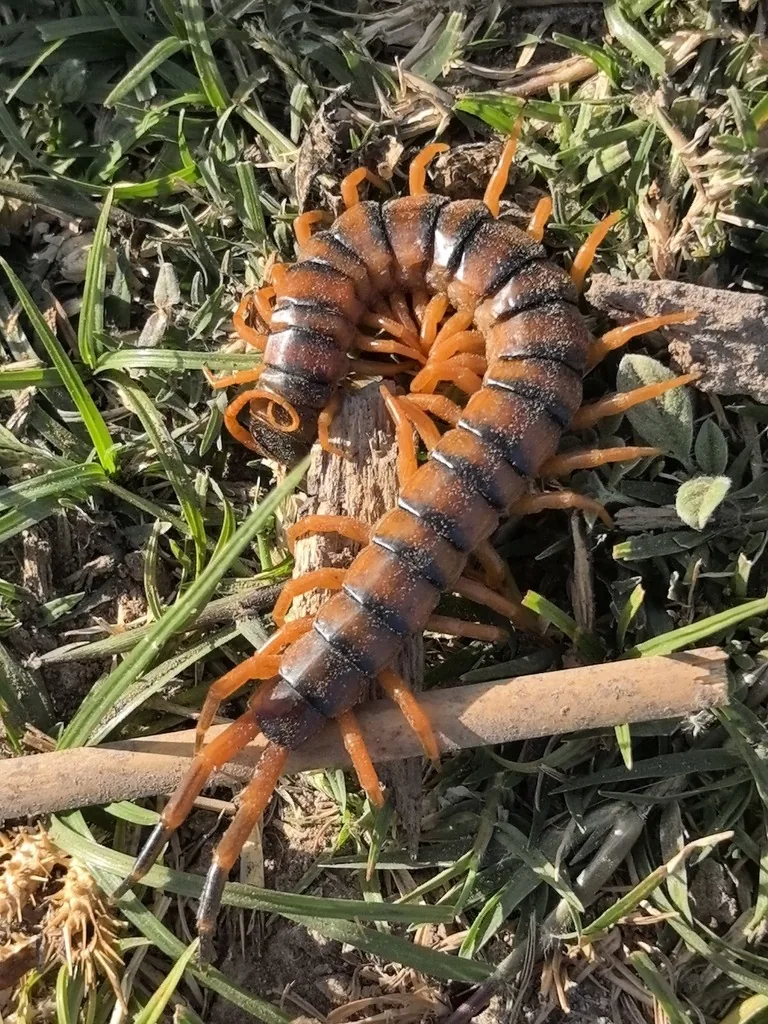
- Adults usually run about 6 to 6 1/2 inches long. The University of Arizona says they can reach 8 1/2 inches, while Missouri gives up to 8 inches and the Arkansas Arthropod Museum nearly 8.[2][1][3]
- A long, flattened body with 21 pairs of legs, one pair per body segment; the last pair points backward like a pair of tails.[1][3]
- Color varies by region: Arizona animals are often reddish-yellow with dark bluish-black bands, while those farther east have a black body, yellow legs and a rusty red head.[2][1][3]
- The rear legs look like stingers but are grasping legs used to seize prey or pinch; the bite comes from fang-like claws just behind the head.[2][1]
- Names get mixed up: Utah State University Extension uses the name giant desert centipede for a different species, Scolopendra polymorpha, and the Arkansas museum calls 'giant desert centipede' a misnomer for S. heros because it is often collected in rocky woodland.[4][3]
Look-alikes
| Look-alike | How to tell them apart |
|---|---|
| House centipede | Much smaller, with fewer legs that, like its antennae, are very long for its body; it usually turns up in damp spots such as showers and bathtubs.[2] |
| Millipedes | Millipedes have two pairs of legs on most body segments, while centipedes have only one pair per segment.[2][3] |
Where it lives
Found across much of the Southwest and south-central U.S., including Arizona, New Mexico, Texas, Oklahoma, Kansas, Louisiana, Arkansas and southern Missouri, and into northern Mexico.[3][2][1]
Biology and life cycle
It is a predator of insects and other arthropods and will also take small frogs, lizards, snakes and newborn mice.[2][1][3]
It hides by day under rocks, logs, wood piles and leaf litter and hunts at night.[2][1][4]
Females lay eggs in cavities in rotting wood, then curl around the egg mass and guard the young after they hatch. Utah State gives 10 to 60 eggs for centipedes in general, hatching after 1 to 3 months.[1][3][4]
Young hatch with the full number of legs, start out nearly colorless, and gain adult coloring over time.[1][3]
Damage and signs
Health risk
MedlinePlus says centipede bites cause pain, swelling and redness, rarely lymph node swelling or numbness, and are not fatal; people allergic to the venom can have trouble breathing, a rapid heart rate or throat swelling. Published case reports of S. heros bites describe lymphangitis and, in one 1985 case, rhabdomyolysis and acute kidney failure.[5][6][7]
Control
Prevention
Wear gloves and work carefully when moving firewood, rocks or wood piles, though its fangs may be able to pierce leather gloves.[2][1]
If centipedes keep turning up indoors, find and manage the cockroaches, crickets and other insects they come in to hunt.[2][4]
Keep them out
Keep window screens and door weather stripping in good repair, and seal cracks in the foundation and gaps around windows and doors.[2][4]
Sanitation
Clear stones, mulch and debris from right next to the house so the soil can dry, and dry out damp rooms such as laundry rooms and bathrooms.[4]
Traps and physical control
To remove one found indoors, grab it with kitchen tongs or heavy gloves, drop it into a large lidded jar, and release it outside.[2]
Pesticides
Spot treatments are a last resort. Utah State lists beta-cyfluthrin, bifenthrin, carbaryl, cypermethrin, esfenvalerate, imidacloprid, lambda-cyhalothrin and permethrin among actives in products registered for centipedes in Utah; read and follow the label.[4][2]
If you are bitten
Wash the bite with plenty of soap and water, then put ice wrapped in a clean cloth on it, 10 minutes on and 10 minutes off. Do not handle centipedes, especially large ones.[5]
Symptoms most often last less than 48 hours, though swelling and tenderness can last as long as 3 weeks.[5]
If someone is bitten, MedlinePlus advises calling 911 or Poison Help at 1-800-222-1222; have the person's age, weight and condition, the type of centipede and the time of the bite ready.[5]
Emergency physicians reporting an S. heros case note that bites can lead to complications such as cellulitis and necrosis, so watch the wound.[6]
A fierce mother
A female coils her body around her eggs to guard them and keeps watching over the young after they hatch.[1][3]
Common questions
- Can a giant desert centipede bite kill you?
- MedlinePlus says centipede bites can be very painful but are not fatal; an allergic reaction needs emergency care.[5]
- Is the tail a stinger?
- No. The last pair of legs grasps prey and can pinch, but the venom is delivered by fang-like claws just behind the head.[2][1]
- Do centipedes attack people?
- No. Reported attacks are most likely centipedes trying to escape by running under a shoe or up a pant leg, not attacking.[2]
- How do I keep them out of my house?
- Seal cracks and gaps, fix screens and weather stripping, keep debris away from the foundation and control the insects they hunt.[2][4]
Sources
- Missouri Department of Conservation, “Giant Redheaded Centipede (Field Guide).” mdc.mo.gov/discover-nature/field-guide/giant-redheaded-centipede (accessed 2026-11-12)
- University of Arizona Cooperative Extension, Yavapai County, “Backyard Gardener #53: Centipedes (January 15, 2023).” extension.arizona.edu/sites/extension.arizona.edu/files/barnesm/Centipedes.pdf (accessed 2026-11-12)
- University of Arkansas Arthropod Museum, “Giant Redheaded Centipede, Scolopendra heros.” arthropod.uark.edu/giant-redheaded-centipede/ (accessed 2026-11-12)
- Utah State University Extension, “Centipedes (Utah Pests fact sheet).” extension.usu.edu/planthealth/research/centipede (accessed 2026-11-12)
- NIH National Library of Medicine, MedlinePlus, “Centipede (Medical Encyclopedia).” medlineplus.gov/ency/article/002842.htm (accessed 2026-11-12)
- Wilderness & Environmental Medicine, via PubMed, “Lymphangitis From Scolopendra heros Envenomation: The Texas Redheaded Centipede (Essler, Julakanti and Juergens, 2017).” pubmed.ncbi.nlm.nih.gov/28089338/ (accessed 2026-11-12)
- Western Journal of Medicine, via PubMed, “Rhabdomyolysis and acute renal failure following the bite of the giant desert centipede Scolopendra heros (Logan and Ogden, 1985).” pubmed.ncbi.nlm.nih.gov/4013269/ (accessed 2026-11-12)
- iNaturalist, “Scolopendra heros taxon page (order and family).” www.inaturalist.org/taxa/146601 (accessed 2026-10-06)