On this page
How to identify it
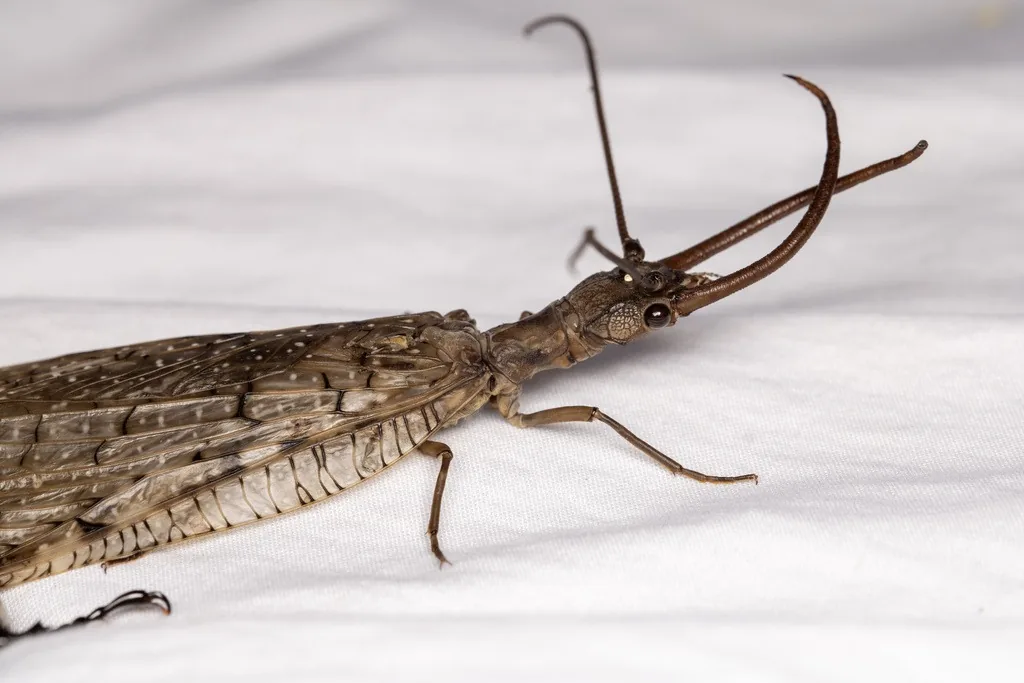
- Adults are large and soft-bodied, usually drab gray, black or brown, with long antennae and veiny wings folded down the length of the body at rest. Mississippi State gives adults up to 3 inches long with a wingspan of up to 5 inches; MDC says they can exceed 3½ inches.[2][1]
- Males have long, curved, tusklike mandibles that add another inch or more, but they can't hurt people for lack of leverage.[1][2]
- Females have short, stout mandibles. A short jaw is not proof of a female, though: two males with unusually short mandibles have been recorded in Missouri.[1][2][3]
- Hellgrammites, the larvae, are somewhat flattened and dark brown, tan or black, with big pincers on the head, six legs, 8 pairs of pointed side appendages with gill tufts, and a pair of hooked appendages at the tail that anchor them in the current.[4][1]
Look-alikes
Where it lives
MDC calls it the only dobsonfly species in eastern North America. Central Ohio lies in the northern part of its U.S. range, and it was the species the public most often asked the Montreal Insectarium to identify, in requests that came mostly from Canada.[2][5][6]
Biology and life cycle
Females lay white, coin-sized egg masses on branches, leaves or rocks over or next to streams; MDC says they look like bird droppings. The young larvae drop or crawl into the water.[1][2]
Hellgrammites live under rocks in the fastest parts of rocky streams and rivers, and eastern dobsonflies sometimes breed in well-oxygenated lakes and ponds. In Ohio riffles they were more likely and more numerous where water was faster and the bottom coarser.[2][1][5]
They are strictly predatory, grabbing other aquatic insects, small fish and anything else they can subdue. They breathe through feathery gills and through spiracles.[1][2]
When grown, larvae crawl out of the water and pupate in a protected place above it; MDC says they form a cocoon and spend the winter there before adults emerge in spring.[1][2]
Adults don't eat, live only a few days to a week, and fly slowly, mostly at night. They are most often seen at outdoor lights near water in late spring and early summer.[2][1]
Damage and signs
Health risk
Dobsonflies are not venomous; the worst they can do is pinch. Females can give a painful, even skin-breaking nip if handled carelessly, and both sexes raise their heads and spread their jaws when bothered. Hellgrammites can pinch too, so hold them behind the head.[2][1][4]
Control
Prevention
There is nothing to control. Adults come from nearby water, are drawn to outdoor lights and live only a few days.[2][1]
Traps and physical control
To move one, avoid the female's short jaws; pick up hellgrammites behind the head.[1][4]
If you get pinched
MedlinePlus advises washing a bite thoroughly with soap and water, then holding ice wrapped in a washcloth on it for 10 minutes on and 10 minutes off, and watching it over the next several days for signs of infection such as increasing redness, swelling or pain.[7]
Where sources disagree
Larval size: MDC's dobsonfly page gives hellgrammites as 2 to 3 inches, its hellgrammite page says up to about 4 inches, and Mississippi State says up to 3.5 inches.[2][4][1]
Time as larvae: Mississippi State says one to three years or more; MDC says 2 or 3 years.[1][2]
What the male's tusks are for: MDC says males use them to clasp the female while mating; Mississippi State says they use them to joust with rivals and possibly to impress females.[2][1]
Common questions
- Is the giant insect with huge pincers dangerous?
- Probably a male dobsonfly, and no: its long tusks can't hurt people. Females, with short jaws, can give a painful pinch if handled.[2][1]
- What's a hellgrammite?
- The aquatic larva of the dobsonfly. It lives under rocks in fast streams, eats other aquatic animals, and is popular as fish bait.[4][1]
Sources
- Mississippi State University Extension, “Eastern Dobsonfly Vol. 9, No. 24.” extension.msstate.edu/newsletters/bugs-eye-view/2023/eastern-dobsonfly-vol-9-no-24 (accessed 2026-11-11)
- Missouri Department of Conservation, “Eastern Dobsonfly (Field Guide).” mdc.mo.gov/discover-nature/field-guide/eastern-dobsonfly (accessed 2026-11-11)
- Journal of Insect Science, via PubMed, “Gynomorphic mandible morphology in the dobsonfly, Corydalus cornutus (Bowles et al. 2007).” pubmed.ncbi.nlm.nih.gov/20302546/ (accessed 2026-11-11)
- Missouri Department of Conservation, “Hellgrammite (Field Guide).” mdc.mo.gov/discover-nature/field-guide/hellgrammite (accessed 2026-11-11)
- Insects, via PubMed, “Small-Scale Habitat Relationships of Corydalus cornutus Hellgrammites in Central Ohio Riffles (Bossley et al. 2026).” pubmed.ncbi.nlm.nih.gov/42042452/ (accessed 2026-11-11)
- Insects, via PubMed, “"What's This Bug?" Questions from the Public Provide Relevant Information on Species Distribution and Human-Insect Interactions (Drapeau Picard et al. 2021, Montreal Insectarium).” pubmed.ncbi.nlm.nih.gov/34680690/ (accessed 2026-11-11)
- MedlinePlus, U.S. National Library of Medicine, “Insect bites and stings (Medical Encyclopedia).” medlineplus.gov/ency/article/000033.htm (accessed 2026-11-11)
- iNaturalist, “Corydalus cornutus taxon page (order and family).” www.inaturalist.org/taxa/126712 (accessed 2026-10-06)