On this page
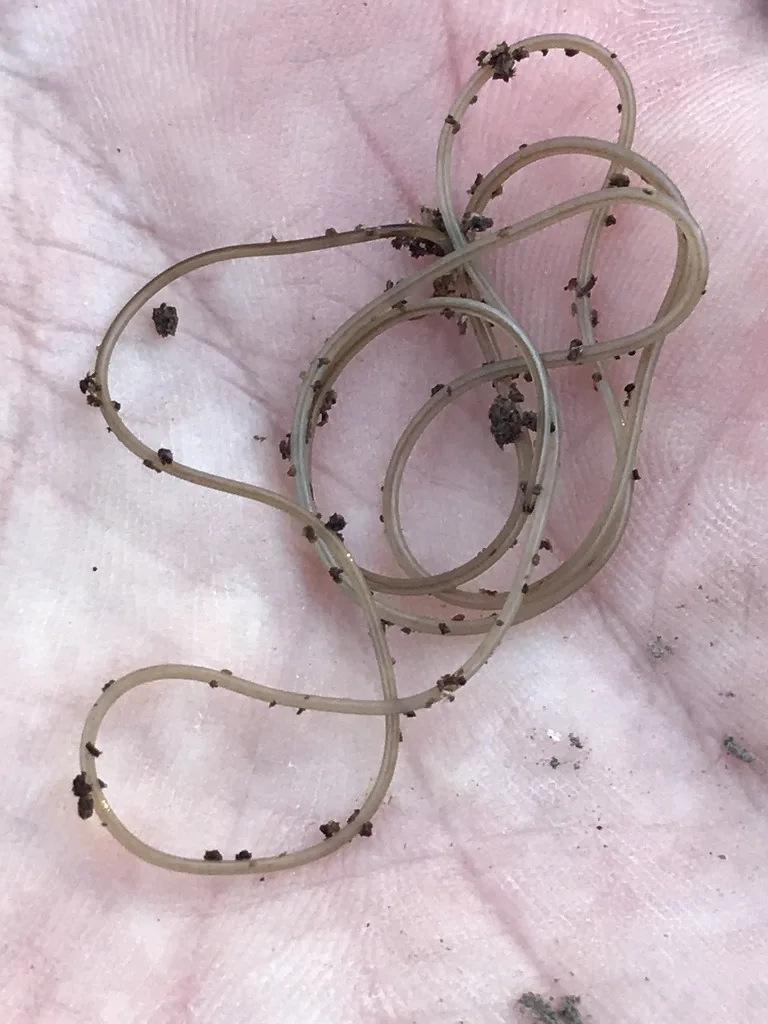
How to identify it
- Sizes differ by source: UC IPM gives about 1/25 inch wide and up to a foot or more long; University of Kentucky gives 4 inches or longer and 1/80 to 1/10 inch wide.[1][2]
- They often twist into a loose knot, which earned them the name Gordian worms.[1]
- They're found singly or in knotted masses in ponds, puddles, pools, troughs and sometimes household water.[1]
Where it lives
They turn up wherever their insect hosts live near water, especially farm areas with ponds and irrigation.[1]
Biology and life cycle
Adults mate in water and females lay long gelatinous strings of eggs, 12 to 24 inches long according to UC IPM. Hatch timing differs: UC IPM says about three weeks to one month, while University of Kentucky says 2 weeks to 3 months depending on water temperature.[1][2]
Larvae develop inside insects such as crickets, mantids, ground beetles or millipedes, sometimes after riding in an aquatic insect.[1]
About three months later the host is driven to water, where the adult worm emerges; adults don't feed and overwinter in water or mud.[1]
University of Kentucky lists grasshoppers, crickets, cockroaches and some beetles as hosts; inside the host the larva digests and absorbs the surrounding tissue.[2]
Infected crickets lose their normal behavior: lab work found hairworm infection makes crickets respond to light in an abnormal, directed way, and most recover once the worm has left. The cricket can live for months after the worm emerges.[5]
Damage and signs
- They don't infect plants and parasitize too small a share of insects to matter much as biological control.[1]
Health risk
A 2022 case report on a horsehair worm found in a patient's urine says there is no evidence that these worms are parasites of humans, and that such pseudoparasites pose no threat to human health and are not a serious public health issue. Older reports read differently: a 2012 Japanese report describes worms collected from an 80-year-old woman's vomit and excreta and from a 1-year-old boy's mouth as human cases infected by a horsehair worm, and a 1996 report describes worms from the vomit or stool of two patients with abdominal pain as intestinal infections. For pets, a 2015 Korean report describes one found in the feces of a 5-month-old dog.[3][6][7][4]
Control
Prevention
University of Kentucky says there is no need for control and that the worms' presence only shows that a cricket or other host got into the container and died; it advises checking for cracks or openings that can be screened or sealed.[2]
Keep them out
Seal and caulk entry points so crickets, a known host, can't get indoors; worms in showers and toilets usually come from dead crickets.[1]
Traps and physical control
Remove worms from swimming pools by hand or with a net, flush livestock troughs routinely, and use a fine mesh filter when pumping water from a canal or pond.[1]
When to call a professional
If worms appear in household water, have the supply filtered, treated and inspected for repairs.[1]
More from UK Entomology
Also called Gordian worms, they're relatives of nematodes but much longer, 4 inches or more, and very thin; they turn up in streams, puddles, cisterns and livestock troughs.[2]
Where the sources disagree
Size: UC IPM gives adults about 1/25 inch in diameter and up to 1 foot or more long; University of Kentucky says 4 inches or longer and 1/80 to 1/10 inch in diameter.[1][2]
Egg hatch: UC IPM says about three weeks to one month after the eggs are laid; Kentucky says 2 weeks to 3 months, depending on water temperature.[1][2]
Hosts: UC IPM lists mantids, water beetles, carabid beetles, dragonflies, crickets and millipedes; Kentucky lists grasshoppers, crickets, cockroaches and some beetles.[1][2]
Getting into a host: Kentucky says the larva is thought to form a cyst within 24 hours that a suitable insect then eats; UC IPM describes several routes, including larvae swallowed directly, larvae encysted in mayflies, mosquitoes or tadpoles that a host later eats, and cysts on leaves when water dries up.[2][1]
People: the 2022 report says there is no evidence these worms are parasites of humans and calls them pseudoparasites; a 2012 Japanese report calls its two finds human cases infected by a horsehair worm, and a 1996 report calls its two finds intestinal infections.[3][6][7]
How many species: a 2015 report gives about 300 freshwater species in 22 genera plus 5 marine species; a 2020 paper gives approximately 350 species in 19 genera.[4][8]
Common questions
- Are horsehair worms dangerous to my kids or my dog?
- A 2022 case report found no evidence that horsehair worms are parasites of humans and called worms found in people pseudoparasites that pose no threat to human health. Older reports describe worms found in a 1-year-old boy's mouth and in vomit or stool, and one in a 5-month-old dog's feces; see Where the sources disagree.[3][6][4]
- Why is there a worm in my toilet?
- Crickets that carry horsehair worms seek water; the worm emerges when an infected cricket ends up in a toilet or shower.[1]
- Do they come from horse hairs?
- No. That's an old misconception; they develop as parasites inside insects.[1]
- Why do crickets jump into water?
- A mature hairworm drives its host to seek water. In a Japanese study, infected crickets and grasshoppers were 20 times more likely to enter a stream than uninfected ones.[1][9]
- Do horsehair worms do anything useful?
- Yes. In a Japanese mountain stream, insects driven into the water by hairworms made up 60% of the yearly energy intake of an endangered trout population. Fun fact: the name Gordian worm comes from the Greek legend of a knot Alexander the Great could not untie.[9][2]
Sources
- University of California Statewide IPM Program, “Pest Notes: Horsehair Worms (Publication 7471).” ipm.ucanr.edu/PMG/PESTNOTES/pn7471.html (accessed 2026-11-13)
- University of Kentucky Entomology, “ENTFACT-613: Horsehair Worms.” entomology.mgcafe.uky.edu/ef613 (accessed 2026-11-13)
- Helminthologia 59, 2022 (Miladinović-Tasić, Schmidt-Rhaesa & Petrović), via PubMed, “Human Encounter with a Horsehair Worm (Nematomorpha): Is There a Reason To Worry?.” pubmed.ncbi.nlm.nih.gov/36118369/ (accessed 2026-11-13)
- Korean Journal of Parasitology 53, via PubMed, “A Horsehair Worm, Gordius sp. (Nematomorpha: Gordiida), Passed in a Canine Feces (Hong et al. 2015).” pubmed.ncbi.nlm.nih.gov/26797439/ (accessed 2026-11-13)
- Behavioral Ecology 22, 2011 (Ponton et al.), via PubMed, “Water-seeking behavior in worm-infected crickets and reversibility of parasitic manipulation.” pubmed.ncbi.nlm.nih.gov/22476265/ (accessed 2026-11-13)
- Korean Journal of Parasitology 50, via PubMed, “Two human cases infected by the horsehair worm, Parachordodes sp. (Nematomorpha: Chordodidae), in Japan (Yamada et al. 2012).” pubmed.ncbi.nlm.nih.gov/22949758/ (accessed 2026-11-13)
- Canadian Journal of Infectious Diseases 7, via PubMed, “Dacochordodes bacescui Capuse, 1966: Report of the first two isolations from humans (Pikula et al. 1996).” pubmed.ncbi.nlm.nih.gov/22514431/ (accessed 2026-11-13)
- Journal of Parasitology, via PubMed, “A New Species of Gordionus (Nematomorpha: Gordiida) from the Rocky Mountains of New Mexico (2020).” pubmed.ncbi.nlm.nih.gov/32673386/ (accessed 2026-11-13)
- Ecology 92, 2011 (Sato et al.), via PubMed, “Nematomorph parasites drive energy flow through a riparian ecosystem.” pubmed.ncbi.nlm.nih.gov/21560690/ (accessed 2026-11-13)
- Global Biodiversity Information Facility (GBIF), “Nematomorpha (phylum) (GBIF Backbone Taxonomy).” api.gbif.org/v1/species/64 (accessed 2026-11-13)
- iNaturalist, “Nematomorpha taxon page (order and family).” www.inaturalist.org/taxa/63142 (accessed 2026-10-06)