The short answer
- Shine: a blow fly has a shiny metallic blue, green or copper body. House flies and cluster flies are dull gray, not metallic.[1][4][7][5]
- Thorax: a house fly has four dark stripes running down the back of the thorax (the middle section). A cluster fly has short golden-yellow hairs there instead.[2][1][7][6]
- Wings at rest: a cluster fly folds its wings so they overlap over its back; house flies hold their wings apart in a V shape.[1][2]
- Season and behavior: slow, clumsy flies on sunny windows in fall, winter or early spring are usually cluster flies. A sudden crowd of metallic flies in one room usually means a dead animal nearby.[6][8][1][4]
Profiles on this site
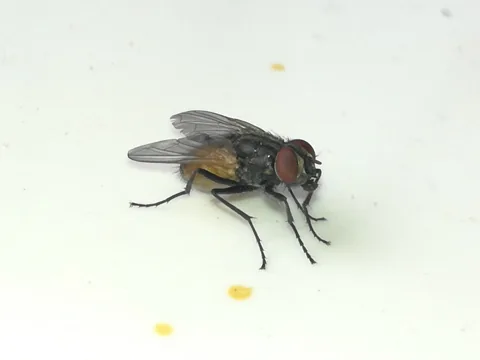 House Fly
Musca domestica
The house fly is a worldwide companion of people and domestic animals; it breeds in garbage, manure and other moist organic matter and is most numerous in hot summer months.
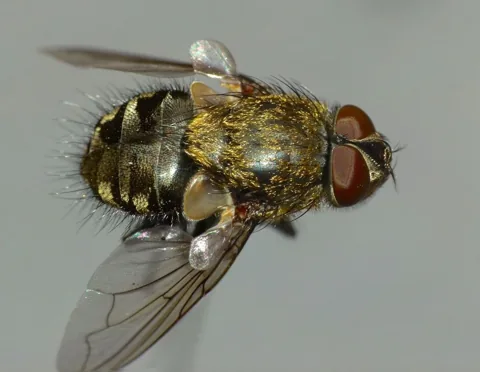 Cluster Fly
Pollenia species (e.g., P. rudis)
Cluster flies gather on the sunny sides of buildings in fall to find places to overwinter and then appear indoors, often in large numbers, on warm days through winter and spring. They do not breed indoors.
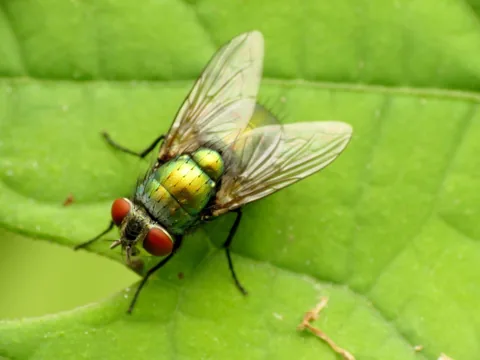 Common Green Bottle Fly
Calliphoridae (shown: Lucilia sericata)
A sudden crowd of shiny green or blue flies indoors often means an animal has died in a chimney, wall or ceiling. Outdoors, most blow flies come from garbage with food waste and from pet waste.
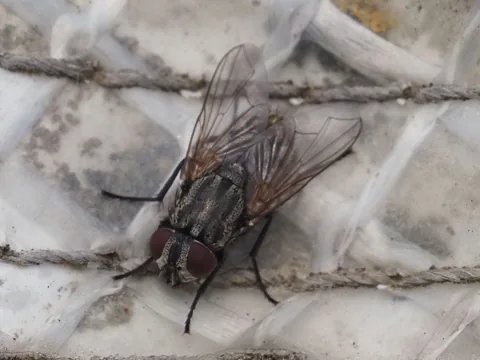 Face Fly
Musca autumnalis
The face fly is a serious pest of pastured cattle that also invades homes and barns near pastures. In fall the adults look for sheltered places to spend the winter, often inside attics and wall voids, much like cluster flies.
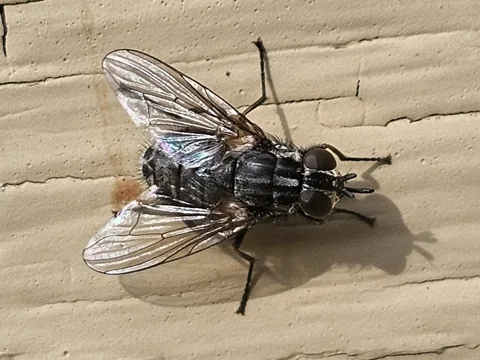 Stable Fly
Stomoxys calcitrans
The stable fly, also called the biting house fly or dog fly, looks much like a house fly but feeds on blood. Cattle are its main hosts, but it also bites horses, dogs and people, especially in neighborhoods near livestock.
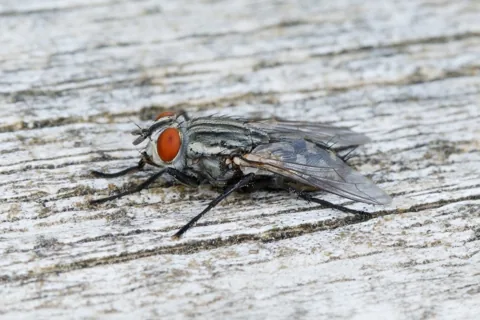 Flesh Flies
Sarcophaga species (family Sarcophagidae)
Flesh flies are large gray flies whose maggots develop in dead animals, excrement and other decaying matter. When a sudden crowd of them appears indoors, a small animal has most likely died in a wall void, attic or similar hidden spot.
Side by side
Size, house fly: about 1/4 inch per Clemson; Minnesota gives 1/6 to 1/4 inch and UC IPM says less than 3/8 inch (5-10 mm per UC Riverside).[4][1][2][3]
Size, cluster fly: a bit larger than a house fly. Sources differ on the number: Minnesota gives 3/8 to 1/2 inch, Montana State about 1/3 inch (8 mm) and Washington State about 5/16 inch.[6][7][1][10][9]
Size, blow fly: medium-sized and robust. Minnesota gives 1/4 to 1/2 inch and Texas A&M 1/4 to 7/16 inch (6 to 11 mm).[4][7][1][11]
Color, house fly: dull medium gray, with some yellowing on the sides of the abdomen according to UC Riverside.[1][3]
Color, cluster fly: dull dark gray with black markings and a nonmetallic body. Washington State describes a black and gray checkered abdomen, and the golden hairs can give the thorax a golden sheen.[6][5][9]
Color, blow fly: metallic blue, green or copper; these are the blue and green bottle flies. Clemson calls the metallic shine the key to identifying them.[1][11][4][7]
Thorax, house fly: four dark lengthwise stripes. The little house fly, a smaller lookalike about two-thirds the size, lacks those stripes.[2][3][1]
Thorax, cluster fly: short golden-yellow hairs, more numerous on the underside between and near the legs.[6][1][7][5]
Wings at rest: cluster fly wings overlap over the back; house flies hold theirs in a V shape, per UC IPM.[1][2]
Flight: cluster flies are sluggish and easy to swat; Penn State, New Hampshire and Kentucky all note how slow they are. Texas A&M describes blow flies as invading homes to lay eggs on a decaying carcass, and Kentucky calls them robust flies that turn up in small numbers in winter and early spring.[6][8][7][11]
Where the young grow, house fly: garbage, fresh manure and decaying vegetation.[1][4][2]
Where the young grow, cluster fly: inside earthworms. Females lay eggs in soil cracks or near earthworm burrows and the maggots enter the worms to feed.[8][7][6][9]
Where the young grow, blow fly: food waste is the most common site in town per UC IPM; also garbage with meat scraps, dead animals, manure and pet waste.[2][1][11]
Season, house fly: a summer fly; it rarely breeds indoors but comes in through open doors and unscreened windows. UC IPM says it can go from egg to adult in as little as 7 days in summer.[1][11][2]
Season, cluster fly: active outdoors in summer, it moves into attics, wall voids and under siding in fall, then appears at windows on warm winter days and in early spring. It doesn't breed indoors.[8][6][1][5]
Related, but not the same problem
Cluster flies are actually members of the blow fly family, Calliphoridae, and their maggots resemble other blow fly maggots, Penn State notes. The adults look and act differently, and their larvae live in earthworms rather than in garbage or carrion.[6][9]
Maggots alone won't settle it: UC IPM says blow fly and house fly larvae look and behave alike, making them hard for the untrained to tell apart. Texas A&M describes blow fly larvae as creamy white, legless and tapered to a pointed head.[2][11]
How to confirm which one you have
Look closely at a dead fly or a sharp close-up photo. Check for metallic shine first, then the top of the thorax for four dark stripes or golden hairs, then how the wings lie.[4][2][1][6]
Use the setting as a clue. Many house flies point to fresh animal feces or uncovered garbage; blow and bottle flies should have you looking for a dead animal such as a mouse, squirrel or bird.[4][1]
Count the season. Flies gathering on the upper, sunny sides of the house and in attics from fall to early spring fit cluster flies; Minnesota says they favor the south and west sides.[1][6][5]
Watch for maggots indoors: blow fly maggots leave a carcass to pupate and can pass through gaps in walls or ceilings and drop to the floor. Texas A&M says adults usually appear 1 to 2 weeks after maggots show up.[1][11]
- If you still can't tell, Clemson advises consulting an expert.[4]
Why the difference matters
Each fly needs a different fix. Texas A&M says correct identification is the first step, because control works best when you find and remove the breeding site.[11]
House flies and blow flies breed outdoors and in waste, so cleanup works. Cluster fly maggots live in earthworms, which are almost everywhere, so Washington State says managing breeding sites is not an option for them.[1][2][9]
- Cluster flies don't reproduce inside the house and Penn State says they won't damage it, though they can leave small dark spots of excrement on windows and walls.[6]
Maggots in wounds (people and pets)
CDC says myiasis is an infection of fly larvae in human tissue, that some flies lay eggs on or near a wound, sore, nose or ears, and that people with untreated or open wounds are at higher risk. CDC advises covering open wounds and cleaning them daily.[12]
- For dogs, Merck Veterinary Manual says house flies, blow flies, bottle flies and flesh flies will lay eggs in infected skin wounds, and that eggs laid in a soiled hair coat produce maggots that move to any infected wound. It says not to remove the maggots yourself: wound cleaning and maggot removal need a veterinarian, and the dog should be kept clean of urine and feces.[13]
What to do for each
House flies: tie garbage bags tightly, use cans with tight lids placed away from the house, clean the cans, and remove manure, rotting mulch, grass clippings and dead animals from the yard.[1][2]
Cluster flies: seal cracks in siding and around windows and screen attic vents before they arrive; New Hampshire says before September 10th. Penn State calls exclusion the best method. Vacuum the ones that get inside and empty the bag outdoors so they can't crawl back out.[8][6][5]
Blow flies indoors: find and remove the dead animal if you can reach it, then seal gaps, since Texas A&M says blow and flesh flies indoors point to a home poorly sealed against wildlife. Outdoors, UC IPM says set garbage out for pickup at least weekly, because garbage left more than a week is likely to produce blow flies, and wash cans with soap and water.[11][2]
Common questions
- Are cluster flies just house flies that came inside for winter?
- No. They are a different fly from the blow fly family. They are a little larger, have golden hairs on the thorax, fold their wings over each other and breed in earthworms, not garbage.[6][1][7]
- Why do I suddenly have big shiny green flies in one room?
- Most likely an animal died in a wall, attic, chimney or ceiling nearby. Minnesota says adult blow flies may appear several days after the death, and Clemson says blow and bottle flies should have you looking for a dead animal.[1][4][11]
- Do any of these three bite?
- No. UC IPM says blow flies, like house flies, have sponging mouthparts and don't bite. A house-fly-sized fly that bites your ankles is likely a stable fly, which has checkerboard markings on the abdomen and piercing mouthparts.[2][1]
- Why are there dead flies on my windowsills in spring?
- Usually cluster flies that wintered in the walls. Montana State says flies coming out of hibernation head for the nearest light, such as a window, and tend to die quickly.[10][6]
Photo credits
- House Fly: ivan_humljani, public domain (CC0), via iNaturalist
- Cluster Fly: (c) Steve Kerr, some rights reserved (CC BY) — via iNaturalist, CC BY 4.0
- Common Green Bottle Fly: (c) Katja Schulz, some rights reserved (CC BY) — via iNaturalist, CC BY 4.0
- Face Fly: (c) Michael Knapp, some rights reserved (CC BY) — via iNaturalist, CC BY 4.0
- Stable Fly: (c) Phoenix M.S, some rights reserved (CC BY) — via iNaturalist, CC BY 4.0
- Flesh Flies: (c) Lek Khauv, some rights reserved (CC BY) — via iNaturalist, CC BY 4.0
Sources
- University of Minnesota Extension, “Flies.” extension.umn.edu/garden-and-home/home-maintenance/household-insects/flies (accessed 2026-11-14)
- UC Statewide IPM Program, University of California, “Pest Notes: Flies.” ipm.ucanr.edu/home-and-landscape/flies/ (accessed 2026-11-14)
- Veterinary Entomology, University of California Riverside, “House Fly (Musca domestica).” www.veterinaryentomology.org/house-fly (accessed 2026-11-14)
- Clemson Cooperative Extension Home & Garden Information Center, “Nuisance Flies (HGIC).” hgic.clemson.edu/factsheet/nuisance-flies/ (accessed 2026-11-14)
- Clemson Cooperative Extension Home & Garden Information Center, “Cluster Flies (HGIC 2415).” hgic.clemson.edu/factsheet/cluster-flies/ (accessed 2026-11-14)
- Penn State Extension, “Cluster Flies.” extension.psu.edu/cluster-flies (accessed 2026-11-14)
- University of Kentucky Entomology, “ENTFACT-624: Cluster Flies, Face Flies, and Blow Flies in Homes.” entomology.ca.uky.edu/ef624 (accessed 2026-11-14)
- University of New Hampshire Extension, “Cluster Flies (fact sheet).” extension.unh.edu/resource/cluster-flies-fact-sheet (accessed 2026-11-14)
- Washington State University Extension, “Cluster flies (Pestsense).” pestsense.cahnrs.wsu.edu/?p=1161 (accessed 2026-11-14)
- Montana State University Extension, “Cluster Flies (insect fact sheet).” montana.edu/extension/ipm/documents/entomology/ent-fact-sheets-2020-2021/insect_fact_sheet_cluster_flies_ada.pdf (accessed 2026-11-14)
- Texas A&M AgriLife Extension Service, “Indoor Flies and Their Control.” agrilifeextension.tamu.edu/library/insects/indoor-flies-and-their-control/ (accessed 2026-11-14)
- Centers for Disease Control and Prevention, “About Myiasis.” www.cdc.gov/myiasis/about/index.html (accessed 2026-11-14)
- Merck Veterinary Manual, “Flies and Mosquitoes of Dogs.” www.merckvetmanual.com/dog-owners/skin-disorders-of-dogs/flies-and-mosquitoes-of-dogs (accessed 2026-11-14)