The short answer
- Fruit flies: remove overripe fruit and rotting vegetables and take out the trash; traps and sprays give only temporary relief.[1]
- Drain flies: tape clear packing tape across part of a drain overnight; flies stuck to it mean the drain is a source. Scrub the pipe and trap with a stiff brush, since bleach and drain cleaner don't remove the film the larvae live in.[1]
- Phorid flies: look for moist, decaying material, from garbage and drains to wet potting soil, and for leaks in sewer lines under the building.[1]
- Moisture is the common thread: fly larvae can't develop without it.[1]
- Fungus gnats: slender, mosquito-like flies that hang around potted plants and windows. Let the soil dry between waterings and make sure pots drain.[3][1]
- Kentucky's small-fly fact sheet sums it up: killing adult flies usually gives only temporary relief, and the larval breeding source has to be removed.[3]
Fly profiles
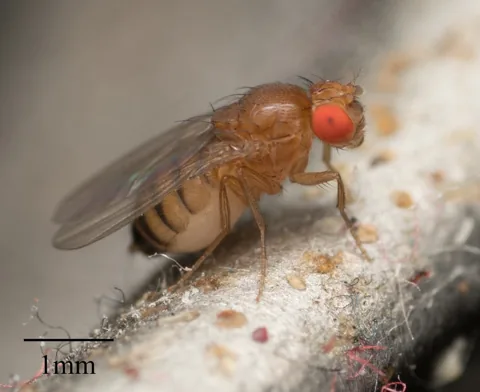 Fruit Fly
Drosophila melanogaster
Fruit flies, also called vinegar or pomace flies, are tiny flies drawn to ripe and fermenting fruits and vegetables. They can show up any time of year, but they are most common from summer into fall.
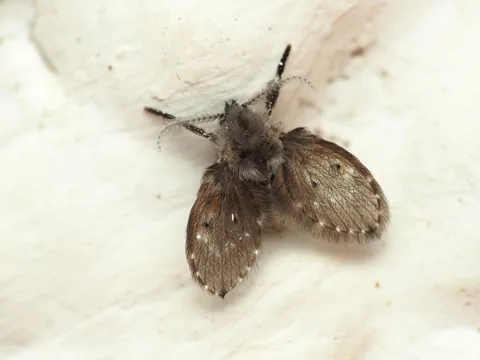 Drain Fly (Moth Fly)
Psychodidae (shown: Clogmia albipunctata)
Drain flies, also called moth flies or filter flies, are small, fuzzy, non-biting flies whose larvae live in the slimy film inside drains, toilets and other places where water stands.
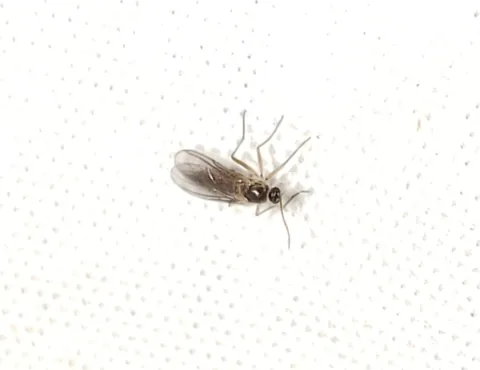 Fungus Gnat
Bradysia and related species
Fungus gnats are small flies whose larvae live in moist potting mix and organic matter. Indoors the adults emerge from houseplants and become a nuisance; they don't bite, and Colorado State calls the larvae minor pests of houseplants.
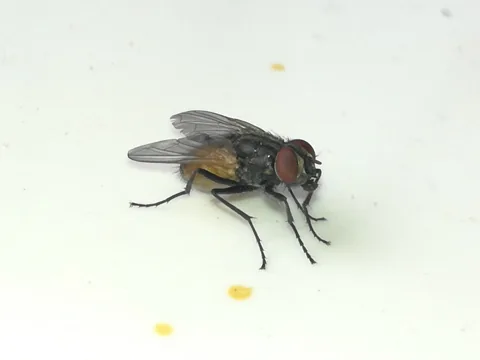 House Fly
Musca domestica
The house fly is a worldwide companion of people and domestic animals; it breeds in garbage, manure and other moist organic matter and is most numerous in hot summer months.
 Eye Gnats
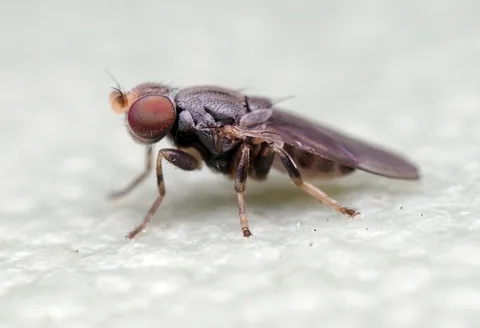
Liohippelates collusor and Hippelates species
Female eye gnats persistently feed at the eyes, nose, mouth and open wounds of people and animals, a severe nuisance near breeding sites. They swarm around the head and dart at the face, and brushing them away does little good.
 Phorid Fly
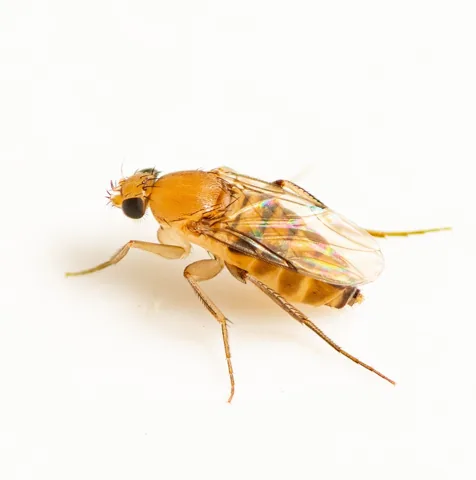
Megaselia scalaris
Phorid flies, also called humpbacked, scuttle or coffin flies, are small flies that breed in moist, decaying material. Indoors they most often come from drains and plumbing, and a hidden sewer leak can feed a large, stubborn infestation.
 Non-Biting Midges
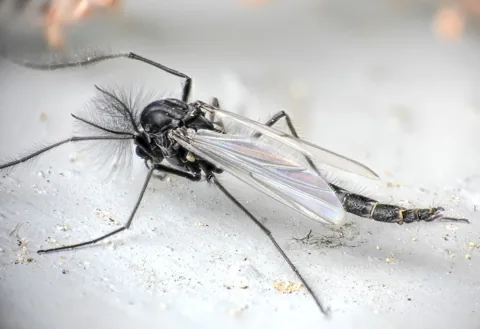
Family Chironomidae
Non-biting midges (family Chironomidae) are small, delicate flies that grow up in water and emerge in large swarms near ponds, lakes and streams. They are often mistaken for mosquitoes, but they don't bite; the problem is sheer numbers.
 African Fig Fly
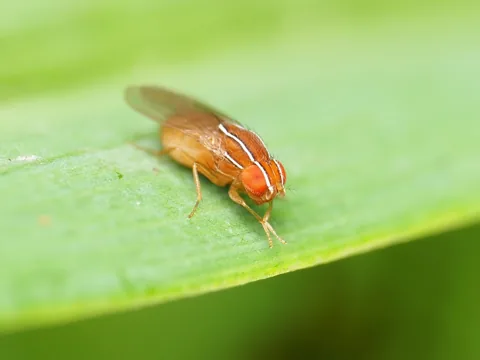
Zaprionus indianus
The African fig fly is an invasive vinegar fly that breeds in rotting and damaged fruit and can also infest some ripening crops, especially figs and caneberries. It is often found in fruit alongside spotted-wing drosophila.
No photo yet
Mushroom Phorid Fly
Megaselia halterata
The mushroom phorid fly (Megaselia halterata) is a tiny humpbacked fly whose larvae feed on the mycelium in commercial mushroom compost. It cuts mushroom yields and spreads fungal diseases on farms, and in parts of Pennsylvania, Delaware and Maryland wind-blown adults have become a nuisance in homes near mushroom farms.
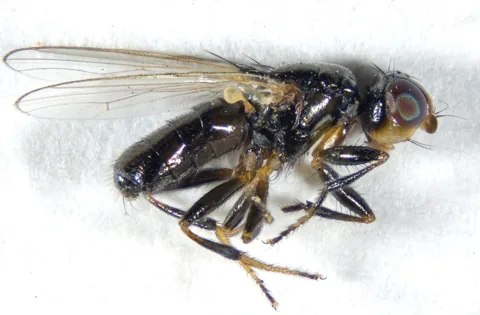 Cheese Skipper
Piophila casei
The cheese skipper (Piophila casei), also called the ham skipper, is a fly found worldwide whose larvae feed on cheese, cured meats such as ham, and other high-protein matter, including carcasses. The larvae get the name from their habit of 'skipping' from one product to another. Swallowing them by accident can cause intestinal myiasis.
No photo yet
Mushroom Sciarid Fly
Lycoriella mali
The mushroom sciarid fly is a fungus gnat (family Sciaridae) that breeds in mushroom compost and casing. Its larvae chew mycelium, destroy developing pins and burrow into the stems and caps of maturing mushrooms, and the adults carry mites, nematodes and mold spores from room to room. Is it harmful? Not to people: it does not bite, but the Pacific Northwest handbook calls it the major insect pest of mushrooms and Penn State says it has been the most devastating insect in the Pennsylvania mushroom industry at least since September 1979. Control rests on sanitation, screening, light-trap monitoring and, where needed, biological and registered products mixed into compost or casing.
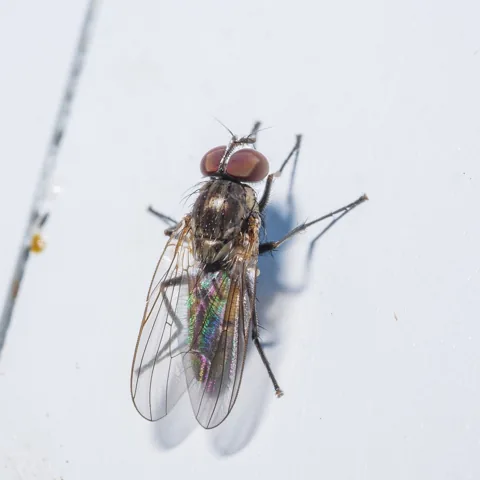 Lesser House Fly
Fannia canicularis
The lesser house fly, also called the little house fly, is a smaller relative of the house fly that breeds in manure, compost and fermenting grass clippings. Swarms of males circle at head height in shady porches and garages, so it is mainly a nuisance, and Texas A&M says it can annoy people living near poultry farms even more than the house fly does.
Which small fly is it?
Fruit flies, fungus gnats, drain flies and phorid flies are the small flies most often found indoors, and each one breeds in a different kind of moist spot. Look at how the fly is built and how it moves before you start cleaning.[3][1]
- Fruit fly: about 1/8 inch, usually red eyes, with a tan front half and a black rear. Seen on ripe fruit, around trash cans and near vinegar, beer or juice. Flies fast and erratically and can hover.[4][3][1]
- Dark-eyed fruit fly: a fruit fly with black eyes. Texas A&M says these breed more often in drains, around bathrooms and urinals, and even in rotting cacti.[1][3]
- Drain fly (moth fly): a fuzzy, moth-like fly with broad, hairy wings held like a roof over the body. It rests on walls near drains and makes short hopping flights; swatted, it disappears in a cloud of fine dust. Kentucky gives its size as 1/16 to 3/16 inch and Texas A&M as 1/16 to 1/5 inch.[3][5][1]
- Phorid fly: fruit-fly size with a humped back, a smaller head and brown eyes, not red. It tends to run across surfaces when disturbed instead of flying, and it spreads through a building rather than staying near one food source the way fruit flies do.[6][3][1]
- Fungus gnat: slender and mosquito-like, with long legs, long antennae and gray or clear wings. A weak flier that stays near potting soil, it is drawn to light and often seen at windows or flying around faces and computer screens. It does not bite.[3][1]
- Little house fly: a bit bigger at 1/8 to 3/16 inch, shaped like a slim house fly. Males look for shade indoors and may hover in rooms for long periods. It breeds in excrement and decaying matter, and Minnesota groups it with the filth flies, alongside house flies and blow flies.[7]
Where you see them points to the source
The larvae barely move, so they stay in the moist material they feed on. The room where you see the most flies, and the time of year, are your first clues.[3][1]
- Kitchen, late summer or fall: fruit flies are the likely answer. Garden tomatoes, melons, squash and grapes, and store produce such as bananas, potatoes and onions left unrefrigerated, often start it. They also breed in garbage disposals, empty bottles and cans, mops and cleaning rags.[4]
- Basement or garage: one forgotten rotting potato or onion, fruit juice spilled under a refrigerator, or a recycling bin that's never emptied or cleaned can breed thousands of fruit flies.[4]
- Bathroom, after you've been away: drain flies breed in standing water, such as the slime along the waterline of a toilet that isn't used, sink and floor drains, and refrigerator drain pans. Small infestations often fade once water moves through the traps again; flies that keep coming for several weeks mean a permanent breeding site.[5]
- Around houseplants, mostly in winter: fungus gnats come from wet potting soil. Texas A&M says these infestations are most common in winter, when overwatering is more common.[1][3]
- Scattered through the house, around floor drains or coming from a crawl space: suspect phorid flies breeding in drain buildup, under a leaking pipe, or in material under the foundation.[6][3]
- Outside, at your face: eye gnats. Swarming at porch lights near a pond or lake: non-biting midges. Both are covered below.[10][9]
Phorid (humpbacked) flies
Phorid flies are about the size of fruit flies, 1/8 inch, tan to dark brown or black, with a humped back when seen from the side. They often run erratically rather than fly.[1][2]
- Larvae develop in almost any moist, decaying material: garbage, drains, vase water, wet potting soil, broken garbage disposals, dead animals and feces. Egg to adult takes 14 to 37 days.[1]
- Large numbers can mean a sewer leak under the building; contaminated soil sometimes has to be dug out.[1]
- They're mainly a nuisance and not generally considered a health problem, though they can mechanically carry bacteria.[2]
- Colorado State says phorid flies in buildings most often breed in organic matter stuck to plumbing or trapped in pockets of it, and in water and drain waste pooling around leaking pipes.[6]
- Liquid drain products poured down the drain can rush past those pockets. Colorado State suggests products made to remove organic residue, including foaming types that expand into cavities, and says hot water or bleach is unlikely to clear the debris.[6]
- If a pipe is leaking, fix it and remove the spilled material if you can. What can't be removed keeps breeding flies until it is used up or dries out completely.[6]
- For flies coming from a crawl space or under the foundation, remove or dry out the breeding material and caulk the places where flies get into the living space.[6]
- Common places to check in a home, per Kentucky: garbage cans, standing water from leaking refrigerators or washing machines, and drain openings.[3]
Finding the breeding site
These quick tests tell you whether a drain or disposal is the source before you spend time scrubbing it. Leave each one in place overnight or for a few days.[1][4][5]
- Clean up spilled or spoiled food on floors and in pantries, and clean sink and tub drains.[1]
- Check under garbage can liners, under floor drain covers and floor mats, and under refrigerators and other appliances where debris collects; clean refrigerator and icemaker condensate pans.[1]
- Hang mops to dry, and look for cracked or loose floor or bath tiles hiding wet films.[1]
- Signs of rodents or wildlife can point to a dead animal, which breeds blow flies and phorid flies; seal entry points.[1]
- Tape test: lay clear packing tape across a drain without covering it completely, since flies may not come up without airflow. Flies stuck to the tape mean you've found a source.[1]
- Bag test: tape a clear plastic food storage bag over a drain or garbage disposal overnight. Flies breeding there will emerge and be caught in the bag.[4]
- Cup test: turn a clear plastic cup with a very light coat of vegetable oil or petroleum jelly upside down over a drain for several days. If nothing turns up, widen the search.[5]
- Sticky cards: set one just above a sink drain, sticky side toward the drain, or place several around the house and see where the most flies are caught.[6][3]
- Check outside too. Drain flies can breed in low, wet spots where air conditioners drain and in clogged gutters, then come in through doors and windows.[5]
How fast each one builds up
Short life cycles and big egg counts are why a few flies can become a swarm. The sources don't always agree on the numbers, so both figures are given where they differ.[3][1]
- Fruit flies: a female can lay about 500 eggs (Kentucky's fruit fly sheet) or over 500 (its small-fly sheet). Egg to adult takes about a week, 8 to 10 days at 77°F, or as few as 8 days under ideal conditions. Adults live about a month.[4][3][1]
- Drain flies: eggs are laid in masses of 20 to 100 (Texas A&M) or clusters of 10 to 100 (Kentucky) and hatch within 48 hours. The larval stage lasts 8 to 24 days, and the full cycle takes about 10 to 15 days at around 70°F. Texas A&M says adults may live as long as 2 weeks; Kentucky's small-fly sheet says 3 to 4 days.[1][3][5]
- Phorid flies: Texas A&M gives 14 to 37 days from egg to adult depending on conditions, Colorado State about 3 weeks at room temperature, and Kentucky about 10 days at around 93°F. Kentucky says females can lay 100 eggs at a time and adults live 1 to 2 months.[1][6][3]
- Fungus gnats: females lay 100 to 200 eggs on moist soil, the eggs hatch in about four days, and the whole cycle usually takes around a month. Adults live only 7 to 10 days.[3]
- Drain fly larvae are hard to drown: Kentucky says they trap air bubbles and can stay under water for a day or more.[5]
Traps and sprays help, but they don't end it
Insecticides alone rarely clear up an indoor fly problem. Once the breeding sites are cleaned out, Texas A&M says you shouldn't need them.[1]
- Vinegar traps are best for finding the source, checking whether your cleanup worked and thinning out adults while you search. A jar or bowl of cider vinegar with a drop of dish soap, or a jar with a paper funnel, catches fruit flies.[1][4][3]
- After the source is gone, a pyrethrin aerosol for flying insects can knock down the adults that are left. Minnesota calls this a short-term step that won't solve an ongoing problem.[4][1][7]
- Don't pour insecticides down drains for drain flies, Kentucky advises; clean the slime out of the pipes and traps instead.[5]
- For phorid flies, Colorado State says no insecticide use helps, because the adults in the room are only the part of the population that has wandered away from the breeding site.[6]
- Indoor light traps catch house flies best but also take some small flies. Texas A&M says outdoor high-voltage bug zappers shouldn't be used indoors, since they scatter insect fragments.[1]
- For fungus gnats, sticky traps and houseplant sprays are temporary unless the wet soil they breed in is dealt with.[3]
Small flies outdoors: eye gnats and midges
Eye gnats are small flies, 1/16 to 1/8 inch long, with shiny black or gray bodies. They don't bite or pierce the skin, but they crawl over people and animals and feed at the eyes, nose, mouth and open wounds; UC IPM calls them severe nuisance pests that potentially transmit disease. They breed in moist, well-drained sandy soils with plenty of organic matter.[10]
Eye gnats are weak fliers, but UC IPM says wind can carry them several miles from where they breed. Clemson notes that an 18 x 16 mesh screen is usually enough to keep them off a porch, and a fan helps because air movement blows them off course.[10][8]
Clouds of mosquito-like flies near ponds, lakes and slow streams that don't bite are usually midges. They are drawn to light and collect on window screens and porch lights. Clemson says about 90% of their activity happens in the first 45 minutes after sundown, so keeping lights off then helps.[9]
Which guide to read next
- Still unsure which gnat you have? Some outdoor gnats, the no-see-ums, are biting midges rather than nuisance flies. The gnat identification guide compares every kind side by side.[8]
- Fruit flies or drain flies confirmed: both end when the breeding material is gone, ripe produce and trash for one and the slime film in pipes and traps for the other. The fruit fly and drain fly guide covers each step.[4][5]
- Gnats coming from houseplants: the larvae live in wet potting soil, so the fix is in the pot. The fungus gnat guide covers watering, repotting and soil treatments.[3][1]
- Bigger flies, 1/4 inch and up, at windows or in the kitchen: see the house fly and types-of-flies guides. Texas A&M notes house flies rarely breed indoors and usually come in through open doors or poor screens.[1]
Common questions
- How do I know if flies are coming from my drain?
- Lay clear packing tape across part of the drain opening, leaving some airflow, and check it over a day or two; flies stuck to the tape confirm the drain is a breeding site.[1]
- Why doesn't pouring bleach down the drain stop drain flies?
- Bleach and drain cleaners don't remove the bacterial film inside the pipes where the larvae live; scrub pipes and traps with a stiff brush.[1]
- What are the tiny humpbacked flies running on my counter?
- Likely phorid flies, which breed in moist decaying matter such as trash, drains and plumbing or sewer leaks.[2][1]
- Are small flies in the house harmful?
- They don't bite. Kentucky says small flies don't transmit diseases themselves, but they can carry bacteria onto food, which is why restaurants and hospitals treat them as a sanitation problem.[3][1]
- Why did I find drain flies after coming home from vacation?
- Drain flies breed in standing water, such as slime in an unused toilet or a drain trap. Kentucky says these small infestations usually go away once water moves through the pipes again; flies that persist for weeks point to a permanent source.[5]
- Will a vinegar trap get rid of fruit flies?
- Not on its own. Traps catch adults and help show where they're coming from, but the flies keep coming until you find and remove what they're breeding in.[1][4]
- Can I cut the bad spot off fruit with fruit flies on it?
- Yes. Kentucky says fruit fly larvae feed near the surface, so damaged or overripe parts can be cut away and discarded without throwing out the rest.[4]
Photo credits
- Fruit Fly: Jesse Rorabaugh, public domain (CC0), via iNaturalist
- Drain Fly (Moth Fly): (c) Katja Schulz, some rights reserved (CC BY) — via iNaturalist, CC BY 4.0
- Fungus Gnat: (c) aispinsects, some rights reserved (CC BY) — via iNaturalist, CC BY 4.0
- House Fly: ivan_humljani, public domain (CC0), via iNaturalist
- Eye Gnats: (c) Tom, some rights reserved (CC BY) — via iNaturalist, CC BY 4.0
- Phorid Fly: (c) Justin Williams, some rights reserved (CC BY) — via iNaturalist, CC BY 4.0
- Non-Biting Midges: (c) Robert Roach, some rights reserved (CC BY) — via iNaturalist, CC BY 4.0
- African Fig Fly: (c) Katja Schulz, some rights reserved (CC BY) — via iNaturalist, CC BY 4.0
- Cheese Skipper: (c) Andrew Meeds, some rights reserved (CC BY) — via iNaturalist, CC BY 4.0
- Lesser House Fly: (c) Dustin Edmundson, some rights reserved (CC BY) — via iNaturalist, CC BY 4.0
Sources
- Texas A&M AgriLife Extension, “ENTO-050: Indoor Flies and Their Control.” agrilifeextension.tamu.edu/library/insects/indoor-flies-and-their-control/ (accessed 2026-10-06)
- University of Minnesota Extension, “Humpbacked Flies (Phorid Flies).” apps.extension.umn.edu/garden/diagnose/insect/indoor/flies/small/humpbacked-flies.html (accessed 2026-10-06)
- University of Kentucky Entomology, “ENTFACT-657: Small Flies.” entomology.mgcafe.uky.edu/ef657 (accessed 2026-11-10)
- University of Kentucky Entomology, “ENTFACT-621: Fruit Flies.” entomology.mgcafe.uky.edu/ef621 (accessed 2026-11-10)
- University of Kentucky Entomology, “ENTFACT-615: Drain Flies or Moth Flies.” entomology.mgcafe.uky.edu/ef615 (accessed 2026-11-10)
- Colorado State University, Department of Agricultural Biology, “Phorid Fly/Drain Fly (Colorado Insect of Interest).” webdoc.agsci.colostate.edu/bspm/arthropodsofcolorado/Phorid-Flies.pdf (accessed 2026-11-10)
- University of Minnesota Extension, “Flies.” extension.umn.edu/garden-and-home/home-maintenance/household-insects/flies (accessed 2026-11-10)
- Clemson Cooperative Extension Home & Garden Information Center, “Gnats, HGIC 2489 (J. Ballew, 2018).” hgic.clemson.edu/factsheet/gnats/ (accessed 2026-11-10)
- Clemson Cooperative Extension Home & Garden Information Center, “Midges, HGIC 2433.” hgic.clemson.edu/factsheet/midges/ (accessed 2026-11-10)
- UC Statewide IPM Program, “Eye Gnats, Pest Notes (J. A. Bethke).” ipm.ucanr.edu/home-and-landscape/eye-gnats/ (accessed 2026-11-10)