On this page
How to identify it
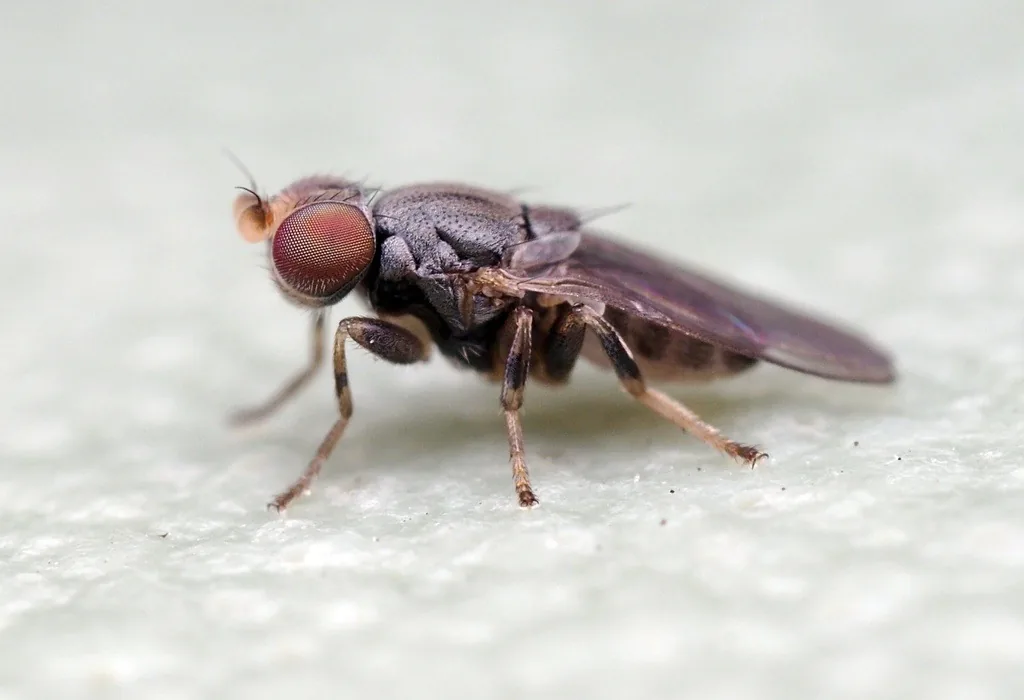
- Eye gnats are small flies, 1/16 to 1/8 inch (about 1.5 to 2.5 mm for the common California species), with shiny black or gray bodies, yellow to orange-brown legs and wings without colored spots.[1][2]
- Their persistent attraction to eyes and wounds sets them apart from other small flies.[1]
- Only females go for faces. Males do not feed on eye secretions and are rarely seen, while females have curved spurs on their hind legs that scrape the skin to increase the flow of secretions.[1]
Look-alikes
| Look-alike | How to tell them apart |
|---|---|
| Fungus gnats | Fungus gnats aren't attracted to eyes the way eye gnats are.[1] |
| Biting midges (no-see-ums) | Midges can bite and draw blood; eye gnats can't make wounds.[1] |
| Black flies | Black flies bite; eye gnats only sponge up secretions.[1] |
Where it lives
Liohippelates collusor is the most abundant species in California and also occurs in parts of the Southwest, northern Mexico and other warm regions; the Coachella Valley vector control district calls eye gnats prevalent in the southern United States, mainly parts of California and Arizona. A related eye gnat, Hippelates pusio, has been tied to outbreaks in the Southeast. GBIF holds only about 25 U.S. records of L. collusor since 1990, most of them from Hawaii.[1][2][3][4]
Biology and life cycle
They breed in moist, well-drained sandy soil rich in organic matter, especially freshly plowed ground with cover crops or manure worked in, and the wind can carry them miles from breeding sites.[1][2]
Females begin laying eggs within 5 to 8 days after hatching, putting batches of up to 50 tiny white eggs into freshly turned soil and 200 to 400 eggs over 2 to 3 days. The larvae feed on decaying organic matter and roots.[1][2]
Timing differs a little by source: UC IPM gives 2 to 4 days to hatch, 5 to 20 days as larvae and 5 to 10 as pupae, while the Coachella Valley district gives about 7 to 12 days as larvae and 6 to 7 as pupae, about 21 days from egg to adult. Both put a full generation at about 28 days.[1][2]
Activity and breeding peak between 70 and 90 degrees F, and cooler weather slows them; in warm, dry regions they can be around all year.[1]
Damage and signs
- Swarms can discourage outdoor recreation near farms, schools, parks and golf courses, and can cut tourism and worker productivity.[1][2]
- Tilling plant waste into fields before replanting has made them worse, and in California's Coachella Valley the problem was serious enough to prompt the formation of a mosquito abatement district in 1928.[1][2]
Health risk
Eye gnats and their relatives feed on wounds, scabs, eyes and other mucous membranes, and medical entomologists regard eye gnats and eye flies as potential mechanical carriers of disease organisms.[5][3]
Control
Prevention
Turn less fresh organic matter into soil and flowerbeds, remove leaf litter, weeds, grass clippings and spent flowers before they decay, and cut back irrigation to keep the soil surface dry, which reduces egg laying and larval survival.[1][2]
Keep them out
Screen fences about 8 feet high kept out more than 90 percent of eye gnats in research, since they fly low.[1]
Traps and physical control
Egg-baited bottle traps give some relief when combined with repellents. UC IPM suggests hanging them 2 to 3 feet off the ground away from doors and patios, painting the lower part flat black, and replacing the bait at least every 14 days. The Coachella Valley district has run 8,000 to 10,000 such egg-bait traps a year since 1990.[1][2]
Pesticides
For temporary relief, repellents with DEET or picaridin help. Insecticides are rarely if ever warranted around homes, larval soil treatments don't work, and in farm settings chemical control has been hampered by resistance; if numbers are very high, call your local vector control district.[1]
Eye gnats and pinkeye
Medical reports link eye gnats to seasonal bacterial conjunctivitis (pinkeye). An outbreak among grade-school children in southeast Georgia in late summer 1981 matched earlier 'gnat sore eyes' outbreaks in the South, and the report noted, as earlier studies had suggested, that the eye gnat Hippelates pusio may carry the suspected bacterium, possibly a Haemophilus species, mechanically.[3]
In Brazil, researchers isolated Haemophilus aegyptius, the conjunctivitis bacterium associated with Brazilian purpuric fever, from eye gnats (Liohippelates and Hippelates) collected around the eyes of children with conjunctivitis, the first such isolation from the flies in the wild.[6]
More from the research literature
A 2006 laboratory study in the Journal of Vector Ecology found thiamethoxam the most toxic of the products tested on adult eye gnats, followed by imidacloprid and spinosad, and gnats died at significantly higher rates when the same insecticide was offered in a 5% sugar solution than in plain water. Spinosad and imidacloprid were toxic when eaten but had low contact activity.[7]
UC IPM, for its part, names pyrethrins or spinosad as the options research has shown effective against adults if an insecticide is used at all, applied to turf and flowerbeds where the gnats rest.[1]
Common questions
- Why do tiny flies keep going for my eyes?
- They're likely eye gnats; females feed on eye secretions and are very persistent.[1]
- Do eye gnats bite?
- No; they can't pierce skin, but they soak up secretions with sponge-like mouthparts.[1]
- Can eye gnats give you pinkeye?
- They are suspected of spreading it mechanically. Investigators of a 1981 school outbreak of bacterial pinkeye in Georgia pointed to eye gnats as a possible carrier, and in Brazil a conjunctivitis bacterium was isolated from eye gnats caught around children's eyes.[3][6]
- How do I make an eye gnat trap?
- UC IPM's version uses a 2-liter bottle with three or four holes in the upper third, filled a quarter to a third with water mixed with cracked eggs, hung 2 to 3 feet up away from doors. Refresh the bait at least every 14 days.[1]
Sources
- University of California Statewide IPM Program, “Eye Gnats (Pest Notes).” ipm.ucanr.edu/home-and-landscape/eye-gnats/ (accessed 2026-11-11)
- Coachella Valley Mosquito and Vector Control District (California public agency), “Eye Gnats.” www.cvmosquito.org/eye-gnats (accessed 2026-11-11)
- Southern Medical Journal, via PubMed, “Gnat sore eyes: seasonal, acute conjunctivitis in a southern state (Buehler et al. 1983).” pubmed.ncbi.nlm.nih.gov/6844965/ (accessed 2026-11-11)
- Global Biodiversity Information Facility (GBIF), “Liohippelates collusor: U.S. occurrence records since 1990 by state (GBIF occurrence search).” api.gbif.org/v1/occurrence/search?taxonKey=1492493&country=US&hasGeospatialIssue=false&occurrenceStatus=PRESENT&year=1990%2C2026&facet=stateProvince&facetLimit=400&limit=0 (accessed 2026-11-11). Exact count at access: 25 U.S. records since 1990 (Hawaii 24; California 1).
- Journal of Vector Ecology, via PubMed, “Pestiferous nature, resting sites, aggregation, and host-seeking behavior of the eye fly Siphunculina funicola in Thailand (Mulla and Chansang 2007).” pubmed.ncbi.nlm.nih.gov/18260520/ (accessed 2026-11-11)
- Revista do Instituto de Medicina Tropical de Sao Paulo, via PubMed, “Isolation of Haemophilus aegyptius associated with Brazilian purpuric fever from Chloropidae of the genera Hippelates and Liohippelates (Tondella et al. 1994; in Portuguese, English abstract).” pubmed.ncbi.nlm.nih.gov/7997783/ (accessed 2026-11-11)
- Peer-reviewed literature (PubMed), “Susceptibility of the adult eye gnat Liohippelates collusor (Diptera: Chloropidae) to neonicotinoids and spinosad insecticides (Jiang Y et al., Journal of vector ecology : journal of the Society for Vector Ecology, 2006).” pubmed.ncbi.nlm.nih.gov/16859091/ (accessed 2026-11-11)
- iNaturalist, “Liohippelates collusor taxon page (order and family).” www.inaturalist.org/taxa/1628486 (accessed 2026-10-06)