On this page
How to identify it
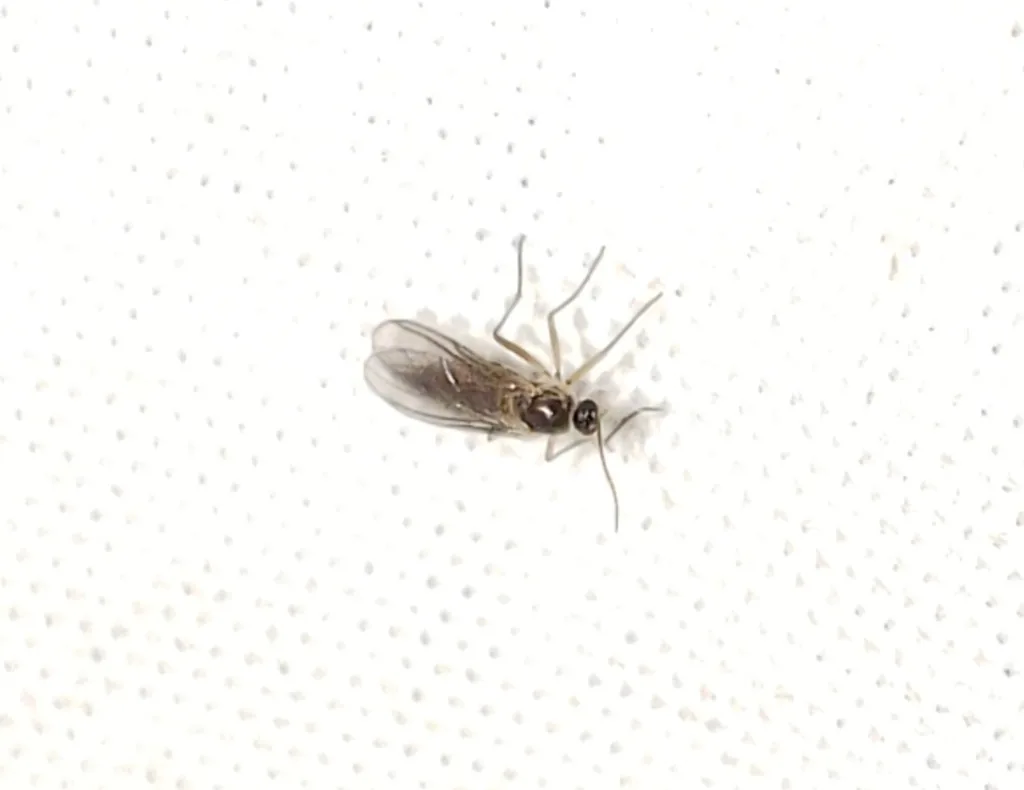
- Adults are dark, delicate, mosquito-like flies with long legs and antennae longer than the head. UC IPM and Minnesota put them at about 1/16 to 1/8 inch; Kentucky and Colorado State say about 1/8 inch (Kentucky: 3 to 4 mm).[1][5][2][4]
- Wings are light gray to clear, and the common Bradysia species have a Y-shaped wing vein.[1][4]
- Larvae have a shiny black head and a whitish to clear, legless body, and mostly live in the top 2 to 3 inches of the growing medium.[1][4][6]
- Adults are weak fliers that stay near pots and run across the soil; they are drawn to light and often collect at windows. Kentucky says people usually report them flying around faces and computer screens.[1][2][4]
Look-alikes
Where it lives
Lives in moist potting mix, compost, mulch and other decaying organic matter; indoors, houseplants are the usual source, often brought in from outdoors.[1][2]
Biology and life cycle
Females lay up to 200 eggs in moist soil or in cracks in the growing medium; Kentucky gives 100 to 200. Mixes high in peat are especially attractive.[4][2][5]
Sources give different life cycle lengths. UC IPM says at 75°F eggs hatch in about 3 days, larvae feed for about 10 days, adults emerge about 4 days after that, and a generation can take about 17 days. Colorado State says egg to adult takes three to four weeks at 65 to 75°F, and Kentucky says around a month.[1][4][2]
Adults live only about 7 to 10 days, but generations overlap and breeding goes on year-round indoors.[2][4][1]
Larvae feed on fungi, algae, decaying plant matter and organic mulch, and also on root hairs and tender plant tissue.[1][4][2]
Colorado State says the gnats are most noticeable in late fall and winter. Plants kept outdoors in summer pick them up, and as days shorten, plants use less water, so soil watered on the summer schedule stays wet.[4]
Damage and signs
- Sources weigh the damage differently. UC IPM says large numbers of larvae can damage roots and stunt seedlings and young plants, though overwatering and root rot are more common causes of wilting; Kentucky says larvae can damage small roots; Minnesota says they rarely, if ever, damage indoor plants.[1][6][5]
- In very moist pots, larvae can leave shiny slime trails on the soil surface.[1]
Health risk
Adult fungus gnats don't bite people and are a nuisance only.[1][2][4]
Control
Prevention
Avoid overwatering, let the top 1 to 2 inches of soil dry between waterings, improve drainage, and use pasteurized potting mix; don't use incompletely composted material in pots.[1][4][2]
Repot when the mix has broken down and holds too much water, and throw out pots with decaying bulbs or roots.[4][5]
Traps and physical control
To check for larvae, set raw potato chunks or 1/4-inch slices on or into the soil and look underneath after a few days; UC IPM says replacing them also pulls some larvae away from roots.[1][4][5]
Yellow sticky cards catch adults. Colorado State says mass-trapping females may cut the next generation, while Minnesota says traps mainly detect adults and shouldn't be the only method.[1][4][5]
Biological control
Bti (Bacillus thuringiensis subsp. israelensis) kills fungus gnat larvae in the soil but not adults. The EPA says its toxins affect only the larvae of mosquitoes, black flies and fungus gnats. It doesn't persist indoors, so UC IPM says to repeat it about every five days.[1][5][7]
Sources disagree on how easy Bti is to buy: UC IPM says products are readily available at retail nurseries, Colorado State says fungus gnat formulations generally aren't sold at retail, and Minnesota says they are available mainly online.[1][4][5]
Steinernema feltiae nematodes, applied as a soil drench, are the most effective nematode against fungus gnat larvae; Colorado State says infected larvae die within three to four days. UC IPM says Hypoaspis predatory mites probably aren't a good choice for houseplants.[1][4]
Pesticides
UC IPM says insecticides are rarely warranted around the home. Colorado State says they may be needed if gnats persist several weeks after watering changes, applied to the soil surface, and notes that sprays aimed at adults don't reach the larvae. Use only products labeled for houseplants.[1][4]
Colorado State says imidacloprid applied to the soil also kills larvae. Minnesota warns that it is toxic to bees, so don't use it on bee-attractive plants that go outside in summer.[4][5]
Common questions
- Why do I have gnats around my houseplants?
- They breed in moist potting soil and organic debris; letting the soil surface dry between waterings is the key fix.[1][2][4]
- Does Bti kill fungus gnats?
- Yes, it targets larvae in the soil, but it doesn't kill adults or persist indoors, so reapply about every five days.[1][5]
- Will sticky traps get rid of fungus gnats?
- Not by themselves. They catch adults and show how many you have, but the larvae keep developing in wet soil until watering changes.[5][4][2]
Sources
- University of California Statewide IPM Program, “Pest Notes: Fungus Gnats, Publication 7448 (August 2013).” ipm.ucanr.edu/legacy_assets/PDF/PESTNOTES/pnfungusgnats.pdf (accessed 2026-11-11)
- University of Kentucky Entomology, “ENTFACT-657: Small Flies.” entomology.mgcafe.uky.edu/ef657 (accessed 2026-11-11)
- iNaturalist, “Bradysia taxon page (order and family).” www.inaturalist.org/taxa/248001 (accessed 2026-11-11)
- Colorado State University Extension, “Fungus Gnats as Houseplant and Indoor Pests.” extension.colostate.edu/topic-areas/insects/fungus-gnats-as-houseplant-and-indoor-pests-5-584/ (accessed 2026-11-11)
- University of Minnesota Extension, “Managing insects on indoor plants.” extension.umn.edu/product-and-houseplant-pests/insects-indoor-plants (accessed 2026-11-11)
- University of Kentucky Entomology, “ENTFACT-406: Houseplant Insect Control.” entomology.mgcafe.uky.edu/ef406 (accessed 2026-11-11)
- U.S. Environmental Protection Agency, “Bti for Mosquito Control (last updated June 2, 2026).” www.epa.gov/mosquitocontrol/bti-mosquito-control (accessed 2026-11-11)