On this page
How to identify it
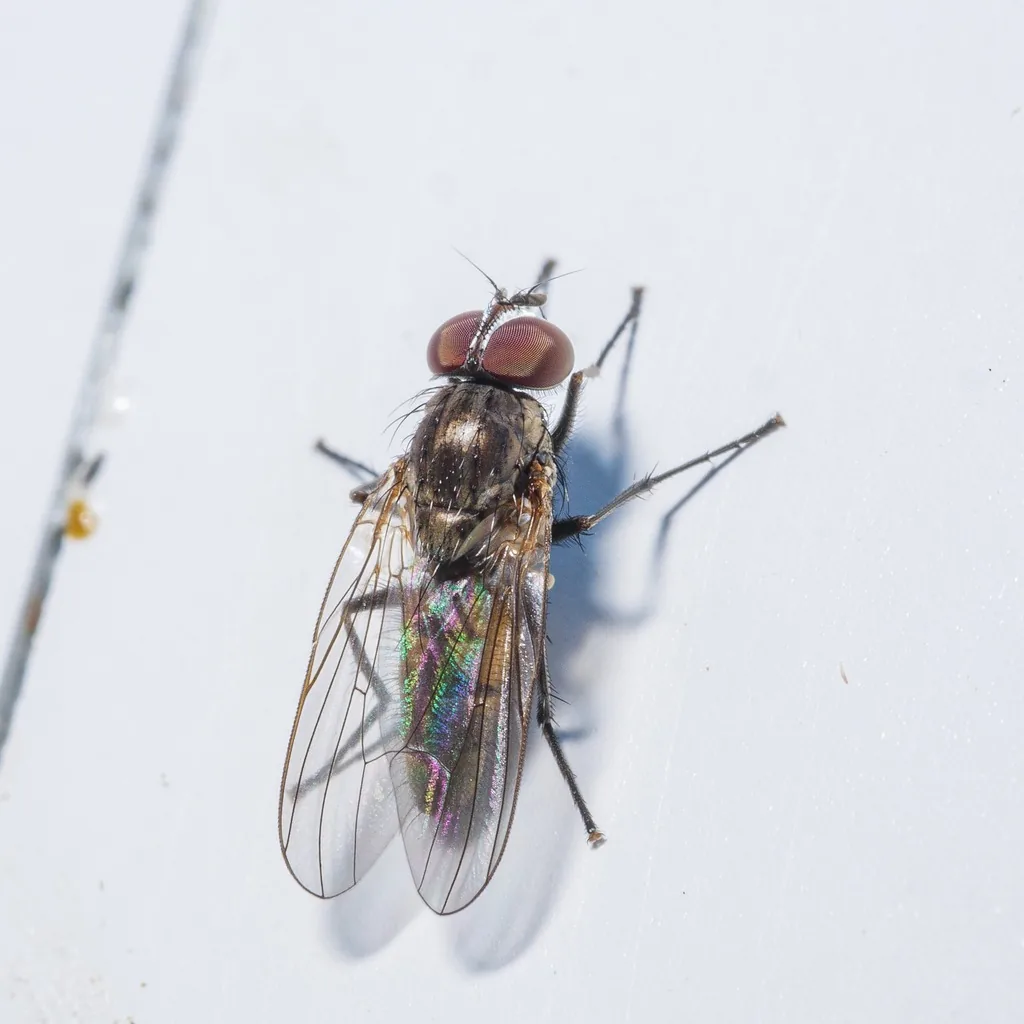
- Sources give slightly different sizes: UC Riverside says 5 to 6 mm long, Texas A&M about 3/16 inch, and Minnesota 1/8 to 3/16 inch. UC IPM puts it at about two-thirds the size of a house fly. The Coachella Valley Mosquito and Vector Control District describes adults as black or dull gray.[2][6][5][1][3]
- The gray thorax has three faint lengthwise stripes, while the house fly has four distinct dark stripes. Penn State adds a distinct yellow patch on each side at the base of the abdomen.[2][1][7]
- It is a narrow, slender fly that rests with its wings overlapping straight back over the body instead of in the house fly's V shape.[1][2][5]
- Males have larger eyes that nearly meet on top of the head and a longer, yellowish abdomen than females.[2]
- Its larvae look different from house fly maggots: brown, flattened and covered in fleshy spines, which Penn State describes as a 'hairy' look.[1][7]
Look-alikes
| Look-alike | How to tell them apart |
|---|---|
| House fly | Larger, with four dark stripes on the thorax, wings held in a V, and a sharp bend in a wing vein near the tip that the lesser house fly lacks. Texas A&M says house flies prefer sunlight and crawl over filth, people and food, while the lesser house fly prefers shade and is less likely to crawl on people and food.[2][1][6] |
| Canyon flies | Other Fannia flies of California hill and canyon areas, which UC IPM says are only distantly related to the little house fly. They are about the same size but have a three-spotted abdomen and yellow at the base of the antennae, and they persistently try to land on faces.[1] |
Where it lives
A common fly around poultry farms and homes; in California and the arid Southwest it is most numerous in the cool spring and fall months and declines in summer heat.[2][1][3]
Biology and life cycle
Females lay eggs in poultry manure and other animal waste, including dog, pig and rabbit droppings, and in compost, fermenting grass clippings, damp feed and food residue in garbage cans. Texas A&M says it chooses poultry manure over most other materials.[3][1][6]
Sources describe its moisture needs differently. UC IPM says the larvae tolerate a wide range of moisture, which makes the fly hard to control; Texas A&M says it prefers a drier breeding medium than the house fly; and UC Riverside says it develops in poultry manure above 40% moisture, with drier manure producing few or no flies.[1][6][2]
Estimates of development time vary: 2 to 4 weeks from egg to adult (Coachella Valley district), four weeks or less (Minnesota), or about two weeks in warm weather (Penn State). UC IPM says it develops somewhat more slowly than the house fly at every temperature.[3][5][7][1]
In a 2019 laboratory study, larvae failed to hatch at 33°C (about 91°F), while the fly still completed its development at 10°C (50°F).[12]
Males form mating swarms about 5 to 6 feet off the ground in still, shaded spots such as breezeways, porches, doorways and open garages, waiting for females.[1][2][6]
Flies travel from where they breed. Texas A&M says little house flies can move up to 20 miles but normally go no more than a mile or two, and Minnesota says they can be a nuisance up to two miles from the breeding site.[6][5]
Damage and signs
- Swarming males rarely land on people but circle constantly at face height, which can keep people from using patios and entryways. They move aside when approached.[2][1]
- Flies spreading from poultry operations to nearby homes have led to nuisance citations and lawsuits.[2]
- Minnesota says males also look for shade indoors, where they may hover in rooms for long periods; UC IPM says they are more reluctant to enter homes than house flies.[5][1]
Health risk
In a study of flies collected at California dairies and poultry ranches, Salmonella was found only in house flies; the little house flies tested (5.5% of 2,686 flies) were negative. The fly has carried exotic Newcastle disease virus, a poultry disease, near infected backyard flocks in California. Human myiasis (fly larvae living in the body) appears in medical case reports, such as a 1999 urinary case in Algeria where the authors tie urogenital myiasis to poor hygiene.[8][9][11]
Control
Sanitation
Find and remove breeding material: manure, piles of fermenting grass clippings and wet organic debris should be removed, spread thin to dry, or properly hot-composted with turning.[1][2]
Keep garbage cans clean of food residue and store animal feed dry.[3]
Around poultry, UC Riverside says the key step is drying manure fast: for example, spread it on soil less than 1 to 2 inches deep, fix leaking waterers, and keep dried manure from getting wet again.[2]
Traps and physical control
Strong fans where males swarm make the spot less attractive, because moving air breaks up the swarms.[1]
A 2015 field study caught significantly more little house flies in traps baited with acetic acid plus ethanol than with either chemical alone, a combination the authors suggest for monitoring or removal.[10]
Pesticides
UC IPM says lesser house flies aren't attracted to the baits and traps that collect house flies, and Texas A&M says commercial-bait jug traps won't catch them. UC Riverside describes molasses-baited traps used at poultry houses but says they aren't enough as the main method.[1][6][2]
At poultry facilities, UC Riverside warns that insecticides sprayed on manure kill the predatory beetles and parasitic wasps that hold fly numbers down, and that relying only on insecticides can lead to resistance.[2]
Why it seems worse in spring and fall
This fly does poorly in high daytime heat, so numbers drop in summer unless breeding sites are shaded or protected.[1][2]
In Southern California it is common into June, falls off from July, and can build up again in fall.[3]
As temperatures fall, adults look for shelter in buildings or dense plants.[1]
Common questions
- Why do small flies hover in circles under my porch roof?
- These are often male lesser house flies forming mating swarms in still, shaded air about 5 to 6 feet up. They move aside when approached and rarely land on people.[1][2]
- Do fly baits work on lesser house flies?
- Not well. They aren't drawn to the baits and traps that catch house flies, so removing manure, compost and grass clipping piles nearby works better.[1][6]
- How far can they travel from a poultry farm?
- Usually a mile or two, according to Texas A&M, though they can go up to 20 miles. Minnesota says they can be a nuisance up to two miles from where they breed.[6][5]
Sources
- University of California Statewide IPM Program, “Pest Notes: Flies (UC ANR Publication 7457), web edition.” ipm.ucanr.edu/home-and-landscape/flies/ (accessed 2026-11-11)
- Veterinary Entomology, University of California, Riverside, “Little House Fly (Fannia canicularis L.).” veterinaryentomology.org/little-house-fly (accessed 2026-11-11)
- Coachella Valley Mosquito and Vector Control District, “Little House Flies (Fannia canicularis).” cvmvcd.specialdistrict.org/little-house-flies-fannia-canicularis (accessed 2026-11-11)
- iNaturalist, “Fannia canicularis taxon page (order and family).” www.inaturalist.org/taxa/121213 (accessed 2026-11-11)
- University of Minnesota Extension, “Flies.” extension.umn.edu/garden-and-home/home-maintenance/household-insects/flies (accessed 2026-11-11)
- Texas A&M AgriLife Extension, Department of Entomology, “Poultry Pest Management.” extensionentomology.tamu.edu/resources/management-guides/poultry-pest-management (accessed 2026-11-11)
- Penn State Extension, “Filth Fly Control on Horse Farms.” extension.psu.edu/filth-fly-control-on-horse-farms (accessed 2026-11-11)
- Journal of Vector Ecology, via PubMed, “Mian LS, Maag H, Tacal JV (2002), Isolation of Salmonella from muscoid flies at commercial animal establishments in San Bernardino County, California, Journal of Vector Ecology 27(1):82-85.” pubmed.ncbi.nlm.nih.gov/12125877/ (accessed 2026-11-11). Cited from the PubMed abstract.
- Journal of Medical Entomology, via PubMed, “Chakrabarti S, King DJ, Afonso C, Swayne D, Cardona CJ, Kuney DR, Gerry AC (2007), Detection and isolation of exotic Newcastle disease virus from field-collected flies, Journal of Medical Entomology 44(5):840-844.” pubmed.ncbi.nlm.nih.gov/17915517/ (accessed 2026-11-11). Cited from the PubMed abstract.
- Environmental Entomology, via PubMed, “Landolt PJ, Cha DH, Zack RS (2015), Synergistic trap response of the false stable fly and little house fly (Diptera: Muscidae) to acetic acid and ethanol, Environmental Entomology 44(5):1441-1448.” pubmed.ncbi.nlm.nih.gov/26314021/ (accessed 2026-11-11). Cited from the PubMed abstract.
- La Presse Medicale, via PubMed, “Human urinary myiasis caused by Fannia canicularis (Diptera, Muscidae) larvae in Algeria (1999), La Presse Medicale 28(11):580-581 (article in French; English abstract).” pubmed.ncbi.nlm.nih.gov/10214378/ (accessed 2026-11-11). Cited from the PubMed abstract.
- Forensic Science International, via PubMed, “Thermal requirements for the development of immature stages of Fannia canicularis (Linnaeus) (Diptera: Fanniidae) (2019), Forensic Science International 297:16-26.” pubmed.ncbi.nlm.nih.gov/30802645/ (accessed 2026-11-11). Cited from the PubMed abstract.