On this page
How to identify it
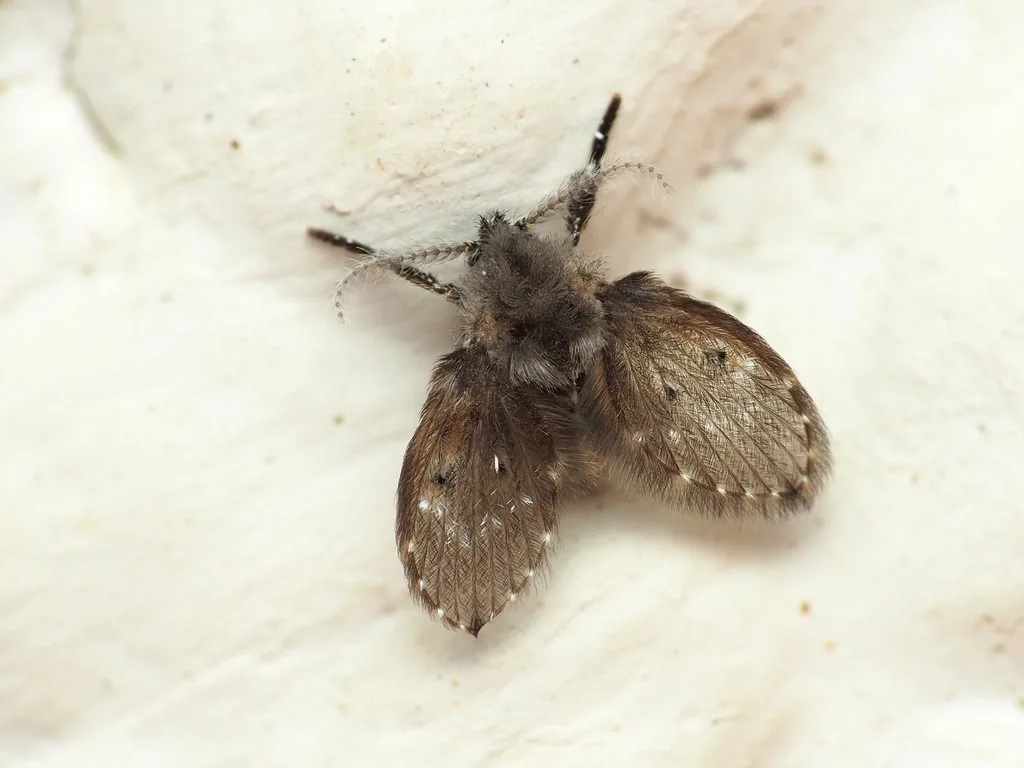
- Adults are about 1/16 to 3/16 inch long and dark, with bodies and broad, leaf-shaped wings covered in fine hairs, giving a fuzzy, moth-like look.[2][3]
- At rest the wings are held roof-like over the body; they sit on walls near drains and make short, hopping flights.[1][2][3]
- When swatted or mashed, they disappear in a cloud of fine dust from their wing scales.[1]
- Larvae are small, slender and gray and can sometimes be seen wriggling in the water film.[1][3]
Look-alikes
| Look-alike | How to tell them apart |
|---|---|
| Fruit fly | Tan with red eyes, not fuzzy, and breeds in fermenting food.[4][2] |
| Fungus gnat | Slender, dark and mosquito-like, staying near moist potting soil.[2] |
| Phorid fly | Humpbacked and runs rapidly over surfaces when disturbed; breeds in decaying matter, leaking sewage and even dead animals.[2] |
Where it lives
Indoors they breed in sink, shower, tub and floor drains, little-used toilets, and refrigerator drain pans; outdoors in low wet spots such as air conditioner drainage and clogged gutters. They can also signal a broken sewer line.[1][3]
Biology and life cycle
Females lay clusters of 10 to 100 eggs on gelatinous organic films; eggs hatch in about 48 hours at around 70°F.[2][1]
The life cycle takes about 10 to 15 days at 70°F and can continue year round indoors.[1]
Larvae feed on decaying organic matter, bacteria, algae and fungi in the water film, and can trap air bubbles to survive submerged for a day or more.[2][1]
The larval stages last 8 to 24 days depending on temperature. Adults emerge 20 to 48 hours after pupation and live 3 to 4 days, feeding on nectar and fluids from decaying material.[2]
Damage and signs
- Few flies after a trip usually means a temporary problem that ends once water flows normally again; many flies over several weeks means a persistent breeding site.[1]
Health risk
Drain flies don't bite. Extension sources differ on disease: Kentucky says they don't transmit diseases but could spread bacteria from drains, while Minnesota says they could potentially carry diseases because they live in filth. In the medical literature, the drain fly Clogmia albipunctata is described as a potential carrier of pathogens and a rare cause of myiasis, including intestinal myiasis from accidentally swallowing larvae, and a sewage plant worker developed occupational asthma from sewer flies (Psychoda alternata).[2][3][9][8][7]
Control
Prevention
If adults don't seem to be emerging indoors, check outside for low, wet spots where air conditioners drain and for clogged gutters, and correct them.[1]
Sanitation
Scrub the slime out of drains and traps with a stiff brush; an enzyme or biological drain cleaner helps break down the film.[1][2][3]
Don't pour insecticides down drains. Sources differ on hot water: Minnesota Extension says hot or boiling water, bleach and chemical drain cleaners aren't effective, while Kentucky Extension says hot water may give short-term control and suggests flushing with hot water after brushing the film out and using an enzyme cleaner, baking soda or vinegar.[3][1][2]
Traps and physical control
Find the source: tape (sticky side down) or an inverted clear cup lightly coated with oil or petroleum jelly over a drain for a few days will catch emerging adults.[1][3]
Pesticides
The few adults from a small, temporary infestation can be killed with a swatter or a flying insect spray; pesticides are usually unnecessary once the breeding source is found and removed, and any product used must follow its label.[1][2]
When to call a professional
If flies persist with no source in drains, suspect a sewer line break under the floor; confirming it may require opening the floor or slab.[3]
Telling small indoor flies apart
Fruit flies: tan with red eyes, around ripe or fermenting food, trash and recycling. Fix: remove the fermenting source.[2][4]
Fungus gnats: slender, dark and mosquito-like, near houseplants. Fix: let potting soil dry and remove organic debris.[2][5]
Drain flies: fuzzy, moth-like, on bathroom and kitchen walls. Fix: scrub out drain slime.[2][1]
Phorid flies: humpbacked, run before flying, around garbage, drains and decaying matter. Fix: find the decaying source, which can be hidden.[2]
Common questions
- Will bleach get rid of drain flies?
- No. Bleach, boiling water and chemical drain cleaners aren't effective; scrubbing out the slime layer is.[3]
- Why do drain flies show up after vacation?
- They develop in standing water in little-used drains and toilets; normal water use usually ends a small infestation.[1]
Sources
- University of Kentucky Entomology, “ENTFACT-615: Drain Flies or Moth Flies.” entomology.mgcafe.uky.edu/ef615 (accessed 2026-11-12)
- University of Kentucky Entomology, “ENTFACT-657: Small Flies.” entomology.mgcafe.uky.edu/ef657 (accessed 2026-11-12)
- University of Minnesota Extension, “Flies (reviewed 2024).” extension.umn.edu/garden-and-home/home-maintenance/household-insects/flies (accessed 2026-11-12)
- University of Kentucky Entomology, “ENTFACT-621: Fruit Flies.” entomology.mgcafe.uky.edu/ef621 (accessed 2026-11-12)
- University of California Statewide IPM Program, “Pest Notes: Fungus Gnats, Publication 7448 (August 2013).” ipm.ucanr.edu/legacy_assets/PDF/PESTNOTES/pnfungusgnats.pdf (accessed 2026-11-12)
- iNaturalist, “Clogmia albipunctata taxon page (order and family).” www.inaturalist.org/taxa/258813 (accessed 2026-11-12)
- Gold, Mathews and Burge, American Review of Respiratory Disease 1985 (via PubMed), “Occupational asthma caused by sewer flies (abstract).” pubmed.ncbi.nlm.nih.gov/3890646/ (accessed 2026-11-12)
- Chalise et al., Journal of Medical Case Reports 2025 (via PubMed), “Intestinal myiasis caused by Clogmia albipunctata in Nepal: a case report (abstract).” pubmed.ncbi.nlm.nih.gov/40055789/ (accessed 2026-11-12)
- Abduljalil et al., Naturwissenschaften 2026 (via PubMed), “Climate change-driven range shifts in a cosmopolitan synanthropic insect: global habitat suitability modeling and projections for Clogmia albipunctata (abstract).” pubmed.ncbi.nlm.nih.gov/42789104/ (accessed 2026-11-12)