On this page
How to identify it
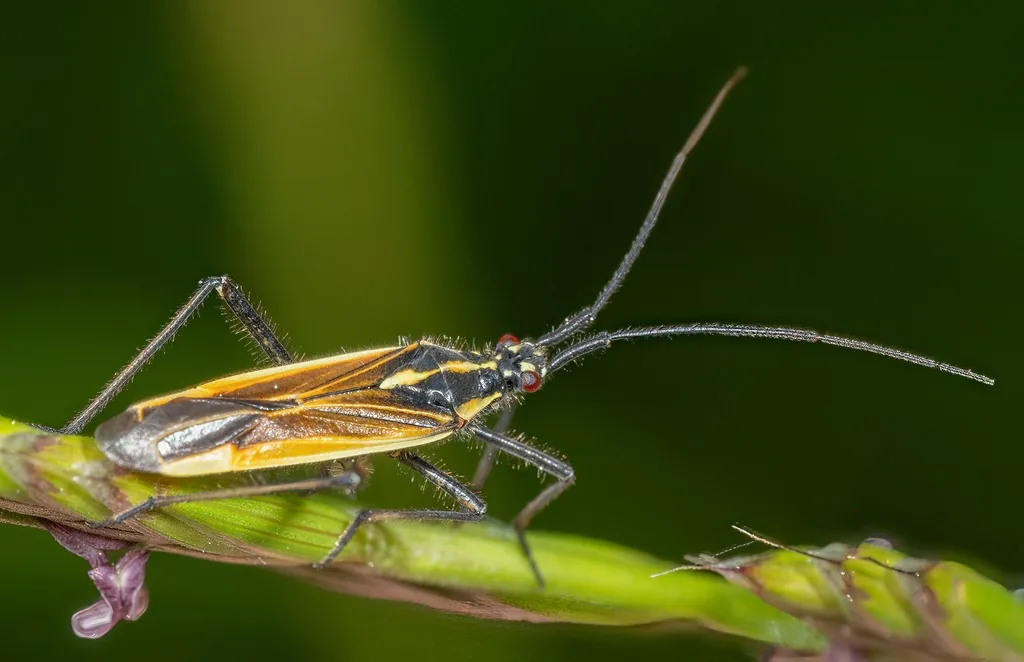
- Adults are narrow, about 1/3 to 3/8 inch long, and dirty yellow to dark brown.[1][2]
- Wings come in two forms, long and short. The UW-Milwaukee Field Station says males are usually long-winged and females usually short-winged, with exceptions.[1][2][3]
- Nymphs look like small adults without fully developed wings.[2]
- They give off an unpleasant odor.[1]
Look-alikes
| Look-alike | How to tell them apart |
|---|---|
| Alfalfa plant bug | The alfalfa plant bug is about 3/8 inch and pale green to brown, and it feeds on alfalfa leaves, buds and flowers, while meadow plant bugs are long, narrow, yellow to dark brown grass feeders.[2] |
| Lygus bugs (tarnished plant bugs) | Lygus bugs are smaller, about 1/4 inch, and green to brown, with a white triangular mark on the back and a downward-bent body tip.[2] |
Where it lives
Originally Eurasian, it now lives in a band across the central and northern United States and southern Canada, according to the UW-Milwaukee Field Station. The Pacific Northwest handbook treats it as a pest of grass grown for seed, and SDSU Extension lists meadow plant bugs among the three kinds of plant bugs common in South Dakota alfalfa fields.[3][1][2]
Biology and life cycle
It prefers grassy places left ungrazed, such as hay fields and road ditches, and is most abundant along field edges, moving farther into alfalfa fields that contain a mix of grasses.[2]
It feeds by sucking plant juices, mainly from grasses.[1][2]
It spends the winter as eggs; in grass seed fields they overwinter in the straw. Females cut holes for their eggs near the base of grass stems, below the mowing or grazing line.[1][3]
Damage and signs
Health risk
It feeds on grasses. The Pacific Northwest handbook, SDSU Extension and the UW-Milwaukee Field Station describe it only as a plant pest; none of them mentions bites, stings or any effect on people or pets.[1][2][3]
Control
Prevention
In alfalfa, managing it is usually unnecessary because it feeds mainly on grasses.[2]
Mechanical controls suggested by the UW-Milwaukee Field Station include crop rotation, close mowing, short grazing, burning and removing grass borders around fields.[3]
Sanitation
Grazing or burning heavily infested fields reduces numbers. In grass seed fields, open field burning kills the adults and nymphs present and, more important, destroys the straw where the eggs overwinter.[2][1]
Pesticides
For grass seed crops, the Pacific Northwest handbook lists beta-cyfluthrin, bifenthrin, dimethoate and zeta-cypermethrin; its dimethoate entry bars grazing or feeding hay, forage, seed or screenings from treated fields.[1]
Where the sources disagree
Size: the Pacific Northwest handbook gives adults as about 0.375 inch long; SDSU Extension says about 1/3 inch.[1][2]
Wings: the Pacific Northwest handbook and SDSU Extension say only that adults have long or short wings; the UW-Milwaukee Field Station ties wing length to sex, with long-winged males and short-winged females.[1][2][3]
Name: the Pacific Northwest handbook spells the genus Leptoterna; GBIF and the UW-Milwaukee Field Station use Leptopterna, and SDSU Extension's photo caption gives only the genus, Leptopterna.[1][4][3][2]
Common questions
- What causes silver top in grass grown for seed?
- Meadow plant bugs produce it by feeding on the stem just above the uppermost node, and heavy populations also reduce seed yield.[1]
- Do meadow plant bugs hurt alfalfa?
- Rarely. They feed mainly on grasses, so SDSU Extension says managing them in alfalfa is usually unnecessary.[2]
- Why are meadow plant bugs worst along field edges?
- They favor ungrazed grassy areas such as hay fields and road ditches, so numbers peak at field edges and reach farther only into alfalfa mixed with grass.[2]
Sources
- Pacific Northwest Pest Management Handbooks (Oregon State University, Washington State University and University of Idaho Extension), “Grass seed - Meadow plant bug (Pacific Northwest Insect Management Handbook).” pnwhandbooks.org/insect/legume-grass-field-seed/grass-seed/grass-seed-meadow-plant-bug (accessed 2026-11-13)
- South Dakota State University Extension, “Plant Bugs Showing Up in Alfalfa Fields.” extension.sdstate.edu/plant-bugs-showing-alfalfa-fields (accessed 2026-11-13)
- University of Wisconsin-Milwaukee Field Station, “Bug of the Week: Meadow Plant Bug (Family Miridae).” uwm.edu/field-station/?p=5314 (accessed 2026-11-13)
- Global Biodiversity Information Facility (GBIF), “Leptopterna dolabrata (Linnaeus, 1758) (GBIF Backbone Taxonomy).” api.gbif.org/v1/species/2011230 (accessed 2026-11-13)
- iNaturalist, “Leptopterna dolabrata taxon page (order and family).” www.inaturalist.org/taxa/321904 (accessed 2026-11-08)