On this page
How to identify it
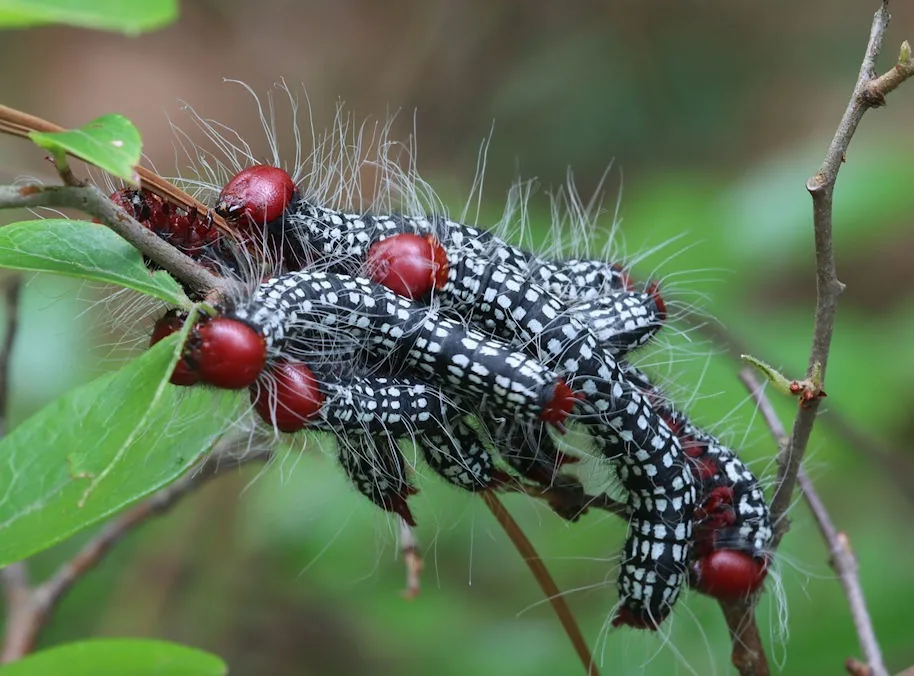
- Grown caterpillars are about 2 inches long, nearly black with broken white or yellow stripes along the body and a red head and legs. UF/IFAS describes the mature caterpillar as predominantly black with eight broken yellow (occasionally white) lengthwise stripes, a red last segment, and mahogany-red head and legs.[2][1][3]
- When disturbed they lift both ends, bending the body into a C shape. UF/IFAS adds that some drop one or two inches below the leaf and hang by a silk thread.[1][2][3]
- NC State says they are sometimes called Labor Day worms because so many people find them around Labor Day.[1]
- The adult is a brownish, night-flying moth with darker lines across the forewings and a cinnamon-colored thorax, one of the hand-maid moths. UF/IFAS describes the moth as light brown with a wingspan of 1 3/4 inches.[1][3]
- Eggs are laid in masses of 80 to 100 on a leaf. UF/IFAS says the female moth lays them in late spring on the underside of the leaf.[1][3]
- First-stage caterpillars are yellow with seven red lengthwise stripes and a black head; UF/IFAS says they are about 3/8 inch long after eight to ten hours of feeding.[3]
Look-alikes
| Look-alike | How to tell them apart |
|---|---|
| Yellownecked caterpillar | A close relative in the same genus. BAMONA says the moths are nearly identical, so the host plant is a useful clue: NC State calls azaleas the azalea caterpillar's primary host.[4][1] |
Where it lives
BAMONA gives the range as Nova Scotia to Florida, west to Kansas and Arkansas. Clemson counts it among the main pests of azaleas and rhododendrons in South Carolina. UF/IFAS says that nationwide it is limited to the southeastern quarter of the United States, as far north as Maryland, and in Florida it is found as far south as Polk and Hillsborough counties.[4][2][3]
Biology and life cycle
There is one generation a year. Grown caterpillars crawl down and burrow into the soil to pupate, spend the winter and spring there, and the moths emerge in early summer to lay eggs. UF/IFAS says one generation is usually the rule, though parts of the South may have a partial second, and that it is thought to spend the winter as a pupa.[1][3]
BAMONA gives the moth's flight season as June to August.[4]
The caterpillars stay together as they feed and do more and more damage as they grow. UF/IFAS says first-stage caterpillars feed side by side in a cluster and soon devour the whole leaf; young ones skeletonize leaves and larger ones eat the entire leaf.[1][2][3]
Damage and signs
- Because they feed in groups, they often strip part of a shrub before anyone notices.[1][2]
- Most damage happens in late summer, mainly August and September. UF/IFAS says that in Florida the damage continues through October.[1][2][3]
- Azaleas are the main host. NC State has also found them on blueberry, andromeda, apple and even oak, and BAMONA lists azalea and bog rosemary. UF/IFAS says Rhododendron species are its only known hosts in Florida and it seems to prefer indica azaleas, but it has been reported on blueberry in Delaware, red oak in Maryland, and andromeda and apple in the mid-Atlantic states.[1][4][3]
- Skeletonized leaves dry up, turn brown and stay on the plant for several days, UF/IFAS says, which can be the first sign of a feeding group.[3]
Health risk
Clemson says the caterpillars are harmless to people, which makes picking them off by hand practical. UF/IFAS agrees: although the caterpillar looks hairy, it is harmless to humans and can be picked off by hand.[2][3]
Control
Prevention
Inspect azaleas regularly in late summer for groups of young caterpillars, and act as soon as you find them.[2]
Traps and physical control
Because they cluster, they are easy to deal with by hand: pick them off, or shake them from the shrub and step on them.[2][1]
Pesticides
If spraying is needed, Clemson says Bacillus thuringiensis (Bt) and spinosad work best on small, young caterpillars and lists contact insecticides such as bifenthrin, cyfluthrin, cyhalothrin and permethrin for large ones. NC State warns that pyrethroids are very toxic to fish, so keep them away from pools, ponds and streams. Follow the label.[2][1]
Where sources disagree
Young caterpillars: NC State describes them as small and green, turning purple before the black-and-yellow final stage, while Clemson describes caterpillars about 3/8 inch long as reddish- to brownish-black with white and yellow stripes.[1][2]
Host plants: BAMONA lists only azalea and bog rosemary; NC State adds blueberry, andromeda, apple and oak.[4][1]
Range: UF/IFAS limits it to the southeastern quarter of the United States, north to Maryland, while BAMONA gives Nova Scotia to Florida, west to Kansas and Arkansas.[3][4]
First-stage caterpillars: UF/IFAS describes them as yellow with seven red lengthwise stripes and a black head, unlike the green (NC State) or reddish- to brownish-black (Clemson) young caterpillars described above.[3][1][2]
Generations: NC State says one a year; UF/IFAS says one is usual but parts of the South may have a partial second.[1][3]
Common questions
- What are the black and yellow striped caterpillars on my azaleas?
- Most likely azalea caterpillars, which feed in groups in late summer and have red heads and legs.[1][2]
- Why do they raise their heads and tails?
- That's how they react when disturbed, curling into a C shape.[1][2]
- Can I pick them off by hand?
- Yes. Clemson calls them harmless to people, and since they feed in clusters, removing or shaking off a group takes care of much of the problem.[2][1]
- When do azalea caterpillars show up in Florida?
- UF/IFAS says they are found on Florida azaleas from July through October. Most damage in the Southeast comes in August and September, but in Florida it continues through October.[3]
Sources
- NC State Extension, “Azalea Caterpillar.” content.ces.ncsu.edu/azalea-caterpillar (accessed 2026-11-14)
- Clemson Cooperative Extension Home & Garden Information Center, “Azalea and Rhododendron Insect Pests in South Carolina (HGIC 2051).” hgic.clemson.edu/factsheet/azalea-rhododendron-insect-pests/ (accessed 2026-11-14)
- University of Florida/IFAS Extension (Featured Creatures), “Azalea Caterpillar, Datana major Grote & Robinson, EENY137/IN294.” ask.ifas.ufl.edu/publication/IN294 (accessed 2026-11-14)
- Butterflies and Moths of North America (BAMONA), “Major Datana, Datana major (species account).” www.butterfliesandmoths.org/species/Datana-major (accessed 2026-11-14)
- iNaturalist, “Datana major taxon page (order and family).” www.inaturalist.org/taxa/1191137 (accessed 2026-11-14)