On this page
How to identify it
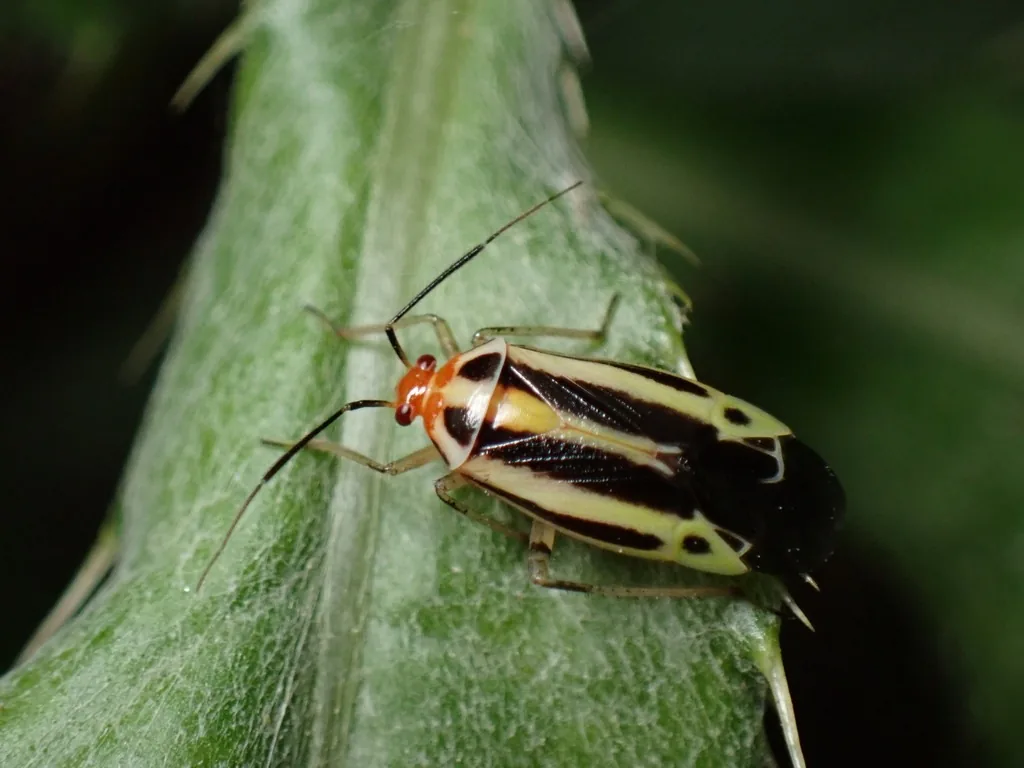
- Adults are greenish yellow with four black stripes down the wings, an orange-brown head and yellow-green legs, and roughly 1/4 to 1/3 inch long (see where the sources disagree on size). UF/IFAS gives adults as 7 to 7.5 mm long and 3.5 mm wide, with an orange head and dark reddish-brown eyes; females are slightly larger and broader than males.[1][2][3][4]
- Newly hatched nymphs are bright red with black wing pads and black dots on the abdomen; older nymphs have a light stripe on each wing pad (see where the sources disagree on their color). UF/IFAS says there are five nymphal stages, bright red until the last one, which is bright orange.[1][3][4]
- Feeding makes dark or translucent round, sunken spots about 1/16 to 1/8 inch wide. After a few weeks the dead tissue can drop out, leaving small holes. UF/IFAS describes the spots as 2 mm or less across, angular or circular, and green, rusty yellow or reddened depending on the leaf; under heavy attack whole shoot tips wilt and new growth may curl or die.[1][3][2][4]
Look-alikes
| Look-alike | How to tell them apart |
|---|---|
| Leaf spot diseases | Minnesota says plant bug spots are all about the same size and shape, while fungal and bacterial spots vary in size and have discolored margins. Iowa State notes that plant bug spots, too, are often surrounded by a halo of a different color, so look for the bugs or their nymphs as well. UF/IFAS adds that spots which drop out later can look like flea beetle holes.[1][2][4] |
| Striped cucumber beetle | Wisconsin notes that the adult looks somewhat like a striped cucumber beetle, but it is a true bug with piercing-sucking mouthparts, not a beetle.[3][1] |
Where it lives
It feeds on about 250 plant species, especially mint, basil, chrysanthemum, shasta daisy, azalea, dogwood, viburnum, currant and peppers.[1]
Biology and life cycle
It spends the winter as eggs inside plant stems. The eggs hatch in late spring as the leaves come out, in late April or early May in Wisconsin.[3][2][1]
Nymphs feed for about four weeks before becoming adults. Because nymphs move around less than adults, Wisconsin finds they do most of the damage. UF/IFAS puts nymph development at about 17 to 20 days.[1][3][4]
Adults feed into early or mid-summer (see where the sources disagree), mate, and lay banana-shaped eggs in slits cut lengthwise into stems. Minnesota describes slits 2 to 3 inches long, and Wisconsin says each holds half a dozen or more eggs. There is one generation a year. UF/IFAS says mating starts about a week after adults emerge, adults are around for about a month, and females outlive males. Eggs are 1.65 mm long, light yellow turning reddish, packed six to eight to a slit, usually in the upper 4 to 5 inches of the current season's growth.[1][3][2][4]
Both nymphs and adults drop to the ground or hide when disturbed, so you may see the damage without seeing the bugs.[1][3]
Timing depends on latitude. UF/IFAS cites Ithaca, New York, where eggs hatch in mid- to late May and adults appear in mid- to late June, and Harrisburg, Pennsylvania, where hatching starts in mid- to late April and the first adults appear in late May. Populations also rise and fall naturally, causing outbreaks that last one or several seasons.[4]
The spots appear almost as soon as the bug feeds. Researchers traced this to its very large salivary glands, which inject enzyme-rich saliva into the leaf.[4]
Damage and signs
- Moderate to heavy feeding can brown leaves, wilt new growth and ruin herbs. On some plants feeding also curls or distorts the leaves.[1][3]
- The damage is mostly cosmetic, but it matters on herbs and flowering plants grown for their looks.[3][1]
- UF/IFAS says it feeds on about 250 plant species in 57 families, most often mint-family and composite plants such as hyssop, lavender, marjoram, mint, sage, ageratum, coreopsis, dahlia, chrysanthemum, Shasta daisy and gaillardia. Vegetables attacked include potato, cucumber, lettuce, peas, radishes and squash, with the most severe damage on parsnips, and it can be an economic pest of commercial perennial herbs. Injury to ornamental shrubs such as azalea, dogwood, forsythia, viburnum and weigela is rare.[4]
Health risk
It feeds on plants; Minnesota, Wisconsin and Iowa State Extension mention no risk to people.[1][3][2]
Control
Prevention
Small to moderate numbers don't seriously harm plants. Start checking plants by mid-May (Wisconsin) or in late May and early June (Minnesota); the sooner the nymphs are found, the less injury.[1][3]
Sanitation
Cut down host plants in fall to remove eggs laid in the stems, and bury or compost the debris. On trees and shrubs the egg slits are easy to see after leaf drop, and those twigs can be pruned out.[1][3]
UF/IFAS says floating row covers suit early-season annual crops but can trap eggs from the previous season on perennials. For perennials, cut growth back thoroughly at the end of the season and destroy the stem debris that may hold eggs.[4]
Traps and physical control
Hand-picking works if you are quick enough to catch the bugs before they drop. UF/IFAS suggests cupping your hands under or around the leaves, since the bugs drop or fly, and knocking nymphs off with a hard stream of water.[3][4]
Biological control
Natural enemies are not well studied, but UF/IFAS notes a tiny eulophid wasp, Cirrospilus ovisugosus, whose larvae tunnel through stems and eat whole rows of eggs, and a jumping spider, Phidippus clarus, that has shown promise.[4]
Pesticides
Insecticidal soap (best on nymphs) or pyrethrins work on contact and are low risk to beneficials; repeat as needed. Iowa State points out that sprays applied after the damage shows and the nymphs are grown are of no benefit; water and care for the plants instead. UF/IFAS says chemical control is rarely recommended because the damage is usually cosmetic and plants have time to recover; horticultural oils and insecticidal soaps may suppress nymphs, but the bugs move quickly and escape sprays.[1][2][4]
More on where it's found
GBIF has 9,346 U.S. records since 1990, most from Texas, Ohio, New York, Michigan, Pennsylvania, Illinois and Minnesota, with very few from the Rockies and the Southwest. Canada has 1,690 records and Mexico 5.[5][6]
Iowa State notes that it is not a common pest in Iowa, which is why damage there often isn't expected until it is too late to spray.[2]
UF/IFAS calls it a native species, common through most of the eastern and midwestern United States and Canada and, though less common, documented in much of the South, with Florida State Collection of Arthropods records as far south as Lee and St. Lucie counties. Its distribution west of the Rocky Mountains is not known.[4]
Where the sources disagree
Adult size: Minnesota gives 1/4 to 1/3 inch, Iowa State slightly more than 1/4 inch, and Wisconsin 1/2 inch. UF/IFAS gives 7 to 7.5 mm.[1][2][3][4]
Older nymphs: Minnesota describes them as reddish orange with a light stripe on each wing pad; Wisconsin calls them yellowish green with a yellow stripe on each wing pad. UF/IFAS says nymphs are bright red until the last stage, which is bright orange.[1][3][4]
Where nymphs feed: Minnesota says on the upper side of the leaves; Wisconsin says on the undersides.[1][3]
Season: Minnesota says adults feed until early July; Iowa State says about mid-July and places egg-laying in the fall.[1][2]
Nymph development: Minnesota says nymphs feed about four weeks, while UF/IFAS gives about 17 to 20 days.[1][4]
Spot margins: Minnesota and UF/IFAS say plant bug spots lack the discolored (chlorotic) margins of disease spots, while Iowa State says they are often surrounded by a halo of a different color.[1][4][2]
Common questions
- What are the dark spots on my mint leaves?
- Fourlined plant bug feeding leaves round, sunken dark spots on mint and basil.[1][3]
- Is it a beetle?
- No, though adults are often mistaken for beetles; it's a true bug with piercing-sucking mouthparts.[1][3]
- Is it too late to spray once I see the spots?
- Usually yes. By the time the spots are obvious the nymphs are grown, and late sprays do no good; plan to watch for nymphs next May instead.[2][1]
- Is the fourlined plant bug found in Florida?
- Yes, though it is less common there. UF/IFAS cites Florida State Collection of Arthropods records as far south as Lee and St. Lucie counties.[4]
- Does it attack vegetables?
- Sometimes. UF/IFAS lists potato, cucumber, lettuce, peas, radishes and squash, with the most severe damage on parsnips.[4]
Sources
- University of Minnesota Extension, “Fourlined plant bugs (Yard and garden insects).” extension.umn.edu/garden-and-home/yard-and-garden/yard-and-garden-insects/four-lined-plant-bugs (accessed 2026-11-14)
- Iowa State University Extension and Outreach, “Fourlined Plant Bug (Yard and Garden, 2016).” yardandgarden.extension.iastate.edu/encyclopedia/fourlined-plant-bug (accessed 2026-11-14)
- University of Wisconsin-Madison Extension (Wisconsin Horticulture), “Four-Lined Plant Bug (Staab and Pellitteri).” hort.extension.wisc.edu/articles/four-lined-plant-bug/ (accessed 2026-11-14)
- University of Florida/IFAS Extension (Featured Creatures), “Fourlined Plant Bug, Poecilocapsus lineatus (Fabricius), EENY-669/IN1151.” ask.ifas.ufl.edu/publication/IN1151 (accessed 2026-11-14)
- Global Biodiversity Information Facility (GBIF), “Poecilocapsus lineatus: U.S. occurrence records since 1990 by state (GBIF occurrence search).” api.gbif.org/v1/occurrence/search?taxonKey=2011262&country=US&hasGeospatialIssue=false&occurrenceStatus=PRESENT&year=1990%2C2026&facet=stateProvince&facetLimit=400&limit=0 (accessed 2026-11-14)
- Global Biodiversity Information Facility (GBIF), “Poecilocapsus lineatus: occurrence records since 1990 by country (GBIF occurrence search).” api.gbif.org/v1/occurrence/search?taxonKey=2011262&hasGeospatialIssue=false&occurrenceStatus=PRESENT&year=1990%2C2026&facet=country&limit=0 (accessed 2026-11-14)
- Global Biodiversity Information Facility (GBIF), “Poecilocapsus lineatus (Fabricius, 1798) (GBIF Backbone Taxonomy).” api.gbif.org/v1/species/2011262 (accessed 2026-11-14)
- iNaturalist, “Poecilocapsus lineatus taxon page (order and family).” www.inaturalist.org/taxa/126211 (accessed 2026-11-14)