On this page
How to identify it
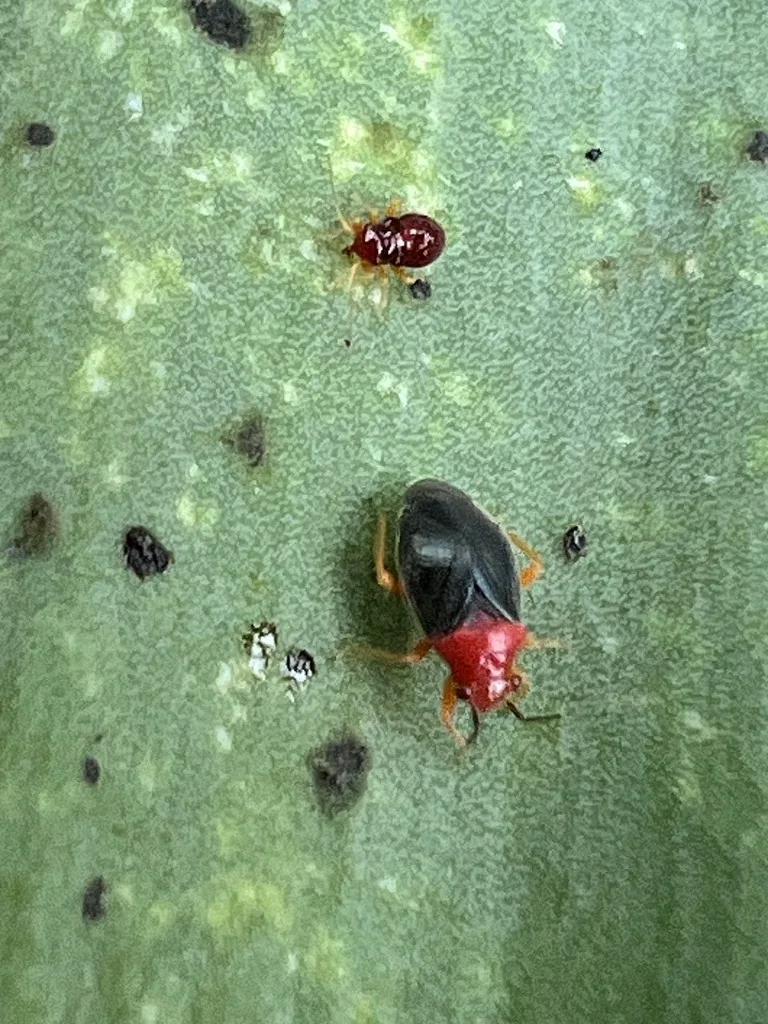
- Adults are tiny, with dark navy-blue to black wings and an orange to reddish head and thorax. Sources differ on details: NC State says about 1/8 inch with a dark abdomen, Ohio State 3/16 inch with an orangish-red abdomen and legs, and Connecticut describes a blue-black bug with a reddish head.[1][2][3]
- Nymphs share the color scheme but look redder because their black wing pads don't cover the abdomen; NC State calls them orange-brown.[2][1]
- They are skittish, with sharp eyesight, and dart to the base of the blades when approached.[1][2]
Look-alikes
Where it lives
A native of the southwestern US, it's a widespread problem on yucca, particularly in the South, and occurs north into Ohio and Connecticut.[2][3]
Biology and life cycle
It overwinters as eggs inserted into yucca leaves, which hatch in early spring; NC State says late March.[1][2]
Generation counts differ: NC State reports four a year in North Carolina, with a second generation around the first of June, while Ohio State sees at least three overlapping generations, so numbers can build fast. Nymphs molt five times and mature in three to four weeks; in North Carolina nymphs can be found into November and adults into late December.[1][2]
Damage and signs
- Feeding causes small yellowish-white spots that merge until leaves yellow and brown, and new foliage looks stippled; the bugs also leave black tarry excrement spots.[1][2][3]
- Heavy feeding year after year reduces vigor and can kill yuccas; feeding on flower stalks reduces blooms.[2]
- It feeds on several yucca species and on Dasylirion.[1][2]
Health risk
It feeds on yucca. NC State, Ohio State and the Connecticut Agricultural Experiment Station describe plant damage only and don't mention any risk to people or pets.[1][2][3]
Control
Pesticides
Contact sprays such as insecticidal soap or ultrafine horticultural oil work if they hit the bugs, but the bugs dart away from an approaching nozzle, so Ohio State says to be sneaky. Ohio State also says spinosad works and penetrates the leaf, giving longer residual action. Repeat treatment may be needed because eggs inside the leaves survive.[2][3][1]
The systemic insecticides imidacloprid and dinotefuran also suppress them; Connecticut describes imidacloprid applied so the roots take it up. Ohio State says to wait until the plants have dropped their flowers, to protect yucca moths, which depend on yucca as much as yucca depends on them. Ohio State found no published insecticide trials for this pest.[2][3]
Common questions
- Why are my yucca leaves speckled yellow with black dots?
- Yucca plant bugs are the most common cause; look for tiny dark-winged, orange-red bugs that hide at the base of the leaves.[1][2]
- When can I use a systemic on yucca?
- Ohio State says to wait until the plant has dropped its flowers, to protect yucca moths, which live in a close partnership with the plant.[2]
Sources
- NC State Extension, “Yucca Plant Bug (PDIC Factsheet).” content.ces.ncsu.edu/yucca-plant-bug-1 (accessed 2026-11-13)
- Ohio State University Extension (Buckeye Yard and Garden onLine), “Yucky Yucca (Buckeye Yard and Garden onLine).” bygl.osu.edu/node/2370 (accessed 2026-11-13)
- Connecticut Agricultural Experiment Station, “Yucca, Spanish Bayonet (Yucca), Plant Pest Handbook.” portal.ct.gov/CAES/Plant-Pest-Handbook/pphY/Yucca-Spanish-Bayonet-Yucca (accessed 2026-11-13)
- Global Biodiversity Information Facility (GBIF), “Halticotoma valida Townsend, 1892 (GBIF Backbone Taxonomy).” api.gbif.org/v1/species/2010939 (accessed 2026-11-13)
- iNaturalist, “Halticotoma valida taxon page (order and family).” www.inaturalist.org/taxa/464230 (accessed 2026-10-06)