On this page
How to identify it
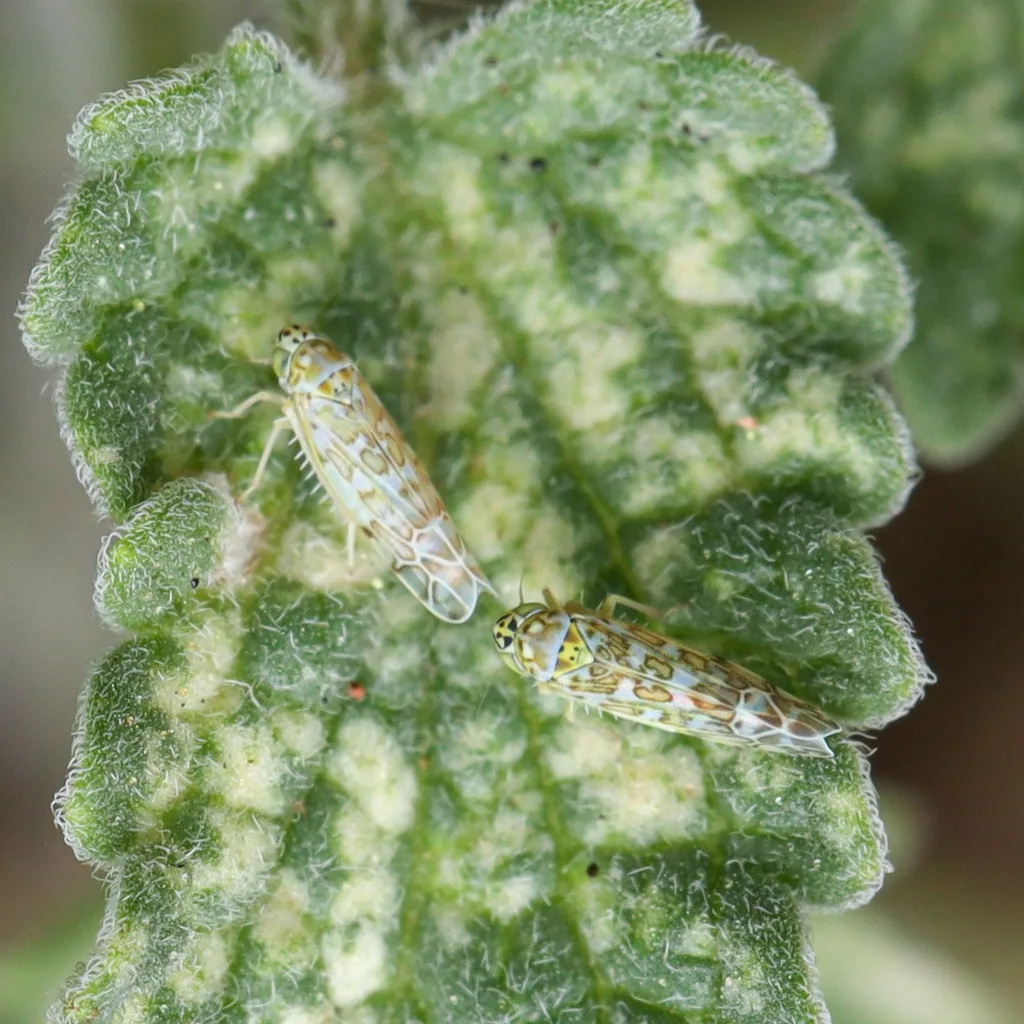
- Adults are tiny, less than 0.12 inch (about 3 mm) long, with the wedge-shaped head, bristle-like antennae and folded wings of a typical leafhopper.[1][3]
- The head and wings carry a characteristic pattern of spots; UF/IFAS describes a mottled brown, yellow and white wing pattern, and the PNW handbook calls the adults yellowish green.[1][3]
- Nymphs are green, wingless and covered in fine hairs, and like the adults they hop. Adults jump quickly on their long hind legs when disturbed.[1][3]
- Seen from the front, the head has five pairs of black spots, which sets it apart from every other Eupteryx leafhopper.[3]
Look-alikes
| Look-alike | How to tell them apart |
|---|---|
| Thrips and spider mite damage | The pale stippling from heavy Ligurian leafhopper feeding can be mistaken for thrips or mite injury; look for the tiny hopping insects on the plants.[1] |
| Sage leafhopper (Eupteryx melissae) | Another Eupteryx found in the United States on similar herbs, but it has fewer than six black spots on the front of the head.[3] |
Where it lives
Native to the Mediterranean around the Ligurian Sea, including parts of Italy and France and islands such as Capraia and Sardinia. Starting in 1983 it spread north through Switzerland and Austria, reaching Germany by 1989, possibly on imported catnip plants, and later the United Kingdom, the United States and Poland. UF/IFAS reports it from sites in eight US states, though the Pennsylvania and Florida records were regulatory interceptions that may not mean established populations. It was first detected in Oregon in 2020. In 2025 it was reported for the first time in Argentina, in the horticultural belt around La Plata in Buenos Aires province, during a survey of leafhoppers on aromatic crops.[3][1][2]
Biology and life cycle
Females lay eggs inside stems, leaf tissue and leaf stalks, where they are nearly impossible to see. In an Argentine study, females laid most often in the secondary veins of leaves, followed by stems and main veins. In Italy most of the population is thought to overwinter as eggs, which hatch 20 to 26 days after laying at 20 C.[1][2][3]
Nymphs pass through five stages over about 20 days before becoming adults, according to the PNW handbook and UF/IFAS; the fifth stage is the longest, about five days. In the Argentine laboratory study, development from egg to adult averaged about 29 days.[1][3][2]
It feeds by piercing leaves with tube-like mouthparts and removing the contents of leaf cells. Several adults may share a single plant.[1][3]
Hosts are plants in the mint family, including sage, rosemary, lemon balm, basil, marjoram, oregano, thyme and mint. Its spread may have been helped by the commercial shipping of these plants.[1][2][3]
Damage and signs
- Feeding causes the characteristic stippling and yellowing, which worsen as numbers rise. In its native range it has been linked to severe yellowing and branch drying of sage and rosemary, and in Argentina researchers saw significant damage to the herbs it fed on.[1][2][3]
- Damage may reduce the vigor and look of herbs sold for food or through nurseries. Feeding by related Eupteryx leafhoppers has lowered essential oil content in oregano, so UF/IFAS suggests mint oil yields could suffer if it reached damaging numbers in a field.[3]
- It has not been shown to transmit any plant pathogens.[3]
Health risk
It is a plant feeder on herbs; UF/IFAS, the PNW handbook and the Argentine study describe no risk to people or pets.[1][2][3]
Control
Traps and physical control
In Poland, herb growers reportedly reduce numbers during the growing season by vacuuming plants and hanging yellow sticky traps.[3]
Biological control
In Britain, Eupteryx eggs were parasitized by wasps resembling Anagrus atomus; UF/IFAS says such wasps may be worth studying as biological control if the leafhopper becomes a pest in the United States.[3]
Pesticides
US guidance is limited: the PNW handbook gives no management recommendations because its pest status is still unknown.[1]
In Switzerland, several applications of a neem seed product gave effective control on rosemary grown in high tunnels.[3]
Common questions
- What is making the leaves of my sage and rosemary pale and speckled?
- It may be the Ligurian leafhopper, a tiny Mediterranean leafhopper whose feeding leaves stippled, yellowing leaves on mint-family herbs such as sage, rosemary, oregano, thyme and mint; similar damage can come from thrips or mites.[1][2][3]
- How do I know it's a Ligurian leafhopper and not another one?
- Look at the face with a hand lens: the Ligurian leafhopper has five pairs of black spots on the front of the head, while the sage leafhopper, found on the same herbs, has fewer than six.[3]
Sources
- Pacific Northwest Pest Management Handbooks (Oregon State University, Washington State University and University of Idaho Extension), “Mint-Ligurian leafhopper (PNW Insect Management Handbook, agronomic crops).” pnwhandbooks.org/insect/agronomic/mint/mint-ligurian-leafhopper (accessed 2026-11-12)
- Anais da Academia Brasileira de Ciencias (via PubMed), “Pereyra, Paradell and Luft-Albarracin 2025, New record of Eupteryx decemnotata in Argentina: biological traits and description of the female and its immature stages (abstract).” pubmed.ncbi.nlm.nih.gov/41124495/ (accessed 2026-11-12)
- University of Florida IFAS Extension (EDIS), “Ligurian Leafhopper, Eupteryx decemnotata (Rey), EENY-750/IN1290 (A. Tasi and A. Lucky; Featured Creatures).” ask.ifas.ufl.edu/publication/IN1290 (accessed 2026-11-14)
- iNaturalist, “Eupteryx decemnotata taxon page (order and family).” www.inaturalist.org/taxa/430532 (accessed 2026-11-09)