On this page
How to identify it
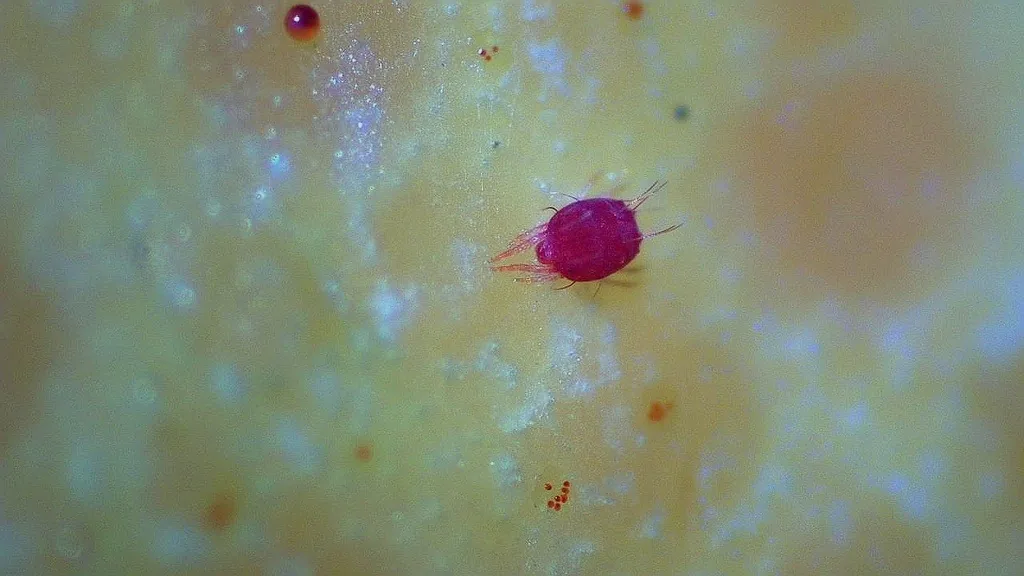
- Adult females are red, plump and oval to nearly round, about 0.5 mm long; males are smaller and taper toward the rear.[1][2]
- The white body hairs grow from red bases.[1]
- Eggs are almost spherical with a crooked stalk sticking up from the top; females often spin a thin silk strand from the stalk down to the leaf.[1]
- It makes little or no webbing on the plant, unlike the twospotted spider mite.[3]
Look-alikes
| Look-alike | How to tell them apart |
|---|---|
| European red mite | A very similar red mite that Penn State describes as a pest mainly of apples, stone fruits and pears, with its white hairs in four rows down the back. Citrus red mite feeds mostly on citrus, and its white hairs rise from red bases.[4][1] |
| Twospotted spider mite | Clemson calls the twospotted spider mite a summer pest of citrus that also builds up on potted citrus brought indoors for winter, often with heavy webbing at the branch tips; citrus red mite is a cool-season mite with little webbing.[3] |
Where it lives
A major citrus pest worldwide (Clemson). NC State calls it a serious pest of citrus in Florida and California, and Clemson covers it on citrus grown in South Carolina.[3][1]
Biology and life cycle
Each female lays two or three eggs a day, on both sides of the leaves.[1][2]
Eggs hatch in 8 to 30 days into six-legged larvae, which pass through two eight-legged nymph stages before molting to adults. Adults may live 18 days.[1]
Development speeds up in warm weather and slows in cool weather.[1][2]
It is a cool-season mite. Numbers rise in spring and again in late summer and fall as trees put out new growth, while summer heat and humidity push them down; UC IPM notes that temperatures above 90°F with low humidity reduce populations.[3][2]
Damage and signs
- Mites pierce leaf cells and suck out the contents, leaving light, scratch-like stippling that gives leaves and fruit a grayish or silvery look; on leaves it shows mostly on the upper surface.[3][1][2]
- Green fruit turns pale. UC IPM says the silvering usually fades as fruit colors unless large numbers fed on nearly ripe fruit, and NC State says injured mature oranges and lemons turn a pale straw yellow.[2][1]
- In severe infestations stippled areas dry out and die, leaves drop and twigs die back. Clemson adds that feeding combined with harsh weather can kill large limbs.[2][1][3]
- Clemson says it does the most damage on lemon and grapefruit, and less on orange and tangerine.[3]
- It can come indoors in fall and spring on citrus kept on porches and in sunrooms.[1]
- Problems are worse on water-stressed trees in hot, dry weather, and dust on leaves also favors the mites.[2]
Health risk
It feeds only on plants; none of the sources describes any risk to people or pets.[1][2][3]
Control
Prevention
Keep trees watered. Mites reproduce faster on water-stressed trees, and UC IPM also suggests keeping dust down.[2]
Traps and physical control
A hard spray of water from a hose, aimed up under the leaves, knocks mites off. Potted citrus can go outdoors in warm weather to be sprayed or rinsed by rain.[3]
Biological control
Predatory mites (in California mainly Euseius tularensis), a small black lady beetle, a dustywing and sixspotted thrips all eat citrus red mites, and a virus specific to this mite can wipe out dense populations in warm, moderately dry weather.[2]
Pesticides
For home citrus, NC State says horticultural or plant-shine oils or insecticidal soaps, used as labeled, should give adequate control. Clemson says to apply oil only between 45 and 85°F, not in direct sun or with rain expected, and not to spray soap or oil on citrus in bloom.[1][3]
Where sources disagree
Eggs per female: 20 to 30 according to NC State, 20 to 50 according to UC IPM.[1][2]
Time from egg to egg in warm weather: as short as 3 weeks (NC State) or as short as 12 days (UC IPM).[1][2]
Do broad-spectrum sprays cause outbreaks? UC IPM says numbers run higher where pyrethroids, organophosphates, carbamates and neonicotinoids have killed off natural enemies. A study of 2002-2013 grove records from California's San Joaquin Valley found no sign that the pesticides used there suppressed Euseius predatory mites or made citrus red mite problems worse.[2][5]
Common questions
- Why are my lemon tree's leaves silvery?
- Citrus red mites suck out leaf cells, and the stippling they leave gives leaves a silvery or grayish cast.[3][1]
- Can these mites get on my indoor citrus?
- Yes. NC State notes they can move onto citrus kept on porches and in sunrooms in fall and spring.[1]
- Do I have to spray?
- Often not. UC IPM found healthy, well-watered trees tolerate far more mites than once thought, and predators, a mite virus and summer heat usually bring numbers down. If you do treat a home tree, oil or insecticidal soap are the options NC State names.[2][1]
Sources
- NC State Extension, “Citrus Red Mite (PDIC Factsheet).” content.ces.ncsu.edu/citrus-red-mite (accessed 2026-11-11)
- University of California Statewide IPM Program, “Citrus Red Mite (Citrus Pest Management Guidelines).” ipm.ucanr.edu/agriculture/citrus/citrus-red-mite/ (accessed 2026-11-11)
- Clemson Cooperative Extension Home & Garden Information Center, “Citrus Insects & Related Pests (HGIC 2221).” hgic.clemson.edu/factsheet/citrus-insects-related-pests/ (accessed 2026-11-11)
- Penn State Extension, “European Red Mite in the Home Fruit Planting.” extension.psu.edu/european-red-mite-in-the-home-fruit-planting (accessed 2026-11-11)
- Journal of Economic Entomology, via PubMed, “An ecoinformatics approach to field-scale evaluation of insecticide effects in California citrus: are citrus thrips and citrus red mite induced pests? (Livingston et al. 2018).” pubmed.ncbi.nlm.nih.gov/29590397/ (accessed 2026-11-11)
- iNaturalist, “Panonychus citri taxon page (order and family).” www.inaturalist.org/taxa/263176 (accessed 2026-11-11)