On this page
How to identify it
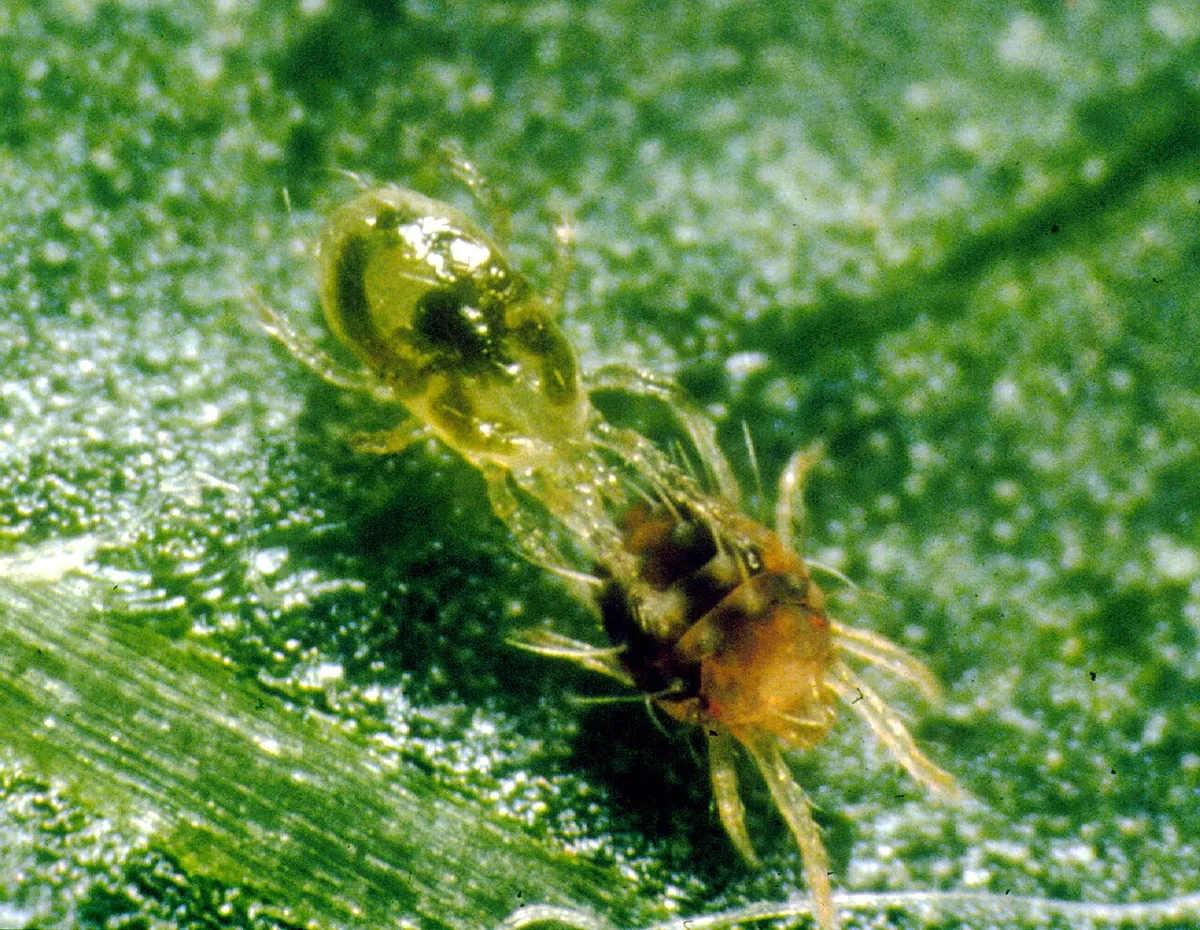
- Females are about 1/20 inch long and brick to bright red. Kentucky and UC IPM describe six to eight white spots at the bases of hairs on the back; Penn State describes four rows of white hairs. Males are smaller and paler, with a pointed abdomen.[1][2][4]
- Overwintering eggs are round, bright red and slightly flattened, with a slender stalk on top; they are laid in groups on rough bark, in cracks and around buds and spurs. Summer eggs, laid on leaves, are pale and translucent.[1][2][4][3]
- Heavy feeding turns foliage brown and, in severe cases, bronze.[1]
- Young mites are bright red, except right after molting, when they look bright green until they feed again.[4]
Where it lives
A European mite introduced to the United States in the early 1900s. It is found through much of the Northeast, mostly on plants in the rose family, and on fruit and shade trees worldwide. Kentucky lists it as a pest of nut, pome and stone fruits and some berries.[3][2]
Biology and life cycle
Overwintering eggs hatch in spring as trees approach bloom: Penn State says from prepink through bloom, Kentucky says starting near tight cluster, and UMass reports late April in New York. Young mites move to new leaves to feed.[1][2][4][3]
Sources differ on generations: Penn State gives 8 to 10 a year and Kentucky 6 to 8; UMass reports up to seven in New York orchards and 8 to 10 farther south. Summer generations take 10 to 18 days per Penn State, or as little as 14 days per Kentucky.[1][2][3]
Each female can lay about 35 eggs in her roughly 18-day life; hot, dry weather speeds development.[1]
Damage and signs
- The worst injury comes in early summer, when trees form next year's fruit buds; moderately to heavily infested trees produce fewer and less vigorous fruit buds. Kentucky adds that feeding can russet fruit.[1][2]
- Pears are badly damaged even by small mite populations.[1]
- Some apple varieties suffer more. Kentucky names Red Delicious and Braeburn as prone to mite buildup, and UC IPM says narrow-leaf varieties such as Red Delicious are hurt more than wide-leaf ones.[2][4]
Health risk
No cited source describes any risk to people or pets; it feeds on plant leaves.[1][2][3]
Control
Prevention
Avoid sprays that kill mite predators. Penn State and Kentucky say pyrethroids, and Penn State adds carbaryl, flare mite populations; Kentucky advises rotating miticides with different modes of action.[1][2]
UC IPM says reducing dust in the orchard and keeping trees well watered lowers the chance of mite problems.[4]
Biological control
Predators often keep it in check. Penn State names the tiny black lady beetle Stethorus punctum and predatory mites; Kentucky adds sixspotted thrips, and UC IPM the western predatory mite and spider mite destroyer. If predators are present and mite numbers are steady or falling, hold off on spraying.[1][2][4][3]
Pesticides
Dormant oil is the preferred early treatment, and it works better the closer it is to egg hatch. Penn State says to apply an early-season oil if overwintering eggs are easy to see on twigs and spurs before prepink; Kentucky times delayed-dormant oil from just before bud swell to half-inch green. UC IPM checks 25 to 100 fruit spurs in winter and treats before bloom if more than 10 percent carry eggs.[1][2][4]
Treatment thresholds differ. Penn State tolerates about 1 to 3 mites per leaf through May, 5 to 7 in June and July and 7 to 12 later; Kentucky treats above 5 per leaf until April 1, 10 in April and May and 15 after that; UC IPM uses 10 to 30 per leaf in summer depending on the tree and its predators. On pears, Penn State says to treat at the first sign of mites.[1][2][4]
Backyard trees versus orchards
Kentucky calls it a secondary pest that usually builds to damaging levels only after insecticides aimed at codling moth and other pests have killed its natural enemies.[2]
Kentucky says it is rarely a problem on backyard apple trees, and UMass calls it mainly an aesthetic issue in landscapes, where it is best tolerated. UC IPM says it only occasionally becomes troublesome even in apple orchards.[2][3][4]
Common questions
- What are the tiny red eggs on my apple tree's twigs in winter?
- Likely overwintering European red mite eggs, which are round, bright red and stalked.[1]
- Why are my apple leaves turning bronze?
- Heavy European red mite feeding browns and, in severe cases, bronzes the foliage.[1]
- Do I need to spray my backyard apple tree for red mites?
- Usually not. Kentucky says it is rarely a problem on backyard trees when predators aren't wiped out by other sprays. Check for overwintering eggs in winter and use dormant oil if they're easy to see.[2][1][4]
Sources
- Penn State Extension, “European Red Mite in the Home Fruit Planting.” extension.psu.edu/european-red-mite-in-the-home-fruit-planting (accessed 2026-11-13)
- University of Kentucky Entomology, “ENTFACT-205: European Red Mite.” entomology.mgcafe.uky.edu/ef205 (accessed 2026-11-13)
- UMass Extension Landscape, Nursery and Urban Forestry Program (Landscape Insect & Mite Guide), “Panonychus ulmi (European Red Mite).” www.umass.edu/agriculture-food-environment/landscape/publications-resources/insect-mite-guide/panonychus-ulmi (accessed 2026-11-13)
- University of California Statewide IPM Program, “European Red Mite (Apple Pest Management Guidelines).” ipm.ucanr.edu/agriculture/apple/european-red-mite/ (accessed 2026-11-13)
- Global Biodiversity Information Facility (GBIF), “Panonychus ulmi (Koch, 1836) (GBIF Backbone Taxonomy).” api.gbif.org/v1/species/2129352 (accessed 2026-11-13)