On this page
How to identify it
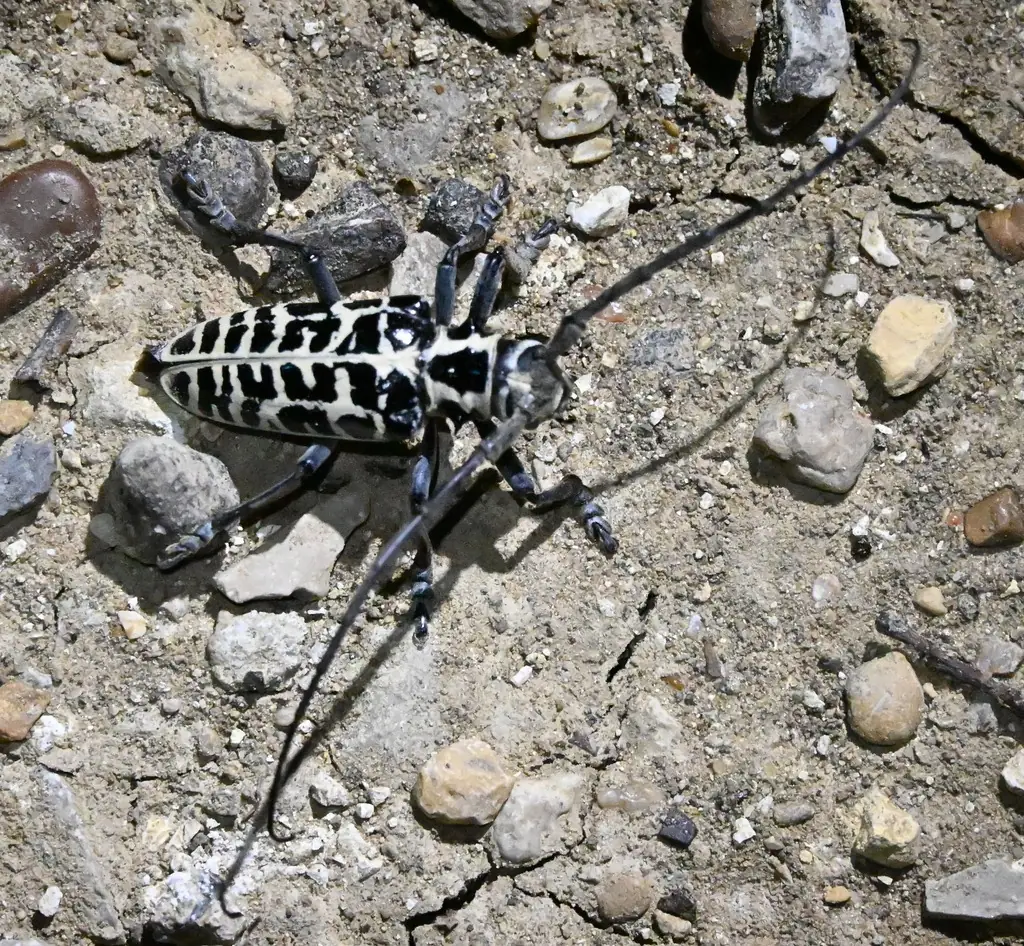
- Adults are big, robust longhorned beetles; the Forest Service's Rocky Mountain Region puts them at about 1 to 1 3/4 inches long and 1/2 inch wide (see where the sources disagree on size).[3][1][4]
- The top of the body has lengthwise rows of black, angular patches bordered by white stripes. Clemson describes it as mostly white with black spots and solid black antennae.[1][4]
- Larvae are large, white, legless grubs, about 2 inches long when mature; the pupa is about 1 1/2 inches long.[2][3]
Look-alikes
| Look-alike | How to tell them apart |
|---|---|
| Asian longhorned beetle | Clemson names the cottonwood borer as the large longhorned beetle most often confused with it. The Asian longhorned beetle is black with white spots, 1 to 1 1/2 inches long, with black-and-white striped antennae and bluish feet; the cottonwood borer is slightly bigger, mostly white with black spots, has solid black antennae and lacks the bluish feet.[4] |
| Poplar borer | It attacks the same trees, but the adult is about 1 inch long and gray-tan with small orange spots, and its larvae work in the trunk and larger branches, leaving swollen areas and exit holes where branches meet the trunk rather than working in the base and roots. Its fibrous frass can also pile up around the base of the tree.[1] |
| Clearwing borer (Paranthrene dollii) | This moth borer of cottonwood attacks the stem above ground near the base, with sap ooze and granular frass instead of fibrous frass. Its larvae are white to pinkish caterpillars with brown heads, and the adults are dark rusty-red clearwing moths that look like wasps.[2] |
Where it lives
It follows the range of eastern cottonwood in the eastern United States and reaches west into the Plains States, with reports as far west as New Mexico and Montana (see where the sources disagree on where it is most common). In Colorado it is limited to the southeastern part of the state.[2][3]
Biology and life cycle
Eastern cottonwood is the main host. Other poplars, including aspen, are attacked too, and willows to a lesser extent.[2][1]
Adults come out in early summer (see where the sources disagree on timing), live about a month and feed on leaf petioles, new twig growth and tender bark; their feeding can make shoots break or shrivel and die.[1][2][3]
To lay eggs, the female digs a shallow pit in the soil at the root collar, chews a niche in the bark, lays a single egg at or just below the ground line and partly fills the pit back in.[3][2][1]
Young larvae mine downward in the inner bark and into the wood of the root collar and roots, pushing frass out at the entry points. In seedlings the galleries reach down into the taproot; in larger trees larvae usually go no deeper than about 1 inch into the wood but often hollow out areas 2 to 3 inches across, especially in large roots.[3][1]
Larvae overwinter in the roots and pupate from April through early July. Nebraska Extension gives a two-year life cycle; both Forest Service sources say 1 to 2 years.[2][3][1]
Damage and signs
- Larvae hollow, partly sever or girdle seedling roots, causing structural weakening, loss of vigor and death. Infested nursery trees may die, or break at the root collar when handled. In plantations infested trees are often riddled with larvae but seldom die, though badly infested trees may break at the base in high wind.[2][3]
- Look for light brown, fibrous, excelsior-like frass pushed out of bark openings at the ground line. Because attacks are at or below the soil surface, infestations often go unnoticed; injury to older trees is hard to see unless the soil is pulled back from the root collar and upper roots, and infested roots are usually swollen and galled.[2][3]
- In nursery stock, adult feeding often kills the terminal shoot, which leads to excessive branching, forking and crooked stems. Stands on poor sites such as sand flats and heavy clays are more heavily infested than those on good sites, and Great Plains shelterbelts have been severely damaged.[2][3]
Health risk
Nebraska Extension and the Forest Service describe it only as a tree pest and don't mention any risk to people or pets.[1][2][3]
Control
Prevention
Keep cottonwoods and poplars vigorous: water and fertilize them properly and protect them from other pests and injury, especially in the first two or three years after planting and during drought. The Forest Service notes that stands on poor sites are more heavily infested than those on good sites.[1][3]
Nebraska Extension lists cottonwood among the trees more prone to borer injury. Where you are choosing a new tree, it suggests well-adapted oaks, lindens, crabapples or conifers, or borer-resistant species and cultivars.[1]
Sanitation
Dispose of dead or dying host trees, and consider removing related wild hosts close to valued trees to reduce borer numbers. Wrapping trunks is not recommended; Nebraska Extension says it typically does more harm than good.[1]
In nurseries and cutting beds, the Forest Service advises a site at least half a mile from wild or planted poplars and willows, borer-free cuttings, burning trimmings and culls, and digging and burning sprout stools every three years, since infested stools are the main source of reinfestation.[2]
Biological control
Natural enemies do little: because most of its life is spent in the tree below ground, it has few parasites and predators. Extended flooding in lowlands often kills many larvae.[3]
Pesticides
Borers are best prevented, because little can be done once larvae are deep beneath the bark. For borers in general, Nebraska Extension lists permethrin or bifenthrin sprayed on the trunk and lower branches, timed to cover adult emergence, egg laying and early larval activity (June to August for this species in Nebraska); several applications may be needed. Read and follow the label.[1]
Where the sources disagree
Adult size: Nebraska Extension says about 1 1/2 inches; the Forest Service's Rocky Mountain Region sheet says about 1 to 1 3/4 inches; Clemson says it can be about 2 inches.[1][3][4]
When adults are out: the Forest Service nursery handbook says mainly June and July; Nebraska Extension lists June to August; the Rocky Mountain Region sheet gives late June through mid-August in Kansas.[2][1][3]
Life cycle: Nebraska Extension says two years; both Forest Service sources say 1 to 2 years.[1][2][3]
Where it is most common: the nursery handbook says the largest populations are in the Southern and Central States; the Rocky Mountain Region sheet says it is most common in the Great Plains from Texas to South Dakota and throughout the Mississippi River Valley.[2][3]
Tree deaths: Nebraska Extension says severely infested young trees may be killed and the nursery handbook lists seedling mortality; the Rocky Mountain Region sheet says trees of all sizes are attacked but plantation trees seldom die from the injury.[1][2][3]
Common questions
- Is the big black-and-white beetle on my cottonwood an Asian longhorned beetle?
- Check the antennae and feet. Clemson names the cottonwood borer as the beetle most often confused with it: it is mostly white with black spots, has solid black antennae and lacks bluish feet, while the Asian longhorned beetle is black with white spots and has black-and-white striped antennae. If you think you have found an Asian longhorned beetle, Clemson advises catching it or photographing it and reporting it (in South Carolina, to the Clemson Department of Plant Industry).[4]
- What is the sawdust-like material piled at the base of my cottonwood?
- Light brown, fibrous frass at the ground line can be a sign of cottonwood borer larvae working in the root collar and roots, though poplar borer frass can also collect at the base. Pull the soil back from the root collar and upper roots to look for damage.[2][1][3]
- Will cottonwood borers kill my tree?
- Young trees are most at risk: severely infested young trees can be badly damaged or killed, and nursery trees may break at the root collar. Larger trees tolerate light to moderate infestations, and in plantations infested trees seldom die, though badly infested ones can break at the base in high wind.[1][3][2]
Sources
- University of Nebraska-Lincoln Extension, “Insect Borers of Shade Trees and Woody Ornamentals, EC1580 (J. A. Kalisch and F. P. Baxendale, 2010).” extensionpubs.unl.edu/publication/ec1580/2010/pdf/view/ec1580-2010.pdf (accessed 2026-11-13)
- USDA Forest Service, “Cottonwood Borers, chapter 29 (F. L. Oliveria and J. D. Solomon), in Forest Nursery Pests, Agriculture Handbook 680 (revised edition).” www.fs.usda.gov/sites/default/files/legacy_files/Forest%20Nursery%20Pests-web.pdf (accessed 2026-11-13)
- USDA Forest Service, “Cottonwood Borer: Striking black and white longhorned beetle (Forest Health Protection, Rocky Mountain Region, 2011).” www.fs.usda.gov/sites/nfs/files/legacy-media/r02/2pager%20-%20Cottonwood%20Borer.pdf (accessed 2026-11-13)
- Clemson Cooperative Extension Home & Garden Information Center, “Asian Longhorned Beetle (HGIC 2021).” hgic.clemson.edu/factsheet/asian-longhorned-beetle/ (accessed 2026-11-13)
- Global Biodiversity Information Facility (GBIF), “Plectrodera scalator (Fabricius, 1793) (GBIF Backbone Taxonomy).” api.gbif.org/v1/species/1141861 (accessed 2026-11-13)
- iNaturalist, “Plectrodera scalator taxon page (order and family).” www.inaturalist.org/taxa/205777 (accessed 2026-11-08)