On this page
How to identify it
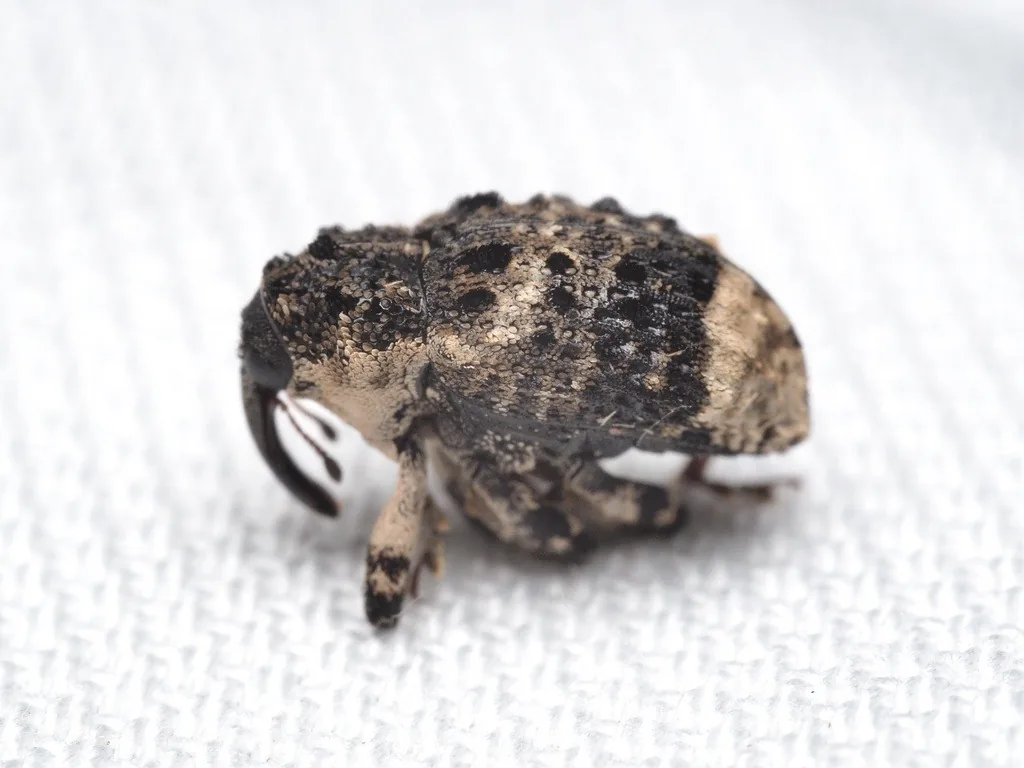
- Adults are mottled whitish with black or brown, with the rear third of the wing covers bright white. UC IPM gives a length of 1/5 to 1/3 inch; the 1972 Forest Service leaflet gives 7 to 10 mm and says the wing-cover tips usually have a pinkish cast, whitish in adults that have overwintered.[1][2]
- The body is hard and bumpy, and the small head extends into a slender beak.[1]
- Larvae are white, legless, C-shaped grubs with a shiny reddish-brown head. UC IPM says they grow to 1/4 inch; the Forest Service leaflet says mature larvae are about 1 cm (about 1/3 inch).[1][2]
Where it lives
Native to Europe and Asia, it was found in New York in 1882 and spread through southern Canada and the northern half of the United States (USDA Forest Service, 1972). UC IPM says it prefers willow and also infests alder, birch and poplar; the Forest Service leaflet says it is less common on poplar, except quaking aspen, and rarely found on alder and birch.[2][1]
Biology and life cycle
Adults feed lightly on young bark, are active mostly in the evening, and play dead when disturbed. Sources differ on emergence: UC IPM says spring through early fall, the Forest Service leaflet summer and early fall in most areas.[1][2]
Females chew holes in bark, lay eggs at the bottom and pack them with frass; egg laying peaks March–April and July–September.[1]
Sources differ on timing: UC IPM says development from egg to reproductive adult takes 1 to 3 years, while the Forest Service leaflet says about 1 year, with adults living and laying eggs for at least another 2 years.[1][2]
Damage and signs
Health risk
It feeds on trees and shrubs, and no cited source describes any risk to people or pets.[1][2]
Control
Traps and physical control
Prune off and destroy infested stems; adults seldom fly, so this reduces local populations.[1]
Biological control
Parasitic wasps attack the larvae and ants and birds eat adults and larvae, but UC IPM says it isn't known whether they suppress the borer; the Forest Service leaflet says natural enemies have not been studied much and that natural flooding during snowmelt may control infestations in willow in some places.[1][2]
When to call a professional
Where damage is intolerable after pruning, UC IPM says bark can be sprayed with a pyrethroid such as permethrin in March and again in July, that effective products are available only to professional applicators, and that repeat treatment may be needed in later years because of the long life cycle. Follow the label.[1]
More from the USDA Forest Service
The USDA Forest Service notes that this weevil strongly prefers willow over poplar, that larvae spend the winter under the bark and push wood fragments out of holes in the stem in spring, and that adults may live and keep laying eggs for another two years.[2]
Common questions
Sources
- University of California Statewide IPM Program, “Poplar and Willow Borer (Pests in Gardens and Landscapes).” ipm.ucanr.edu/PMG/GARDEN/PLANTS/INVERT/poplrwilborer.html (accessed 2026-11-13)
- USDA Forest Service (Forest Insect & Disease Leaflets), “Poplar-and-Willow Borer (FIDL 121).” www.fs.usda.gov/foresthealth/docs/fidls/FIDL-121-PoplarWillowBorer.pdf (accessed 2026-11-13)
- Global Biodiversity Information Facility (GBIF), “Cryptorhynchus lapathi (C.Linnaeus, 1758) (GBIF Backbone Taxonomy).” api.gbif.org/v1/species/1194505 (accessed 2026-11-13)