On this page
How to identify it
- Big for an aphid: UMass gives 5.0-5.8 mm (just under 1/4 inch) and PNW Handbooks 0.2 inch. Harper Adams University adds that adults can weigh up to 13 mg.[2][3][1]
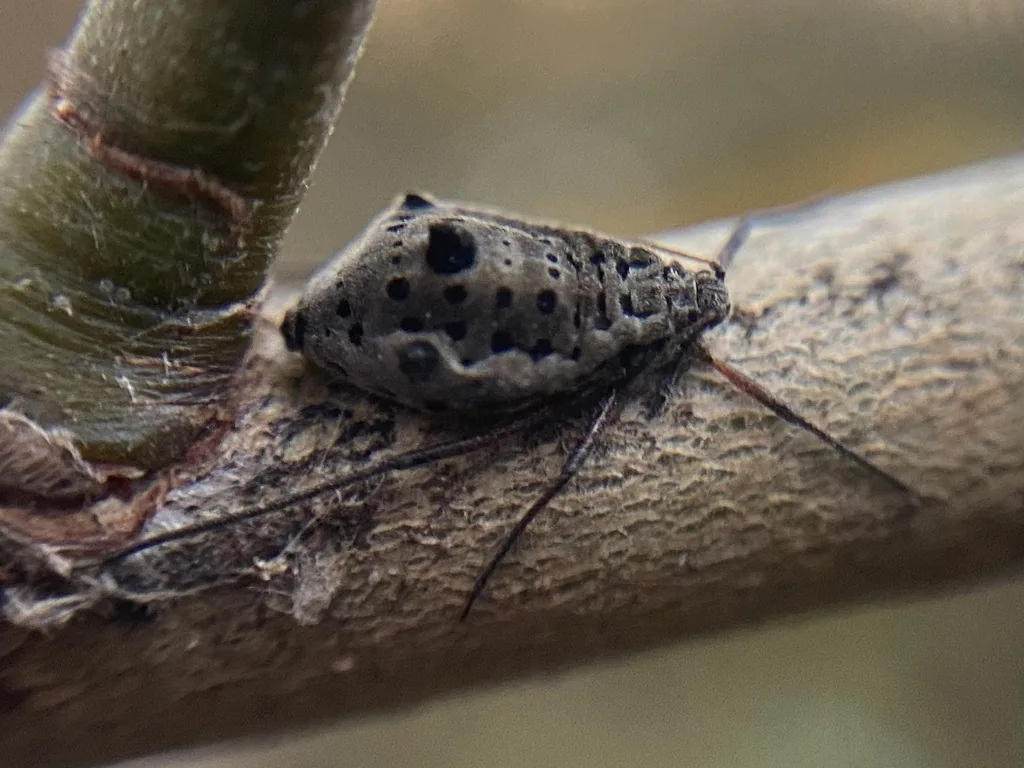
- UMass describes it as medium to dark brown with rows of black patches and fine hairs that give a grayish-golden sheen; PNW Handbooks says the dark body looks gray because of the many hairs.[2][3]
- A large dark projection in the middle of the back looks like a rose thorn or a shark's fin. Nobody knows what it is for.[2][1]
- Antennae are less than half the length of the body.[2]
- Harper Adams University says a crushed one stains your fingers bright orange for several days, and the aphid 'blood' permanently stains clothes.[1]
Where it lives
Reported on willows in Massachusetts and the Pacific Northwest, and an invader in many regions worldwide, including Patagonia and New Zealand. GBIF holds about 350 U.S. records since 1990 from 30 state-level areas, the most from California (139), Indiana (87) and Oregon (14).[2][3][4][5][6]
Biology and life cycle
All are females that reproduce without mating; no males have ever been found.[2]
It feeds through the bark of stems and twigs rather than on leaves, using mouthparts up to 1.8 mm long, more than a third of its body length.[1]
Colonies become noticeable by midsummer and peak in late summer or fall. It is cold tolerant and stays on its hosts into winter in the southern part of its range. Then, about February each year, it disappears for about four months, and where it goes is still a mystery.[2][1]
In the Pacific Northwest, colonies often concentrate on bark close to the ground. Colonies are often attended by ants.[3][1]
Its full genome was sequenced in 2024 from a single female: 456.8 megabases, mostly assembled into 10 chromosome-scale pieces.[7]
Damage and signs
- It feeds mainly on willow, with reports from poplar, and in heavy years can cover most 1- to 3-year-old twigs.[2]
- Sources differ on how much it hurts the tree. UMass and PNW Handbooks say damage is usually or seemingly minimal; Harper Adams University says the large aggregations can have serious effects on tree growth.[2][3][1]
- Colonies drip large amounts of honeydew that coats whatever is below and grows black sooty mold. In Patagonia, researchers estimated honeydew production at 1517 ± 139 kg per hectare per season, and yellowjackets were significantly more abundant foraging on it than in nearby areas.[2][4]
- The sugary rain changes the ground below: in a two-year New Zealand field trial, honeydew raised soil carbon, microbial activity and soil meso-fauna under infested willows. In Patagonia the honeydew drew 16 kinds of pollinating insects, and pollinators were more abundant on a native wildflower placed near the infested willows than on one placed farther away.[5][8]
Health risk
It feeds on sap from willow bark. UMass and PNW Handbooks treat it only as a willow pest and don't mention any risk to people or pets. UMass notes that its honeydew attracts stinging insects, and a study in Patagonia found yellowjackets were more abundant foraging on the honeydew than in nearby areas.[2][3][4]
Control
Prevention
Check willow twigs and small branches for large aphids, and treat honeydew on or under a willow as a sign they are present.[2]
Traps and physical control
Prune out heavily infested twigs and branches while populations are still low, or knock aphids off with a strong jet of water from a hose.[2]
Biological control
Do not expect much help from predators: UMass reports that natural enemies are rare, perhaps because of the aphid's warning coloration, though multicolored Asian lady beetles have been seen eating them. Harper Adams University notes the aphids are full of distasteful willow chemicals, and attending ants and wasps also keep predators away.[2][1]
Pesticides
UMass lists horticultural oil, insecticidal soap and neem oil among the active ingredients for giant willow aphid, in a list it says was last updated September 27, 2024. It says to read and follow all label instructions and to confirm that the site and the pest are on the label before using any pesticide.[2]
Where the sources disagree
Harm to the tree: UMass says damage is usually minimal and PNW Handbooks says it seems minimal; Harper Adams University says the large aggregations can have serious effects on tree growth.[2][3][1]
Size: UMass gives 5.0 to 5.8 mm, PNW Handbooks 0.2 inch (about 5 mm), and Harper Adams University says it can reach 5 mm.[2][3][1]
Why predators leave it alone: UMass says natural enemies are reportedly rare, perhaps because of its warning coloration; Harper Adams University points to distasteful willow chemicals and to the ants and vespid wasps drawn to its honeydew.[2][1]
Common questions
- What are the huge aphids covering my willow branches?
- Most likely giant willow aphids, one of the largest aphids, common on willow bark in late summer and fall.[2][1]
- Do giant willow aphids hurt willows?
- Usually not much, according to UMass and PNW Handbooks, though Harper Adams University says big colonies can slow tree growth; the honeydew and sooty mold are the main nuisance.[2][3][1]
- Why are so many wasps around my willow?
- They are likely feeding on the aphids' honeydew. A study in Patagonia linked giant willow aphid honeydew to higher numbers of foraging yellowjackets.[4][2][1]
- Why did my fingers turn orange?
- Crushed giant willow aphids leave a bright orange stain that can last several days on skin and permanently mark clothes.[1]
Sources
- Harper Adams University, “NIW Insect of the day: Large willow aphid (Prof. Simon Leather).” www.harper-adams.ac.uk/news/202279/niw-insect-of-the-day-large-willow-aphid (accessed 2026-11-13)
- UMass Extension Landscape, Nursery and Urban Forestry Program (Landscape Insect & Mite Guide), “Tuberolachnus salignus (Giant Willow Aphid).” www.umass.edu/agriculture-food-environment/landscape/publications-resources/insect-mite-guide/tuberolachnus-salignus (accessed 2026-11-13)
- Pacific Northwest Insect Management Handbook (Oregon State, Washington State, University of Idaho), “Willow (Salix)-Aphid (Hosts and Pests of Landscape Plants).” pnwhandbooks.org/insect/hort/landscape/hosts-pests-landscape-plants/willow-salix-aphid (accessed 2026-11-13)
- Pest Manag Sci 2023;79(8):2912-2919, via PubMed, “Honeydew production by the giant willow aphid (Tuberolachnus salignus, Hemiptera: Aphididae) and its effect on foraging yellowjackets.” pubmed.ncbi.nlm.nih.gov/36977969/ (accessed 2026-11-13)
- Insects 2020;11(8):460, via PubMed, “Honeydew Deposition by the Giant Willow Aphid (Tuberolachnus salignus) Affects Soil Biota and Soil Biochemical Properties.” pubmed.ncbi.nlm.nih.gov/32707954/ (accessed 2026-11-13)
- Global Biodiversity Information Facility (GBIF), “Tuberolachnus salignus: U.S. occurrence records since 1990 by state (GBIF occurrence search).” api.gbif.org/v1/occurrence/search?taxonKey=2073744&country=US&hasGeospatialIssue=false&occurrenceStatus=PRESENT&year=1990%2C2026&facet=stateProvince&facetLimit=400&limit=0 (accessed 2026-11-13)
- Wellcome Open Res 2024;9:59, via PubMed, “The genome sequence of the giant willow aphid, Tuberolachnus salignus (Gmelin, 1790).” pubmed.ncbi.nlm.nih.gov/39114489/ (accessed 2026-11-13)
- Oecologia 2026;208(8):101, via PubMed, “Honeydew-mediated indirect interactions: magnet and spillover effects of an invasive willow-aphid complex.” pubmed.ncbi.nlm.nih.gov/42489924/ (accessed 2026-11-13)
- Global Biodiversity Information Facility (GBIF), “Tuberolachnus salignus (Gmelin, 1790) (GBIF Backbone Taxonomy).” api.gbif.org/v1/species/2073744 (accessed 2026-11-13)
- iNaturalist, “Tuberolachnus salignus taxon page (order and family).” www.inaturalist.org/taxa/354036 (accessed 2026-10-06)