On this page
How to identify it
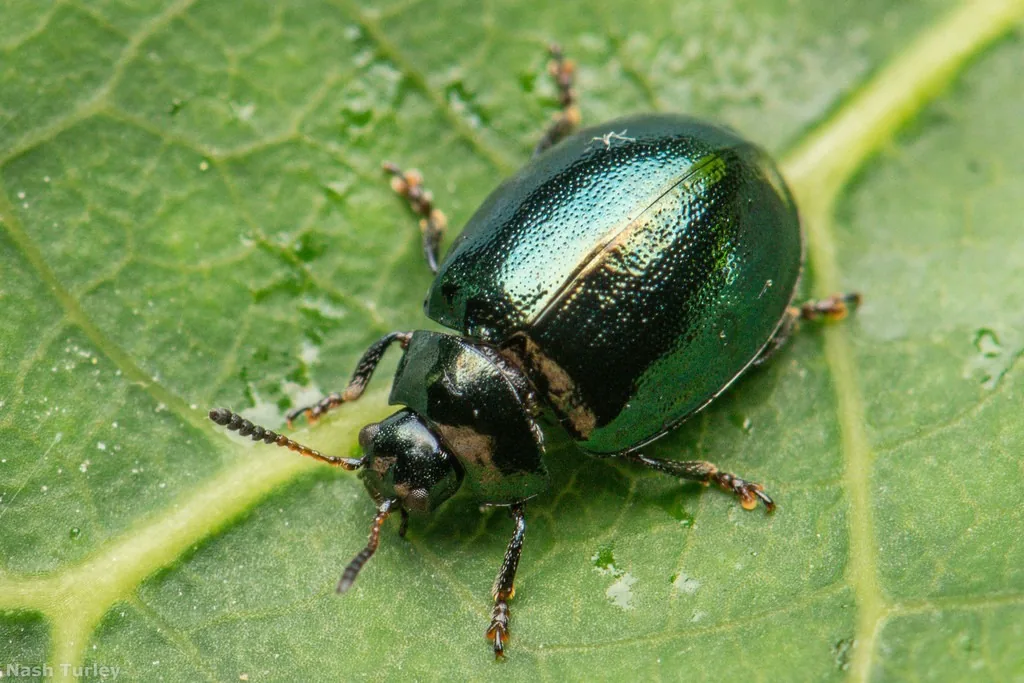
- Adults are small, convex and oval, nearly black to metallic greenish blue. UMass gives about 3/16 inch; Virginia Tech gives about 3 mm (1/8 inch).[2][3]
- They resemble an all-black lady beetle, but lady beetles are in a different family and black ones usually have orange spots.[1]
- Larvae have a black head, thorax and legs, a greenish-yellow abdomen with rows of black bumps, and reach about 1/4 inch. Young larvae feed side by side in groups; older ones feed alone.[3][4][2]
- Eggs are bright yellow, spindle-shaped and set upright in clusters on leaf undersides. UMass notes they can be confused with some lady beetle eggs.[3][2]
Where it lives
Native to Europe, it's established through eastern North America, from Nova Scotia south to the Carolinas, and Ohio State says through most of the eastern and Midwestern states.[3][4]
Biology and life cycle
Adults overwinter under loose bark or in leaf litter near the tree and come out in spring shortly after the leaves open.[1][2][3]
Females lay egg clusters on leaf undersides; larvae hatch in a few days and skeletonize the leaves, then pupate after three to four weeks. Virginia Tech says pupae are attached to the leaf.[1][2][3]
Generations overlap, so all stages can be found together; see where the sources disagree for how many there are.[1][2]
Damage and signs
- Hosts are willows, cottonwood and poplars (not tulip poplar). Virginia Tech says hosts with hairy leaves may be somewhat resistant.[1][2][3]
- Adults notch and chew holes in leaves and larvae skeletonize them; Ohio State says larvae usually do more damage. Leaves turn brown, dirty and ragged and may drop early, and trees can look scorched or dead from a distance.[1][4][3]
- Virginia Tech says most trees can withstand total defoliation as long as it doesn't happen every year; NC State says it isn't fatal to a willow but isn't good for it.[3][1]
Health risk
It feeds on willow and poplar leaves. NC State, UMass, Virginia Tech and Ohio State describe leaf damage only and don't mention any risk to people or pets.[1][2][3][4]
Control
Prevention
NC State says to keep pyrethroids away from pools, ponds and streams, since they're very toxic to fish.[1]
Trees properly planted on good sites handle the feeding better, Virginia Tech says.[3]
Biological control
UMass says the wasp Schizonotus sieboldi is a highly effective parasite of the pupae, and lady beetles, lacewings, predatory bugs and spiders also feed on it; Virginia Tech says no biological control is sold for it.[2][3]
Pesticides
Sprays can seem to fail because eggs survive and hatch afterward and the adults don't all leave their winter shelters on the same day. Virginia Tech says to start when the yellow eggs first appear and aim at leaf undersides.[1][3]
Where the sources disagree
First U.S. record: UMass says 1911; Virginia Tech and Ohio State say 1915.[2][3][4]
Generations: NC State says at least two a year; Virginia Tech and Ohio State say two or three; UMass says two or three in New England and possibly four in parts of Virginia and North Carolina.[1][3][4][2]
Whether to treat: UMass says management is rarely needed, especially on established trees. Virginia Tech says treatment may be justified for heavy infestations on small or newly planted trees, and Ohio State says standard labeled insecticides and insecticidal soap on the larvae work.[2][3][4]
Common questions
- What are the small shiny blue beetles on my willow?
- Likely imported willow leaf beetles; look for clusters of yellow eggs and dark, group-feeding larvae on the leaf undersides.[1][2][3]
- Are they black lady beetles?
- No. They resemble black lady beetles but belong to a different family, and black lady beetles usually have orange spots.[1]
- Why do the beetles come back after spraying?
- Eggs may survive and hatch later, and adults leave their winter shelters over several days.[1]
Sources
- NC State Extension, “Imported Willow Leaf Beetle (PDIC Factsheet).” content.ces.ncsu.edu/imported-willow-leaf-beetle (accessed 2026-11-13)
- UMass Extension Landscape, Nursery and Urban Forestry Program (Landscape Insect & Mite Guide), “Plagiodera versicolora (Imported Willow Leaf Beetle).” www.umass.edu/agriculture-food-environment/landscape/publications-resources/insect-mite-guide/plagiodera-versicolora (accessed 2026-11-13)
- Virginia Cooperative Extension (Virginia Tech), “Imported Willow Leaf Beetle (ENTO-139NP; P. Wooden, T. Dellinger and E. Day, 2026).” www.pubs.ext.vt.edu/ENTO/ENTO-139/ENTO-139.html (accessed 2026-11-13)
- Ohio State University Extension, Buckeye Yard & Garden onLine (BYGL), “Imported Willow Leaf Beetle: Look for 2nd Generation Larvae (J. Boggs, July 4, 2016).” bygl.osu.edu/node/405 (accessed 2026-11-13)
- Global Biodiversity Information Facility (GBIF), “Plagiodera versicolora (Laicharting, 1781) (GBIF Backbone Taxonomy).” api.gbif.org/v1/species/1048626 (accessed 2026-11-13)
- iNaturalist, “Plagiodera versicolora taxon page (order and family).” www.inaturalist.org/taxa/83839 (accessed 2026-10-06)