On this page
How to identify it
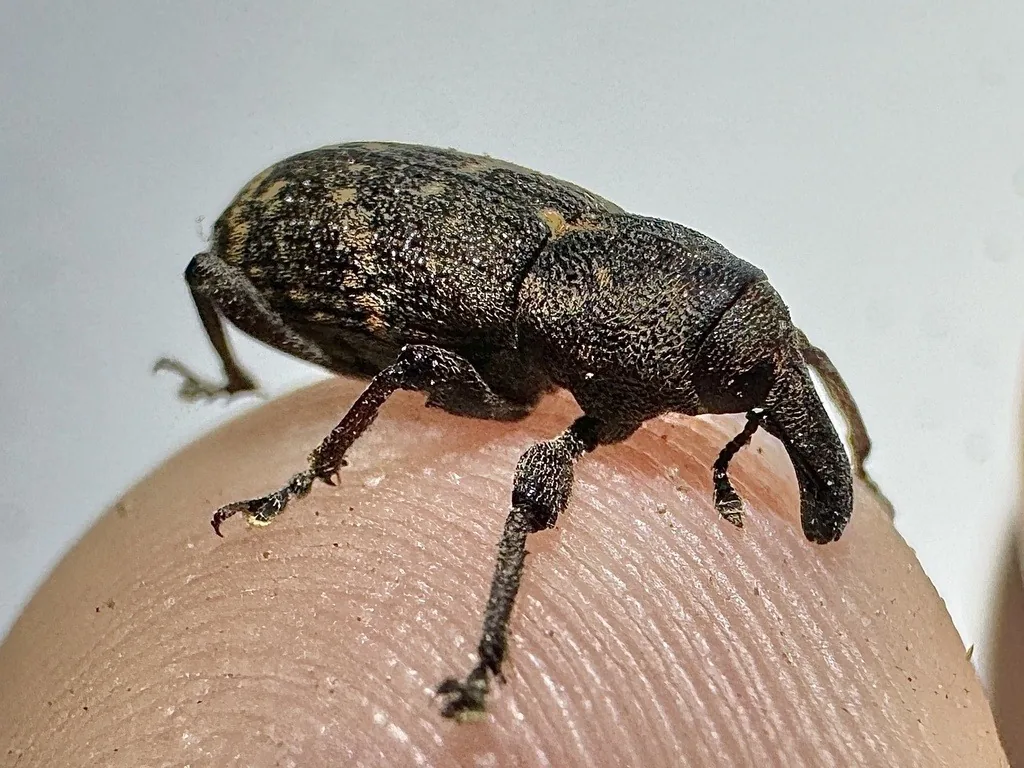
- Adults are dark weevils with a snout and patches of pale scales. NC State describes them as very dark, up to 1/2 inch long, with gray or pale orange spots; UMass says about 1/4 inch, black to reddish brown, with yellow to white patches on the head and wing covers. Grubs are legless and white with brown heads.[1][3][4]
- Chewed bark heals over with white, crystallized resin that looks like sugar. Heavy feeding strips bark completely, leaving criss-crossed ridges.[1][3]
- Disturbed weevils drop to the ground and play dead.[3]
Look-alikes
| Look-alike | How to tell them apart |
|---|---|
| Pine root collar weevil | Has a similar life cycle, but its larvae feed under the bark at and below the soil line of living trees, yellowing and killing the foliage.[2] |
| Northern pine weevil | Illinois says it has a similar life cycle and causes the same kind of feeding damage, but its larvae feed under the bark of the stump above ground rather than in the roots.[2] |
Where it lives
Found in the eastern United States and parts of Canada; Natural Resources Canada calls it common through the conifer range in Ontario. Illinois Extension calls it a serious pest in southern Illinois and the South, especially in nurseries, Christmas tree farms and forests.[3][4][2]
Biology and life cycle
Adults overwinter in leaf litter and become active in spring, from late April to June depending on location; UMass says adults can be active year-round in warm climates. They feed at night and hide by day. Natural Resources Canada says some also overwinter as larvae in the roots.[2][3][1][4]
Fresh pine resin and sawdust draw adults to newly cut stumps and dying pines. Females burrow down to the roots, chew small notches and lay 1 to 3 eggs in each. Grubs tunnel down the roots through the summer and pupate in a cocoon of wood chips.[1][3][4][2]
Generation counts differ: Natural Resources Canada says there is usually one a year, while NC State says North Carolina may have two depending on timing and altitude. New adults emerge in late summer or fall, and some live through two winters.[4][1][3][2]
Damage and signs
- Adults chew bark down to the wood on seedlings and on twigs near branch tips, girdling them so the tips flag, turn reddish brown and die. UMass says seedlings and conifers up to 18 feet tall can be fed on.[1][2][3]
- NC State says it breeds in pines, hemlocks, junipers, spruces, firs and cedars and likely attacks any conifer near a harvest site. Natural Resources Canada lists many pines plus spruces, balsam fir, eastern white-cedar, hemlocks, junipers and larches.[1][4]
- Sources disagree on landscapes. NC State says it readily invades them; Illinois says it seldom bothers landscapes because little breeding material is left there, and UMass says it's usually less serious in landscapes for the same reason.[1][2][3]
- In recently logged pine, Natural Resources Canada calls it potentially the most serious insect pest of regenerating pine and has recorded 90% seedling mortality in new plantations.[4]
- A Georgia study found pales weevil and a related root weevil fed far more on pine twigs placed near stressed (girdled) loblolly pines than near healthy ones, and concluded that these weevils are secondary colonizers of stressed trees.[5]
Health risk
It feeds on conifer bark, and no cited source describes any risk to people or pets. If you use a pyrethroid, NC State notes these products are toxic to fish, so keep them away from pools, ponds and streams.[1][3]
Control
Prevention
Don't plant pine seedlings right after a harvest. UMass and Natural Resources Canada both advise waiting up to two years before replanting a cut area; Natural Resources Canada says direct seeding can follow after one year.[3][4]
UMass suggests checking from April to October for adults and stripped bark on flagged branches.[3]
Sanitation
Grind out or remove the stumps of cut conifers so the weevils have nowhere to breed. In Christmas tree plantings, Natural Resources Canada strongly recommends removing stumps the spring after cutting.[2][4][3]
Biological control
Natural enemies include woodpeckers that eat larvae, fungi such as Metarhizium anisopliae, and insect-parasitic nematodes, according to UMass. NC State says that beyond two parasitic fungi, little is known about biological control.[3][1]
Pesticides
NC State says a pyrethroid labeled for landscape use, applied as soon as damage is first noticed, should protect conifers. Illinois suggests checking with your local Extension office for a recommended insecticide.[1][2]
Common questions
- Why are the tips of my young pines dying near where trees were cut?
- Pales weevils breeding in fresh stumps nearby may be girdling the twigs. Look for chewed bark with white, sugary resin, and check the base of plants after dark for the weevils.[1][2][3]
- What is the white sugary stuff on chewed pine bark?
- Crystallized resin over pales weevil feeding wounds.[1]
Sources
- NC State Extension, “Pales Weevil (PDIC Factsheet).” content.ces.ncsu.edu/pales-weevil (accessed 2026-11-13)
- University of Illinois Extension, “Pales Weevil and Root Collar Weevil.” extension.illinois.edu/insects/pales-weevil-and-root-collar-weevil (accessed 2026-11-13)
- UMass Amherst Extension (Center for Agriculture, Food, and the Environment), “Hylobius pales (Insect & Mite Guide).” www.umass.edu/agriculture-food-environment/landscape/publications-resources/insect-mite-guide/hylobius-pales (accessed 2026-11-13)
- Natural Resources Canada, Canadian Forest Service, “Pales weevil (Trees, insects and diseases of Canada's forests).” tidcf.nrcan.gc.ca/en/insects/factsheet/1721 (accessed 2026-11-13)
- Journal of Economic Entomology (via PubMed), “Colonization Dynamics of Subcortical Insects on Forest Sites With Relatively Stressed and Unstressed Loblolly Pine Trees. Helbig et al. 2016 (abstract).” pubmed.ncbi.nlm.nih.gov/27252398/ (accessed 2026-11-13)
- Global Biodiversity Information Facility (GBIF), “Hylobius pales C.H.Boheman, 1834 (GBIF Backbone Taxonomy).” api.gbif.org/v1/species/8397877 (accessed 2026-11-13)