On this page
How to identify it
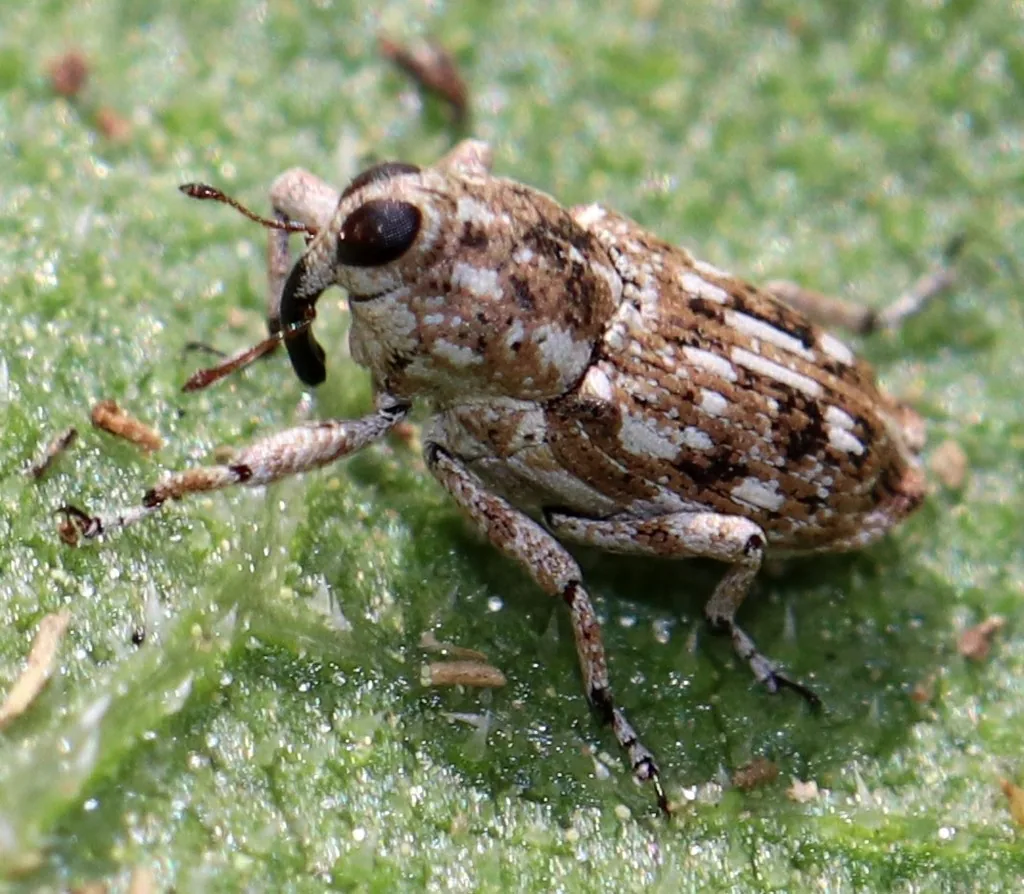
- Adults are about 3/16 inch (4 to 5 mm) long, grayish-brown, with irregular white spots on the wing covers and thorax and a narrow black snout that points down and back under the head.[3][1][2]
- NDSU describes the larvae as legless and creamy white with a small brown head, about 1/4 inch (5 to 6 mm) long when grown, lying curled in a C shape inside the stalk; in fall they are in chambers at the stalk base or root crown.[3][2][1]
Look-alikes
| Look-alike | How to tell them apart |
|---|---|
| Dectes stem borer | Another sunflower stalk borer that also causes lodging; its larvae are cannibalistic, so a stalk usually holds only one, while dozens of stem weevil larvae can share a stalk.[2] |
Where it lives
NDSU says this native weevil has been reported from most states west of the Mississippi River and into Canada, with economically damaging populations in Colorado, Kansas, Nebraska, North Dakota, Minnesota, South Dakota and Texas. The UMN-hosted textbook chapter calls it an economic pest across the northern and southern Great Plains and in Saskatchewan, with occasional severe losses in western Kansas, eastern Colorado and the Dakotas.[3][2]
Biology and life cycle
There is one generation a year. Adults emerge from last year's stalks and root crowns in spring, and degree-day models can predict when; see where the sources disagree on timing.[3][2][1]
Females lay eggs under the epidermis near the base of the stalk, starting around the cotyledon node; the larvae feed in the vascular tissue, then tunnel into the pith.[3][1][2]
By late August the larvae move down to the lower stalk or root crown and dig overwintering chambers, pupating there the following spring.[2][3][1]
Damage and signs
- Adult feeding on stems and leaves is minor; the main loss is lodging, when stalks weakened by tunnels and chambers break before harvest. In North Dakota a mean of 38 larvae per stalk produced 28 percent lodging, while in the southern Plains it took more than 80 larvae per stalk to cause a yield loss from larval feeding.[2][3][1]
- Breakage is worst in drought or high winds as plants dry down. NDSU says it usually happens at or just above the soil line, while breakage from stalk disease is usually higher up.[2][3]
- The weevil has been implicated in the spread of Phoma black stem and in charcoal stem rot of sunflower.[2][3][1]
Health risk
It feeds on sunflowers and, NDSU says, some weeds. Colorado State, NDSU and the UMN-hosted textbook chapter describe crop damage only and don't mention any risk to people or pets.[1][3][2]
Control
Prevention
Colorado State says planting after June 1 in northeastern Colorado keeps plants too small to attract egg-laying weevils at the peak, though yield and quality drop in crops planted after June 15; NDSU found later planting cut larval numbers in North Dakota trials. Thinner stands grow thicker stalks that resist lodging.[1][3][2]
Sanitation
Tillage to destroy the overwintering larvae has mixed results; see where the sources disagree.[1][2][3]
Biological control
Parasitic wasps attack the eggs and larvae; NDSU names Nealiolus curculionis as the most common larval parasitoid and notes that insecticides toxic to the weevil also kill parasitoids.[3][2]
Pesticides
Foliar insecticides control adults but not larvae already inside the stalk, so they have to go on before egg laying; see where the sources disagree on thresholds. Colorado State says to read and follow all label instructions.[1][3][2]
Where the sources disagree
Emergence: the UMN-hosted chapter says early to mid-April in the southern Plains and mid to late June in the northern Plains; NDSU says early April to early May in the south and mid-June to late July in the north; Colorado State says females emerge mid-May through June, with emergence usually complete by the second week of June.[2][3][1]
Tillage: Colorado State says fall tillage that destroys overwintering chambers has been recommended but may conflict with soil conservation; the UMN-hosted chapter says tillage did not raise larval mortality, though burying stalks reduced adult emergence; NDSU says disking plus moldboard plowing to 6 inches can kill larvae and pupae, but only when both are done.[1][2][3]
Thresholds: NDSU and the UMN-hosted chapter use one adult per three plants; Colorado State says to consider a foliar treatment when more than eight weevils are found on 25 scouted plants.[3][2][1]
Common questions
- Why are my sunflower stalks snapping before harvest?
- Sunflower stem weevil larvae are one possible cause; their tunnels and overwintering chambers weaken the stalk base.[1][2]
- When do I need to treat sunflower stem weevil?
- NDSU and the UMN-hosted chapter use about one adult per three plants, and Colorado State more than eight weevils on 25 plants; treatment has to come before eggs are laid, since sprays don't reach larvae inside the stalk.[3][2][1]
Sources
- Colorado State University Extension, “Sunflower Stem Weevil Management.” extension.colostate.edu/resource/sunflower-stem-weevil-management (accessed 2026-11-13)
- University of Minnesota, “Sunflower Insect Pest Management in North America (L. D. Charlet et al., Radcliffe's IPM World Textbook).” ipmworld.umn.edu/charlet (accessed 2026-11-13)
- North Dakota State University Extension Service, “Biology and Integrated Pest Management of the Sunflower Stem Weevils in the Great Plains, E-821 (Revised) (J. J. Knodel and L. D. Charlet; October 2002; copy held by the North Dakota State Library state documents collection).” www.library.nd.gov/statedocs/NDSUExtensionService/e82120090409.pdf (accessed 2026-11-13)
- Global Biodiversity Information Facility (GBIF), “Cylindrocopturus adspersus (LeConte, 1876) (GBIF Backbone Taxonomy).” api.gbif.org/v1/species/4291767 (accessed 2026-11-13). GBIF lists this name as a homotypic synonym of Conotrachelus adspersus; order Coleoptera and family Curculionidae are the same either way. The page keeps Cylindrocopturus adspersus, the name used by NDSU, Colorado State and USDA-ARS.
- iNaturalist, “Cylindrocopturus adspersus taxon page (order and family).” www.inaturalist.org/taxa/304317 (accessed 2026-10-06)