On this page
How to identify it
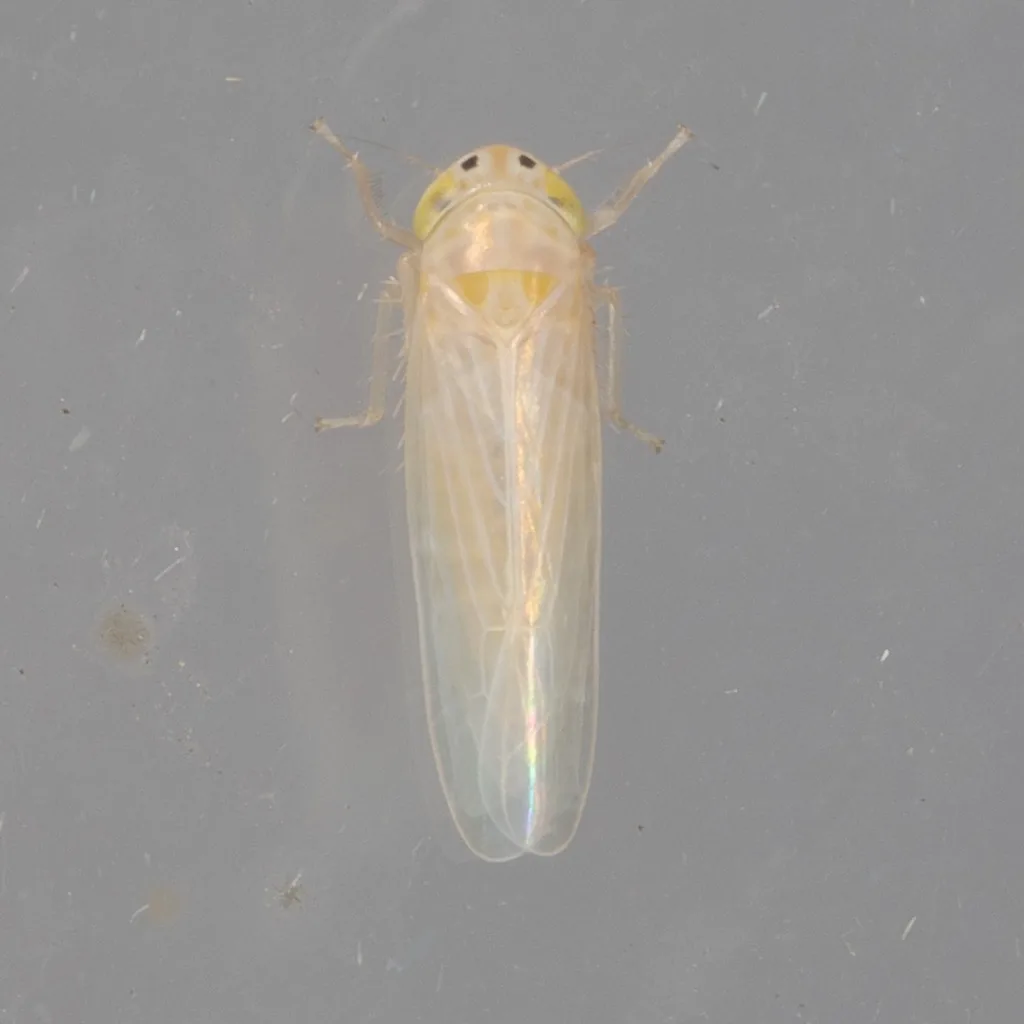
- Adults are light tan to pale yellow or beige and about 1/8 to 1/4 inch long, with two conspicuous dark spots on top of the head between the eyes, visible with a 10X hand lens.[3][1]
- Nymphs are wingless and range from translucent yellow or green to tan or dark brown. When disturbed they run quickly across the underside of the leaf and may move sideways or even backwards.[3][1]
- Adults and nymphs feed inside the whorl of young corn, then move to the undersides of the leaves as plants grow.[3]
Look-alikes
| Look-alike | How to tell them apart |
|---|---|
| Other leafhoppers | The corn leafhopper's most distinguishing feature is the pair of dark spots between its eyes, on top of the head; check with a 10X hand lens.[3][1] |
Where it lives
It is native to tropical and subtropical Central and South America and has been expanding into more temperate regions. It was detected in southern Texas in 2016 and first recorded in Oklahoma and Kansas, along with the corn stunt pathogen, in summer 2024. Nebraska Extension says the leafhopper and corn stunt were first reported in 11 new states in 2024; in Nebraska the leafhopper was confirmed in several counties in 2024 and 2025 and corn stunt in a few fields, late enough in the season that economic damage there is unlikely so far. In California it has been found in many Central Valley counties and in Riverside and Los Angeles counties, and corn stunt has been identified in Kern, Kings, Tulare and Fresno counties.[1][2][3]
Biology and life cycle
Adults can feed on a number of grasses but lay eggs only on corn, and nymphs are not known to complete development on any other plant. Females prefer young plants and can each lay up to 600 eggs, inserted one at a time into the plant tissue where contact insecticides cannot reach them.[1]
There are five nymphal stages, and the whole life cycle takes only 25 to 30 days, so two generations can develop in a single corn crop. Adults live 30 to 80 days.[1]
Adults overwinter carrying their pathogens. In California's southern San Joaquin Valley they shelter in grassy vegetation along waterways, ditch banks and fence lines, and in the crowns of alfalfa, which they do not feed on, then fly to corn as soon as it emerges in spring. Kansas State considers overwintering survival unlikely where winters freeze and expects Kansas infestations to come from seasonal migrants from lower latitudes.[3][1]
Adults are strong dispersers: a dry-season form can survive several months without host plants and migrate long distances.[1]
Once a leafhopper picks up the corn stunt pathogen it stays infected for life, and the pathogen multiplies inside it. Nebraska Extension says it can pass the pathogen to new plants about two to three weeks after acquiring it, and that the corn leafhopper is the only known way corn stunt spiroplasma is transmitted.[1][2]
Damage and signs
- Feeding removes sap, heavy populations can dry the leaves, and the honeydew they produce grows black sooty mold that reduces photosynthesis.[3][1]
- The greater damage is disease. The leafhopper transmits Spiroplasma kunkelii, which causes corn stunt, as well as maize bushy stunt phytoplasma and maize rayado fino virus. Outbreaks in Argentina have cost up to 12% of the corn crop to corn stunt.[1][3]
- Corn stunt symptoms appear about 30 days after infection. Only plants infected early are greatly reduced in final height; later infections cause shortened internodes and reddening of the leaves.[1]
- Losses are greater when leafhoppers arrive early in the crop's development, and infestations and corn stunt get worse as the growing season goes on.[1][3]
Health risk
It feeds only on plants. Kansas State, UC IPM and Nebraska Extension describe it only as a pest of corn and don't mention any risk to people or pets.[1][3][2]
Control
Prevention
Plant as early as possible and keep a corn-free period over the winter; in Kansas, later plantings are more at risk because the leafhoppers arrive as migrants. Early planting lowers infestation and disease but will not eliminate them.[3][1]
Do not try to make up for stunting with extra nitrogen: it makes corn more attractive and more suitable for the leafhoppers. Thin stands are also more attractive.[1]
Keep them out
In sweet corn, reflective plastic mulch repels adult leafhoppers and reduces corn stunt. It is too expensive for silage or grain corn but may be practical for sweet corn.[3]
Sanitation
In Central and South America, management rests on annual corn-free periods, control of volunteer corn and control of grassy weeds around field borders. Corn-free periods break the green bridge and drive leafhopper numbers down by depriving them of host plants.[1]
Biological control
A tiny fairyfly wasp, Anagrus virlai, is the main egg parasitoid in the Americas, and lady beetles, lacewings, earwigs, predatory bugs, spiders and ants prey on the young stages. Natural enemies are worth conserving, though they cannot be relied on alone; in California, a parasite known from Mexico and South America has not been found, and the common predators there appear to have little effect.[1][3]
Pesticides
UC IPM says treatment thresholds have not been established and insecticide treatments are not recommended: registered insecticides do not prevent corn stunt, and systemic seed treatments reduced leafhopper numbers but only negligibly reduced the disease. Kansas State says neonicotinoid seed treatments protect young plants for only about two weeks and that the eggs sit inside plant tissue out of reach of contact insecticides, and Nebraska Extension says chemical management is not currently considered economically viable. Yellow sticky traps show whether leafhoppers are present, but there is no established economic threshold.[3][1][2]
Where the sources disagree
Native range: Kansas State says it is native to tropical and subtropical Central and South America; Nebraska Extension says it is native to Central America and has expanded south into Brazil and Argentina.[1][2]
Size: UC IPM and Nebraska Extension give about 1/8 inch; Kansas State gives 1/8 to 1/4 inch.[3][2][1]
Hosts: UC IPM says corn is its only host in California; Kansas State says adults can feed on a number of grasses but lay eggs only on corn.[3][1]
Seed treatments: Kansas State says neonicotinoid seed treatments give about two weeks of protection; Nebraska Extension cites some evidence of protection through the V3 stage; UC IPM says they reduced leafhopper numbers but only negligibly reduced corn stunt.[1][2][3]
Spraying: UC IPM does not recommend insecticide treatments, and Nebraska Extension says chemical management is not currently economically viable; Kansas State says that in subtropical regions the mere presence of the insect is often taken as justification for spraying, and that it is not yet clear whether monitoring or spraying will be justified in Kansas.[3][2][1]
Overwintering: UC IPM says adults overwinter in California's southern San Joaquin Valley; Kansas State considers overwintering survival unlikely where winters freeze and expects Kansas infestations to come from migrants.[3][1]
Common questions
- How can I protect sweet corn from corn leafhopper?
- Plant as early as possible, keep a corn-free period over the winter, and consider reflective plastic mulch, which repels adult leafhoppers and reduces corn stunt in sweet corn.[3]
- Why are my corn plants short with reddish leaves?
- Corn stunt, spread by the corn leafhopper, is one cause. Symptoms show about 30 days after infection: plants infected young end up much shorter, and later infections cause shortened internodes and reddened leaves.[1]
Sources
- Kansas State University Extension, “Corn Leafhopper, MF3685 (J. P. Michaud, November 2025).” bookstore.ksre.ksu.edu/download/corn-leafhopper_MF3685 (accessed 2026-11-13)
- University of Nebraska-Lincoln Extension (CropWatch), “Presence of Corn Leafhoppers Confirmed in Nebraska (CropWatch).” cropwatch.unl.edu/presence-corn-leafhoppers-confirmed-nebraska/ (accessed 2026-11-13)
- University of California Statewide IPM Program, “Corn Leafhopper (Pest Management Guidelines: Corn).” ipm.ucanr.edu/agriculture/corn/corn-leafhopper/ (accessed 2026-11-13)
- Global Biodiversity Information Facility (GBIF), “Dalbulus maidis (DeLong, 1923) (GBIF Backbone Taxonomy).” api.gbif.org/v1/species/2040969 (accessed 2026-11-13)
- iNaturalist, “Dalbulus maidis taxon page (order and family).” www.inaturalist.org/taxa/738011 (accessed 2026-11-08)