On this page
How to identify it
- The caterpillar is dark green when it hatches. Mature caterpillars are about 1.5 inches long and olive green, with a dark band along the center of the back and lighter stripes on each side.[1]
- The Pacific Northwest handbook describes the caterpillars as varying from light to dark, with three white lengthwise stripes and many black and white tubercles.[2]
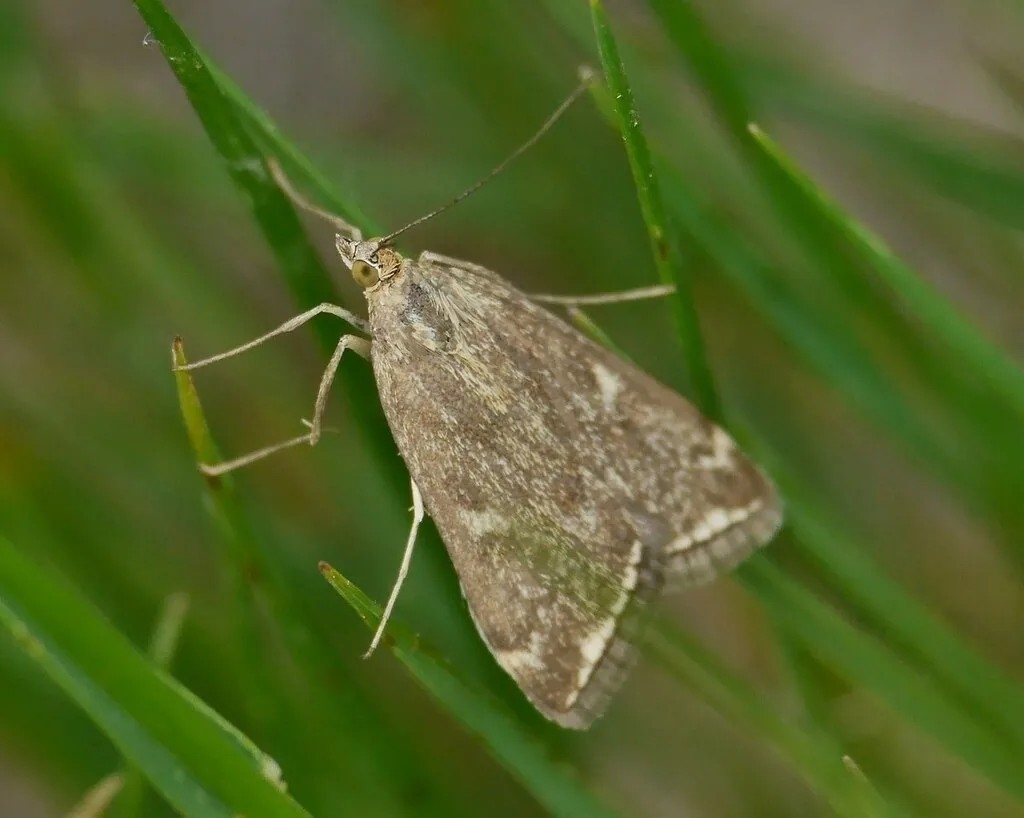
- Adults are small buff to smoky brown moths that are active at night; during the day they can be seen flying out of the foliage as you walk through a field.[1]
- Eggs are small, yellow or green, and laid in groups of 2 to 20 on the undersides of leaves. Beet webworm eggs are laid end to end, while alfalfa webworm eggs are in overlapping groups.[1]
- Utah State University describes the caterpillars as mainly green with light stripes and white spots that have black centers, and the adults as brownish-tan moths with white markings on the wings.[6]
Look-alikes
| Look-alike | How to tell them apart |
|---|---|
| Alfalfa webworm | Yellowish to dark green with a broad light-colored stripe down the back and a darker stripe parallel to it. Its eggs are laid in overlapping groups rather than end to end.[1] |
| Garden webworm | Yellowish to green with a pale double stripe along the center of the back, a lighter line on each side and numerous distinct black spots.[1] |
Where it lives
UC IPM covers it as a pest of sugarbeets in California, and the Pacific Northwest handbook as a pest of clover hay. GBIF holds 117 U.S. records since 1990, led by North Dakota (21), Colorado (18) and Minnesota (8). Utah State University reports it is commonly found in Utah field-grown hemp, feeding on scattered leaflets.[1][2][3][6]
Biology and life cycle
UC IPM covers it in sugarbeets and the Pacific Northwest handbook in clover hay. UC IPM says injury and defoliation appear to be worse in weedy fields, particularly fields with pigweed and lambsquarters.[1][2]
Webworms overwinter as larvae or pupae and emerge in early spring.[1]
Hosts listed by Utah State University include beets, field-grown hemp, amaranth (Amaranthus), legumes, spinach, cotton, corn, eggplant and a variety of weeds.[6]
Utah State University gives 2 generations a year. Caterpillars overwinter in the soil and pupate in late spring; adults emerge in June and females lay egg clusters on the undersides of leaves. The caterpillars spread out to feed and later drop to the ground to pupate in the soil.[6]
Damage and signs
- Webworms eat large amounts of foliage by skeletonizing leaves. As they feed they spin a web, drawing leaves together or folding single leaves into a tube in which they hide when disturbed. UC IPM says damage by the beet, alfalfa and garden webworms is nearly identical.[1]
- They can completely defoliate a field in a very short time, although plants can tolerate considerable defoliation without yield loss.[1]
- On hemp, Utah State University says young caterpillars first skeletonize a patch about the size of their body; as they grow they roll leaflets or pull leaves together with silk and feed inside the tube, leaving irregular holes, webbing and shredded leaves.[6]
Health risk
UC IPM and the Pacific Northwest handbook describe it only as a pest of crops and mention no effect on people.[1][2]
Control
Prevention
Keep fields weed-free, particularly free of pigweed and lambsquarters, since injury and defoliation appear to be worse in weedy fields.[1]
No treatment thresholds are available. Plants tolerate considerable defoliation, but because webworms can defoliate plants quickly, UC IPM advises closely monitoring fields where they are active and treating if defoliation continues.[1]
Traps and physical control
Utah State University advises looking for small egg masses on leaf undersides starting in June, and for caterpillars from June to early July. Hand-pick and destroy caterpillars, remove weeds and plant debris around the crop, and maintain natural enemies.[6]
Biological control
Many biological control agents attack webworms. The Pacific Northwest handbook says parasitic wasps such as Trichogramma species may provide long-term suppression.[1][2]
Bacillus thuringiensis (Bt) has to be eaten to work, so Utah State University advises using it only while the caterpillars are less than one-half inch long, and considering treatment only after chronic infestations or where large populations are consistently present.[6]
Pesticides
If management is needed, UC IPM suggests materials such as Bacillus thuringiensis or spinosad, which have low impact on natural enemies. Read the label of the product being used.[1]
Where the sources disagree
Natural enemies: UC IPM says numerous parasites and predators attack webworms but doubts any of them can regulate webworm populations; the Pacific Northwest handbook says parasitic wasps such as Trichogramma may provide long-term suppression.[1][2]
Caterpillar markings: UC IPM describes an olive-green caterpillar with a dark band along the back and lighter stripes on each side; the Pacific Northwest handbook says caterpillars vary from light to dark with three white lengthwise stripes.[1][2]
Damage potential: UC IPM says webworms can completely defoliate a sugarbeet field in a very short period of time; Utah State University rates the threat to hemp as low, saying foliage damage is minor and should not reduce yields.[1][6]
Overwintering: UC IPM says webworms overwinter as larvae or pupae; Utah State University says beet webworm overwinters as larvae in the soil and pupates in late spring.[1][6]
Seeing the moths: UC IPM says the night-active moths can be readily seen flying out of the foliage as you walk through a field; Utah State University says they fly at night and are rarely seen.[1][6]
Common questions
- What are the olive-green caterpillars webbing my beet leaves together?
- If they are olive green with a dark band down the center of the back and lighter stripes on each side, and reach about 1.5 inches, they may be beet webworms. The Pacific Northwest handbook also notes many black and white tubercles.[1][2]
- How fast can beet webworms damage a field?
- Quickly. UC IPM says webworms can completely defoliate a field in a very short period of time, so fields where they are active should be closely monitored.[1]
Sources
- University of California Statewide IPM Program (UC IPM), “Webworms, Sugarbeet: Agriculture Pest Management Guidelines.” ipm.ucanr.edu/agriculture/sugarbeet/webworms/ (accessed 2026-11-14)
- Pacific Northwest Pest Management Handbooks (Oregon State University, Washington State University, University of Idaho), “Clover hay-Webworm (Pacific Northwest Insect Management Handbook).” pnwhandbooks.org/node/6659 (accessed 2026-11-14)
- Global Biodiversity Information Facility (GBIF), “Loxostege sticticalis: U.S. occurrence records since 1990 by state (GBIF occurrence search).” api.gbif.org/v1/occurrence/search?taxonKey=1882210&country=US&hasGeospatialIssue=false&occurrenceStatus=PRESENT&year=1990%2C2026&facet=stateProvince&facetLimit=400&limit=0 (accessed 2026-11-14)
- Global Biodiversity Information Facility (GBIF), “Loxostege sticticalis Linnaeus, 1761 (GBIF Backbone Taxonomy).” api.gbif.org/v1/species/1882210 (accessed 2026-11-14)
- iNaturalist, “Loxostege sticticalis taxon page (order and family).” www.inaturalist.org/taxa/224154 (accessed 2026-11-09)
- Utah State University Extension, “Beet Webworm, Loxostege sticticalis (hemp IPM).” extension.usu.edu/planthealth/ipm/notes_ag/hemp-beet-webworm (accessed 2026-11-14)