On this page
How to identify it
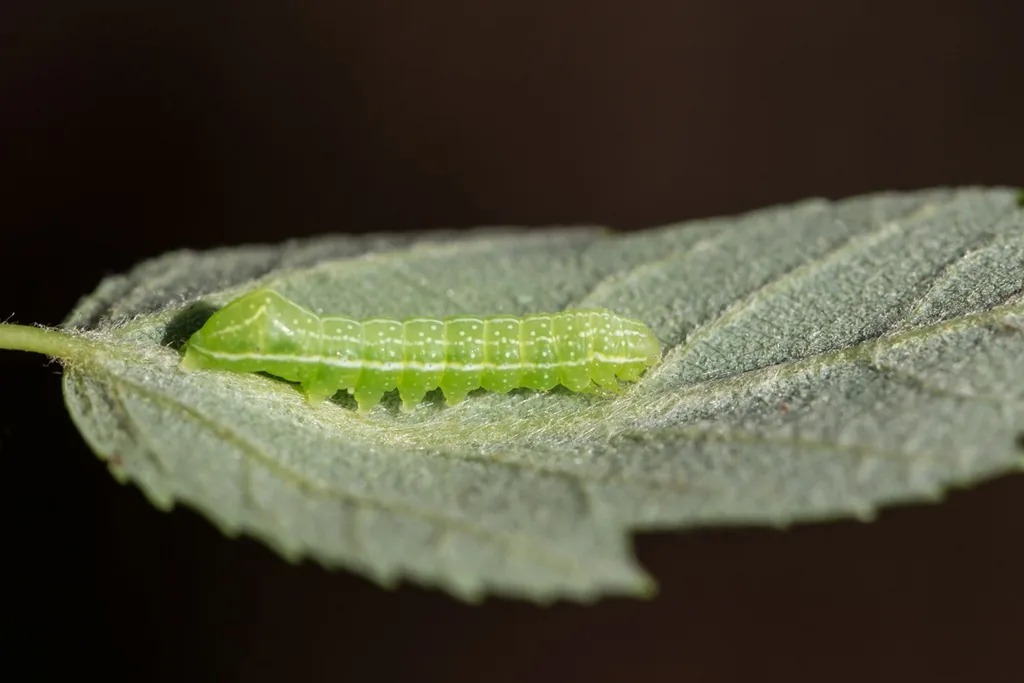
- The mature caterpillar is green with a green head and a prominent hump on the last body segment, bright yellow lines along the sides and fainter white lines on the back; the Forest Service describes it as sea green with numerous creamy yellow spots and a yellow and white spiracular line that is often interrupted on the third thoracic and first abdominal segments.[1][2][4]
- Young larvae are plain light green and hard to tell from other small green caterpillars; they feed by day, while older larvae feed at night and hide during the day.[1][2]
- Green fruitworms have five pairs of fleshy prolegs, unlike sawfly larvae, which have a pair on every abdominal segment.[2]
- Adult fruitworm moths are large, with gray to reddish-brown wings, and are attracted to lights in fall and spring.[3]
Look-alikes
| Look-alike | How to tell them apart |
|---|---|
| Speckled green fruitworm and other green fruitworms | The speckled green fruitworm has cream-colored lines down the back and sides but no tail hump; the Pacific Northwest page lists the pyramidal fruitworm alongside Lithophane antennata, the green fruitworm.[1][3] |
| Pear sawfly and other sawfly larvae | Sawfly larvae have a pair of legs on every abdominal segment, whereas the copper underwing and other fruitworms have only five pairs of prolegs.[2] |
| Cutworms | Immature fruitworms look like cutworms with green bodies and heads; cutworms are duller and usually hide in the soil rather than in the fruit cluster.[3] |
Where it lives
UC IPM treats it as one of the two most important green fruitworms in California, and the Pacific Northwest handbook lists it as a pest of apple. A USDA Forest Service guide gives its range as Quebec through the eastern and midwestern US, west to British Columbia and California, and south to Arizona, Texas and Florida. GBIF's US records since 1990 number about 12,000.[1][2][3][5][7]
Biology and life cycle
There is one generation a year. Eggs hatch from pink bud through after petal fall; young larvae feed on leaves and flowers, sometimes tying them together with silk, and fruit feeding starts around petal fall and continues until the larvae finish developing and drop to the soil to pupate.[1][3]
Depending on the species, green fruitworms overwinter either as a pupa in the ground or as a fertilized female moth that lays eggs on twigs in spring, often before the buds open.[3]
In forests the caterpillar is found from May to June on a wide range of trees and shrubs; orchard hosts named by the handbooks include willow, birch, alder and maple as well as tree fruits.[4][3]
Birds are often seen eating the larvae, ground predators probably reduce overwintering pupae and adults, and some parasitic wasps are important.[3]
A USDA Forest Service guide to oak caterpillars in Missouri says it feeds on plants in 17 families, favoring birch, oak, willow, basswood and elm, and in the West maple and Arctostaphylos; mature caterpillars sometimes feed on apple or peach fruit.[5]
Damage and signs
- Fruit feeding begins inside the cluster, with the caterpillar taking bites out of most fruits in it; badly damaged fruit drop, and fruit that stays on the tree is misshapen at harvest with large, roughened, russeted cavities.[1][3]
- Populations are spotty within an orchard and often heaviest near borders where windbreaks and other trees act as sources, so the larvae tend to occur in clumps and thorough monitoring is required.[1][3]
Health risk
The sources treat it only as a fruit and foliage feeder; no cited source describes any risk to people or pets.[1][3][4]
Control
Prevention
Examine fruit clusters shortly after fruit set for the small green larvae. UC IPM samples 100 fruit clusters, takes 50 beating-tray samples around petal fall when larvae are easily dislodged, or inspects a block for half an hour, and considers treatment when one or more larvae turn up per 100 clusters or 50 tray samples.[3][1]
Traps and physical control
Hand-pick larvae when thinning fruit; adults can be collected in black-light traps.[3]
Biological control
Birds, ground predators and parasitic wasps already take a toll; in orchards that received a delayed-dormant spray for other pests, green fruitworms are often controlled incidentally, and they become a problem mainly where that spray was skipped.[3][1]
Pesticides
UC IPM lists Bacillus thuringiensis and an organic formulation of spinosad as organically acceptable; in the Pacific Northwest, Btk is applied two to three times from prepink through petal fall when temperatures exceed 60 F. Home-orchard pink sprays listed there include azadirachtin, kaolin and pyrethrins, with carbaryl and several pyrethroids noted as highly toxic to bees.[1][3]
Where the sources disagree
Overwintering: the Pacific Northwest handbook says green fruitworms, depending on species, overwinter as pupae in the ground or as fertilized female moths, with eggs laid on twigs in spring; the USDA Forest Service oak guide says copper underwing eggs laid from September spend the winter and hatch in early spring.[3][5]
Pupation: the Pacific Northwest handbook says mature larvae drop to the soil to pupate and, depending on species, stay there as pupae through winter or emerge as adults in fall; the oak guide gives pupation in a cocoon at the soil surface in mid-June, with adults emerging in July.[3][5]
Common questions
- What is the green caterpillar with a hump on its tail eating my apple leaves?
- A green caterpillar with a raised hump on its last segment and bright yellow stripes along its sides is the humped green fruitworm, the caterpillar of the copper underwing moth; it feeds on leaves and flowers in spring and then bites into young fruit.[1][2]
- Will the damaged apples recover?
- No. Fruit bitten by green fruitworms either drop or grow on misshapen with large, rough, russeted scars where the caterpillar fed.[1][3]
- Is the copper underwing only an orchard pest?
- No. The Forest Service lists it as a general feeder on trees and shrubs, and the Pacific Northwest handbook names willow, birch, alder and maple among its hosts.[4][3]
Sources
- University of California Statewide IPM Program, “Green Fruitworms, UC Pest Management Guidelines: Apple.” ipm.ucanr.edu/agriculture/apple/green-fruitworms/ (accessed 2026-11-13)
- University of California Statewide IPM Program, “Pest identification and confirmation: Green fruitworm (Home, Garden, Turf and Landscape Pests).” ipm.ucanr.edu/PMG/GARDEN/FRUIT/PESTS/ID/idgreenfruitworm.html (accessed 2026-11-13)
- Pacific Northwest Pest Management Handbooks (Oregon State University, Washington State University and University of Idaho), “Apple-Green fruitworm, Pacific Northwest Insect Management Handbook.” pnwhandbooks.org/insect/tree-fruit/apple/apple-green-fruitworm (accessed 2026-11-13)
- USDA Forest Service, Forest Health Technology Enterprise Team, “Caterpillars of Eastern Forests, FHTET-96-34 (D. L. Wagner, V. Giles, R. C. Reardon and M. L. McManus, 1997).” www.fs.usda.gov/foresthealth/technology/pdfs/Caterpillars_of_Eastern_Forests.pdf (accessed 2026-11-13)
- USDA Forest Service, Forest Health Assessment and Applied Sciences Team, “Illustrated Guide to the Immature Lepidoptera on Oaks in Missouri, FHAAST-2018-05 (R. J. Marquis and others, 2019).” www.fs.usda.gov/foresthealth/technology/pdfs/FHAAST-2018-05_Immature_Lepidoptera_Oaks.pdf (accessed 2026-11-13)
- Global Biodiversity Information Facility (GBIF), “Amphipyra pyramidoides Guenée, 1852 (GBIF Backbone Taxonomy).” api.gbif.org/v1/species/1766205 (accessed 2026-11-13)
- Global Biodiversity Information Facility (GBIF), “Amphipyra pyramidoides: U.S. occurrence records since 1990 by state (GBIF occurrence search).” api.gbif.org/v1/occurrence/search?taxonKey=1766205&country=US&hasGeospatialIssue=false&occurrenceStatus=PRESENT&year=1990%2C2026&facet=stateProvince&facetLimit=400&limit=0 (accessed 2026-11-13)