On this page
How to identify it
- Caterpillars are pale green with a dark head and feed inside leaves they roll or web together. UC IPM and Kentucky use the shiny black head and the black spot just behind it to tell it from other leafrollers (see where the sources disagree).[1][2][4][3]
- Full-grown caterpillars are roughly 3/4 to 1 inch long (see where the sources disagree).[4][1][2][3]
- Egg masses are flat, irregular patches of 30 to 100 eggs cemented over with a secretion on twigs and small branches; they turn white by spring.[1][2][5]
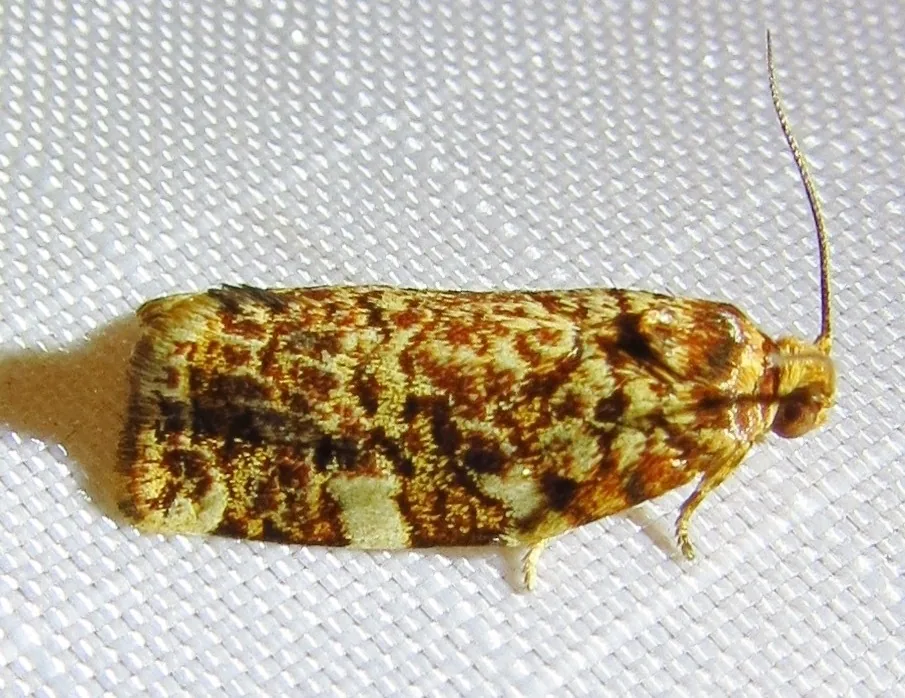
- Adult moths are about 1/2 inch long with a wingspan of about 5/8 to 7/8 inch. UC IPM describes the forewings as mottled brown and tan with gold flecks and the hind wings as whitish to gray; the USDA guide adds that most have two pale tan patches on the front edge and that females are generally lighter than males.[1][3]
Look-alikes
| Look-alike | How to tell them apart |
|---|---|
| Obliquebanded leafroller | Its young larvae also look green with a black head, but it has two generations a year, so its second brood causes damage later in summer.[1] |
Where it lives
Native to North America and found throughout the continental United States and southern Canada. It attacks ornamentals and fruit trees throughout California, is one of three common leafrollers on fruit trees in Kentucky, and occurs in Connecticut apple orchards, though infestations there have been uncommon for decades.[3][1][4][5]
Biology and life cycle
It has one generation a year and spends the winter as eggs on twigs and bark. Eggs laid in June and July hatch the next spring, from late February to mid-May depending on the area, about when buds open.[1][3][4][5]
In Connecticut the caterpillars feed from late April to mid-June, pupate in late June and lay new egg masses starting in early July.[5]
Young larvae bore into buds; older ones roll or tie leaves together or to fruit and feed on leaves, flower buds, blossoms and young fruit. They pupate inside the leaf shelter, and moths emerge one and a half to two weeks later (see where the sources disagree) and fly for about three weeks.[3][2][1][4]
Damage and signs
- Caterpillars web and chew new leaves and sometimes fruit; heavy outbreaks can defoliate trees, and oaks in California's Central Valley can be hit especially hard.[1][2][5]
- In the first half of the 1900s, outbreaks completely defoliated large areas; the USDA guide says the moth was brought under control after pesticides arrived in the mid-1950s. In outbreaks the caterpillars feed on almost any plant near their main host, and recorded hosts include maples, oaks, birch, dogwood, rhododendron, blueberry and black locust.[3]
- UC IPM notes that a single defoliation will not kill a tree unless it is very small.[1]
Health risk
It feeds only on plants and does not bite or sting; UC IPM, Kentucky and the Connecticut station mention no risk to people.[1][4][5]
Control
Prevention
Look for the flat, whitish egg masses on twigs in winter and check new leaves at bud break; Connecticut notes that pheromone traps can monitor the moth flight.[2][5]
Biological control
General predators such as lacewing and lady beetle larvae, plus parasites, usually keep numbers low.[2]
Pesticides
A thorough dormant oil spray that covers the egg masses gives good control, and oil sprays used for scales in the dormant season also help. Bacillus thuringiensis (Bt) works best on caterpillars under 1/2 inch and usually needs a second spray 7 to 10 days later; Kentucky also recommends Bt for backyard apples while the larvae are small.[2][1][4]
UC IPM lists narrow-range oil, Bt and spinosad as organically acceptable choices, and says sprays are seldom necessary in landscapes. Treat only when many egg masses or young larvae show up: by the time trees are badly defoliated the caterpillars are almost done.[2][1]
Where the sources disagree
Caterpillar head: UC IPM and Kentucky describe it as black and use it for identification; the USDA identification guide says last-instar heads are reddish brown to dark brown and too variable to diagnose.[1][2][4][3]
Caterpillar size: Kentucky says up to about 3/4 inch, UC IPM's home-landscape page 3/4 to 1 inch, its apple guidelines about an inch, and the USDA guide 15 to 24 mm.[4][1][2][3]
Pupal period: UC IPM says moths emerge 8 to 11 days after pupation, the USDA guide about 10 to 12 days, and Kentucky about two weeks.[1][3][4]
Common questions
- What are the green caterpillars rolling up leaves on my oak in spring?
- Often fruittree leafrollers, the most common leafroller in California landscapes; they feed inside rolled or webbed leaves.[1]
- When should I treat fruittree leafrollers?
- In the dormant season with oil on the egg masses, or with Bt while caterpillars are small; late sprays after heavy defoliation do little good.[2][1]
- Will leafrollers kill my tree?
- Rarely. UC IPM says a single defoliation will not kill a tree unless it is very small, and late sprays after heavy defoliation do little good.[1]
Sources
- University of California Statewide IPM Program, “Leafrollers on Ornamental and Fruit Trees (Pest Notes 7473).” ipm.ucanr.edu/home-and-landscape/leafrollers-on-ornamental-and-fruit-trees/ (accessed 2026-11-13)
- University of California Statewide IPM Program, “Fruittree Leafroller (UC IPM Pest Management Guidelines: Apple).” ipm.ucanr.edu/agriculture/apple/fruittree-leafroller/ (accessed 2026-11-13)
- USDA APHIS PPQ Identification Technology Program, “Archips argyrospila fact sheet (TortAI: Tortricids of Agricultural Importance).” idtools.org/id/leps/tortai/Archips_argyrospila.htm (accessed 2026-11-13)
- University of Kentucky Entomology, “Leafrollers (ENTFACT-216).” entomology.mgcafe.uky.edu/ef216 (accessed 2026-11-13)
- Connecticut Agricultural Experiment Station, “Plant Pest Handbook: Apple (Malus).” portal.ct.gov/caes/plant-pest-handbook/ppha/apple-malus (accessed 2026-11-13)
- Global Biodiversity Information Facility (GBIF), “Archips argyrospila (Walker, 1863) (GBIF Backbone Taxonomy).” api.gbif.org/v1/species/4302202 (accessed 2026-11-13)
- iNaturalist, “Archips argyrospila taxon page (order and family).” www.inaturalist.org/taxa/214078 (accessed 2026-10-06)