On this page
How to identify it
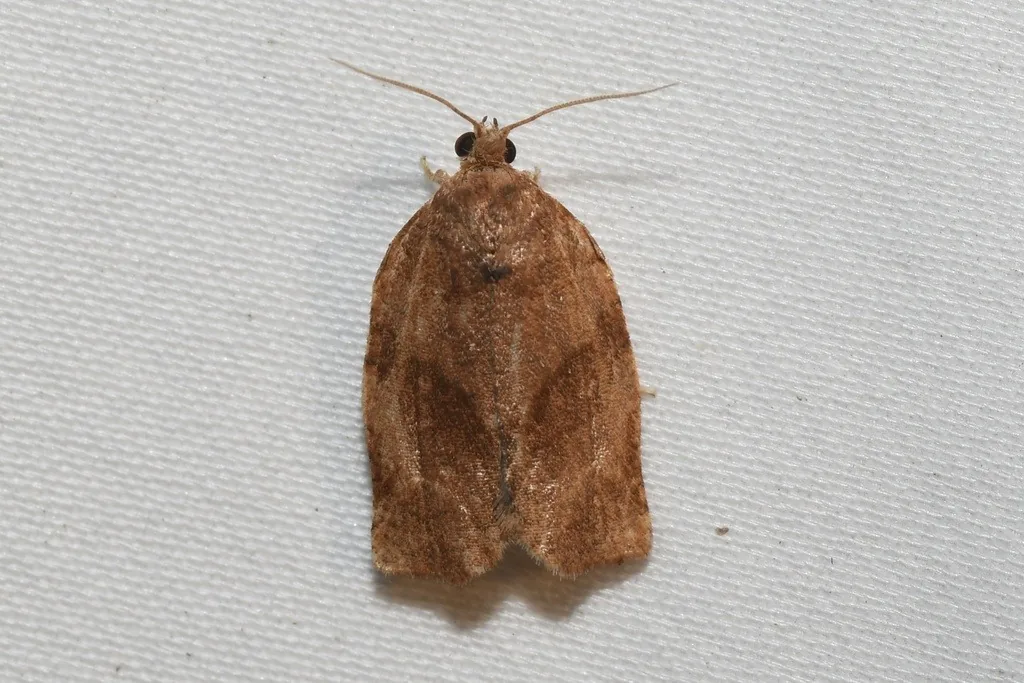
- Moths are reddish brown to light beige, often tinged pink, with three oblique chocolate-brown bands across the forewings; the hind wings are pale yellow. Cornell gives a body length of 9-12 mm and a wingspan of 20-27 mm; Utah State describes the moths as around 3/4 to 1 inch long.[3][5][4]
- Caterpillars are yellowish green to olive green with a head that ranges from light brown to black, and grow to 20-25 mm. When exposed in their rolled leaves they wriggle and drop on a silk thread.[3][5][4]
- Eggs are laid in greenish-yellow overlapping masses on the upper sides of leaves; a mass may hold 200 or more eggs.[1][3][2]
- Pupae are dark brown, about 11 mm long, and usually sit inside rolled leaves on the tree.[3]
Look-alikes
| Look-alike | How to tell them apart |
|---|---|
| Redbanded leafroller | Lays similar overlapping egg masses, but obliquebanded leafroller egg masses are larger, 3/16 to 1/3 inch across, and its fruit feeding is usually much deeper.[2] |
| Fruittree leafroller and other leafrollers | Several leafrollers attack fruit trees; Utah State notes the obliquebanded leafroller is the most common in Utah.[4] |
Where it lives
Native to and widely distributed throughout temperate North America. In California it occurs in Central Valley orchards but is rarely found on the Central Coast. GBIF holds 6,893 U.S. records since 1990 from 51 state-level areas, the most from Alabama (549), Illinois (486) and Maryland (396).[3][1][6][7]
Biology and life cycle
It spends the winter as a small caterpillar in a tight silk shelter (hibernaculum) in bark crevices or under loose bark scales, and resumes feeding at bud break.[4][5][6]
The number of generations depends on the climate: two a year in Pennsylvania, one or two depending on the area per Cornell, and two or three in California's Central Valley.[1][3][6]
Moths emerge in late May or early June in Pennsylvania. Females can lay up to 900 eggs over a 7- to 8-day laying period, and eggs hatch in about 10 to 12 days.[1][3]
Late-summer and fall caterpillars feed mainly on leaves until they reach the third instar, then build their winter shelters on twigs or bark.[1][3]
Wasps in the genera Macrocentrus, Cotesia and Exochus parasitize the caterpillars, and lacewings, assassin bugs and minute pirate bugs eat eggs and larvae.[6]
Damage and signs
- It prefers plants in the rose family, including apple, pear, peach, cherry, apricot and plum, and many other deciduous trees.[1][2][4][3]
- Overwintered caterpillars feed on buds, flowers and young fruit. Many damaged fruits drop early, and the rest carry deep corky scars and dents at harvest; summer caterpillars feed on the fruit surface and leave shallow pits that may not show up until fruit has been stored.[3][5]
- Penn State says it has historically been a minor pest but warns of outbreaks in several areas, and NC State says it is generally not a major problem in North Carolina.[1][2]
- Some commercial orchard populations resist insecticides. In Michigan apple and cherry orchards, populations showed resistance to several insecticides, highest for indoxacarb, and the loss of field performance was measurable for some products.[8][9]
Health risk
It feeds on fruit trees and other plants. Penn State, NC State, Cornell, UMass, Utah State and UC IPM don't mention any risk to people or pets.[1][2][3][5][4][6]
Control
Prevention
A pheromone trap shows when moths are flying and how many there are. Utah State says leafrollers often do not cause enough damage in backyard trees to warrant treatment.[4][3][5]
Traps and physical control
Check terminal shoots for rolled leaves or holes in leaves starting in mid-May, and kill the caterpillars by hand or cut out infested shoots.[4]
Thinning fruit and pruning water sprouts in midsummer helps reduce fruit damage.[5]
Biological control
Protect the parasitic wasps and predators that keep leafroller numbers low by choosing selective products when treating other pests.[6]
Pesticides
If treatment is needed, Bacillus thuringiensis subsp. kurstaki (Bt) works on young caterpillars. UC IPM says Bt is a stomach poison that must be eaten, so it is most effective in warm, dry weather when larvae are actively feeding, and UMass says Bt is not effective against larger larvae. EPA's product search lists active registrations under that name.[5][3][6][10]
Utah State lists spinosad and Bt among residential examples. For orchards, Cornell and UC IPM also list spinetoram, chlorantraniliprole and methoxyfenozide, and EPA's product search lists active registrations under each of these names. Penn State says a petal fall treatment with an insecticide effective on mid-sized to large larvae should control overwintered larvae, with a second window in June and July when most summer-brood eggs have hatched; Utah State gives May or late June. UC IPM says spinosad and spinetoram are toxic to bees for 3 hours after treatment, so do not spray them on or let them drift onto blooming crops or weeds where bees are foraging, and apply in the late evening after bees have stopped. Follow the label.[4][3][6][11][12][13][14][1]
If repeat sprays are needed, UMass says to rotate insecticides from different IRAC groups to reduce the chance of resistance. NC State says that in some areas the obliquebanded leafroller has developed resistance to standard insecticides, and Michigan State researchers documented resistance in apple and cherry orchard populations.[5][2][8]
Where the sources disagree
Generations a year: Penn State says two; Cornell says one or two depending on the locality; UC IPM says two or three in the Central Valley; NC State says that in warmer areas the summer larvae may produce a third generation.[1][3][6][2]
Moth size: Penn State says adults are ½ inch long with a 1-inch wingspan; Cornell and NC State give 9 to 12 mm long with a 20 to 27 mm wingspan; Utah State says around ¾ to 1 inch long; UMass gives about 24 mm for females and 20 mm for males.[1][3][2][4][5]
How serious it is: Penn State says multiple outbreaks in various areas are cause for concern; NC State says it is generally not a major problem in North Carolina.[1][2]
Overwintering larvae: UMass says they overwinter as second or third instars; UC IPM and Cornell say third instars.[5][6][3]
First moths: Penn State says adults begin to emerge in late May or early June; UMass says around mid-June; NC State says usually by mid-May in North Carolina; UC IPM says late March or April in California.[1][5][2][6]
Common questions
- What is rolling and webbing the leaves on my apple tree?
- Often a leafroller such as the obliquebanded leafroller, the most common leafroller in Utah. Its green, dark-headed caterpillar hides in the rolled leaf and wriggles out on a silk thread when disturbed.[1][4]
- Do I need to spray?
- Usually not on backyard trees, by Utah State's account: leafrollers often do not cause enough damage to warrant treatment, and it suggests killing the caterpillars by hand or cutting out infested shoots. UMass says Bt may reduce larvae while they are still small but is not effective against larger larvae.[4][5]
- When are the caterpillars active?
- From bud break through spring, then again in summer; there are one to three generations a year depending on the area.[4][1][3][6]
- Is it harmful to people or pets?
- Penn State, NC State, Cornell, UMass, Utah State and UC IPM describe it as a pest of fruit trees and don't mention any risk to people or pets.[1][2][3][5][4][6]
Sources
- Penn State Extension, “Tree Fruit Insect Pest - Obliquebanded Leafroller (updated February 25, 2026).” extension.psu.edu/tree-fruit-insect-pest-obliquebanded-leafroller/ (accessed 2026-11-13)
- NC State Extension, “Obliquebanded Leafroller (PDIC Factsheet).” content.ces.ncsu.edu/obliquebanded-leafroller (accessed 2026-11-13)
- Cornell University, New York State Integrated Pest Management, “Obliquebanded Leafroller (Choristoneura rosaceana) Fruit IPM Fact Sheet.” cals.cornell.edu/integrated-pest-management/outreach-education/fact-sheets/obliquebanded-leafroller-choristoneura-rosaceana-fruit-ipm-fact-sheet (accessed 2026-11-13)
- Utah State University Extension (Integrated Pest Management), “Fruit Leafrollers (fruit pest fact sheet).” extension.usu.edu/planthealth/ipm/notes_ag/fruit-fruit-leafrollers.php (accessed 2026-11-13)
- UMass Amherst Extension, Center for Agriculture, Food, and the Environment, “Apple IPM: Obliquebanded Leafroller.” www.umass.edu/agriculture-food-environment/fruit/fact-sheets/apple-ipm-obliquebanded-leafroller (accessed 2026-11-13)
- UC Statewide IPM Program, University of California, “Obliquebanded Leafroller (Apricot Pest Management Guidelines).” ipm.ucanr.edu/agriculture/apricot/obliquebanded-leafroller/ (accessed 2026-11-13)
- Global Biodiversity Information Facility (GBIF), “Choristoneura rosaceana: U.S. occurrence records since 1990 by state (GBIF occurrence search).” api.gbif.org/v1/occurrence/search?taxonKey=5102671&country=US&hasGeospatialIssue=false&occurrenceStatus=PRESENT&year=1990%2C2026&facet=stateProvince&facetLimit=400&limit=0 (accessed 2026-11-13)
- J Econ Entomol 2019;112(2):812-817, via PubMed, “Choristoneura rosaceana (Lepidoptera: Tortricidae) resistance to insecticides in Michigan apple and cherry orchards.” pubmed.ncbi.nlm.nih.gov/30590515/ (accessed 2026-11-13)
- Insects 2021;12(9):846, via PubMed, “Resistance affects the field performance of insecticides used for control of Choristoneura rosaceana in Michigan apples and cherries.” pubmed.ncbi.nlm.nih.gov/34564286/ (accessed 2026-11-13)
- U.S. EPA Pesticide Product Label System, “Pesticide Product Label System: product-name search 'Bacillus thuringiensis subsp. kurstaki'.” ordspub.epa.gov/ords/pesticides/cswu/ProductSearch/partialprodsearch/v2/riname/Bacillus%20thuringiensis%20subsp.%20kurstaki (accessed 2026-11-13). 4 product-name rows, 4 with product status Active; saved 2026-11-13.
- U.S. EPA Pesticide Product Label System, “Pesticide Product Label System: product-name search 'Spinosad'.” ordspub.epa.gov/ords/pesticides/cswu/ProductSearch/partialprodsearch/v2/riname/Spinosad (accessed 2026-11-13). 41 product-name rows, 39 with product status Active; saved 2026-11-13.
- U.S. EPA Pesticide Product Label System, “Pesticide Product Label System: product-name search 'Spinetoram'.” ordspub.epa.gov/ords/pesticides/cswu/ProductSearch/partialprodsearch/v2/riname/Spinetoram (accessed 2026-11-13). 4 product-name rows, 4 with product status Active; saved 2026-11-13.
- U.S. EPA Pesticide Product Label System, “Pesticide Product Label System: product-name search 'Chlorantraniliprole'.” ordspub.epa.gov/ords/pesticides/cswu/ProductSearch/partialprodsearch/v2/riname/Chlorantraniliprole (accessed 2026-11-13). 38 product-name rows, 38 with product status Active; saved 2026-11-13.
- U.S. EPA Pesticide Product Label System, “Pesticide Product Label System: product-name search 'Methoxyfenozide'.” ordspub.epa.gov/ords/pesticides/cswu/ProductSearch/partialprodsearch/v2/riname/Methoxyfenozide (accessed 2026-11-13). 9 product-name rows, 8 with product status Active; saved 2026-11-13.
- Global Biodiversity Information Facility (GBIF), “Choristoneura rosaceana (Harris, 1841) (GBIF Backbone Taxonomy).” api.gbif.org/v1/species/5102671 (accessed 2026-11-13)
- iNaturalist, “Choristoneura rosaceana taxon page (order and family).” www.inaturalist.org/taxa/143728 (accessed 2026-10-06)