On this page
How to identify it
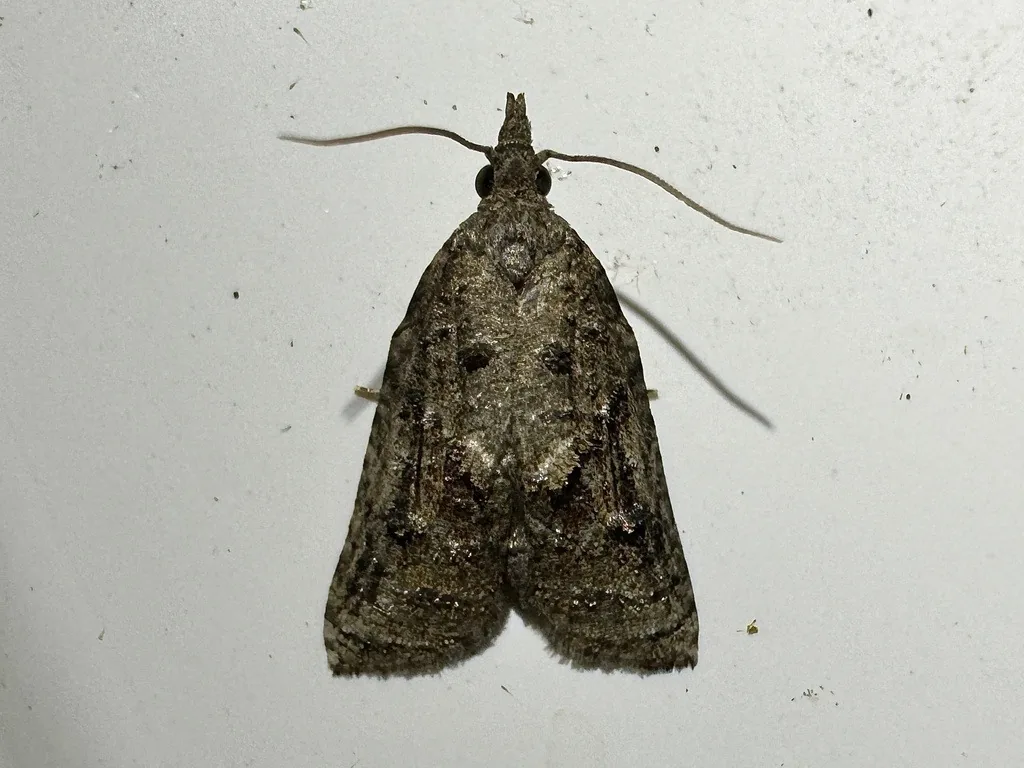
- Moths are about 1/2 inch (12.5 mm) long. Penn State describes the wings as grayish at the base and darkening to brown at the tips, with two or three tufts of raised scales; NC State calls them mottled gray-brown, with mouthparts that extend in front of the head.[1][2]
- Larvae are light brown to grayish tan with a chestnut-brown head, a darker shield behind the head and a dark stripe down the back. NC State says grown larvae are about 3/4 inch long.[1][2]
- Eggs are laid in oval, apple-green masses of about 150 or more, usually along a vein on the upper leaf surface.[1][2]
Look-alikes
| Look-alike | How to tell them apart |
|---|---|
| Redbanded leafroller | Its larva has a pale green body and a yellowish-green head.[1] |
| Obliquebanded leafroller | Its larva is yellowish green with a brown to black head.[1] |
| Fruittree leafroller | Its larva is a translucent apple green with a reddish to dark brown head and an amber shield behind the head.[1] |
| Codling moth and oriental fruit moth | NC State says leafroller feeding leaves canal-like channels on the fruit surface, while codling moth and oriental fruit moth larvae tunnel inside the fruit.[2] |
Where it lives
NC State says it occurs throughout eastern North America and is the most common leafroller on apples in the Southeast. Penn State covers it in Pennsylvania orchards, where larvae also overwinter under cherry, peach and pear trees and in woods.[2][1]
Biology and life cycle
There are two generations a year. Partly grown larvae overwinter in leaves and rotting fruit on the ground.[1][2]
In spring they finish feeding on root suckers and weeds such as dandelion, dock and wild strawberry. Sources differ on timing: Penn State says moths emerge around the beginning of May in Pennsylvania, and NC State says late April in North Carolina.[1][2]
Penn State says egg laying starts in early June and NC State says late May through June. Young larvae spread by crawling or floating on the wind, and Penn State says the second brood starts laying eggs about early August.[1][2]
NC State says first-generation larvae feed mainly on leaves, with some larger ones moving to fruit by July, and second-generation larvae feed on fruit in August and September.[2]
Damage and signs
- Rolled leaves matter little; the trouble starts when a larva ties a leaf to an apple and feeds on the fruit.[1]
- Penn State describes tiny holes, irregular scarring or galleries on the skin, or rot around the stem, and says larvae sometimes get into the calyx and seed cavity. NC State says they also feed at the calyx and stem ends and where two fruits touch.[1][2]
- Most fruit damage comes from the second brood, though in some years the first brood does more.[1]
- Penn State says the injury doesn't lower processing grade but can promote decay in storage.[1]
- NC State says it was the most destructive apple insect in the Southeast in the 1990s, until new insecticides in the early 2000s cut its numbers sharply.[2]
Health risk
It feeds on plants, and no cited source describes any risk to people or pets.[1][2]
Control
Prevention
Orchards track moth flights with sex pheromone traps. Penn State hangs them 5 to 6 feet up in the outer third of the canopy; NC State puts them out at the tight cluster to pink bud stage and uses the catches with a degree-day model to time first-generation sprays.[1][2]
Sanitation
NC State says special precautions are doubtful unless an orchard has a history of damage. It suggests keeping the orchard floor clean in early spring before bloom, which removes the root suckers and broadleaf weeds overwintered larvae feed on.[2]
Pesticides
Penn State says it has become a minor pest because insecticides aimed at codling moth also give long-lasting control of leafrollers; NC State credits new insecticides adopted in many orchards.[1][2]
If damage was too high the previous season, Penn State times sprays around third cover or in the first two weeks of September, and says both timings also help against obliquebanded and redbanded leafrollers. Follow the label.[1]
Common questions
- What makes small holes and scars on apples under a stuck-on leaf?
- Tufted apple bud moth larvae tie leaves to apples and feed on the skin underneath, leaving small holes, scars or shallow channels.[1][2]
- How do I tell tufted apple bud moth larvae from other leafrollers?
- Look for a light brown to grayish-tan body, a chestnut-brown head and a dark stripe down the back. Penn State says redbanded leafroller larvae have a yellowish-green head and obliquebanded larvae a brown to black head.[1]
- Do I need to spray for tufted apple bud moth?
- Often not. Penn State says codling moth sprays usually control it and suggests targeting it only when the previous season's damage was too high; NC State says special precautions are doubtful unless the orchard has a history of damage.[1][2]
Sources
- Penn State Extension, “Tree Fruit Insect Pest: Tufted Apple Bud Moth.” extension.psu.edu/tree-fruit-insect-pest-tufted-apple-bud-moth (accessed 2026-11-13)
- NC State Extension, “Tufted Apple Bud Moth.” content.ces.ncsu.edu/tufted-apple-bud-moth (accessed 2026-11-13)
- Global Biodiversity Information Facility (GBIF), “Platynota idaeusalis (Walker, 1859) (GBIF Backbone Taxonomy).” api.gbif.org/v1/species/1741824 (accessed 2026-11-13)