On this page
How to identify it
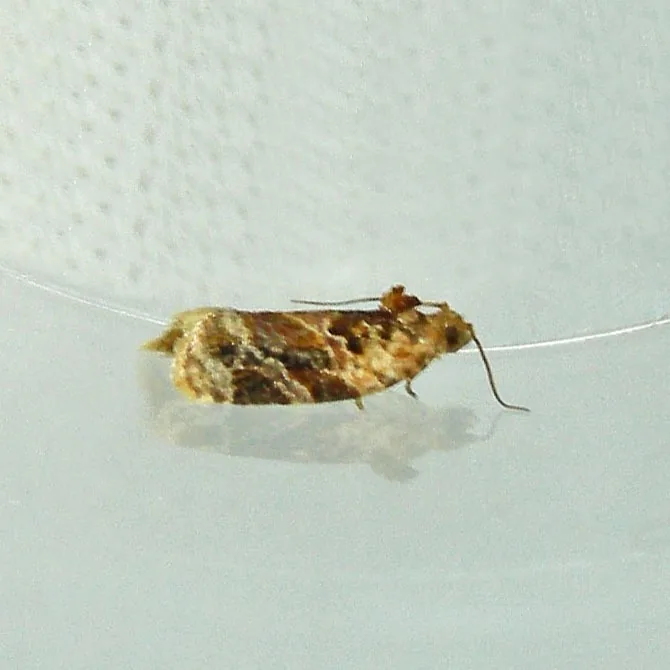
- Moths are tan to brown with a rusty red or red-brown band across each forewing that forms a V when the wings are folded. Kentucky compares them to codling moth in size; NC State says about 1/2 inch long, and Virginia Tech gives wingspans of about 1/2 inch for males and 6/10 inch for females.[1][2][3]
- Larvae are slender and yellow-green to grass-green, with a green head per Virginia Tech, and turn yellowish after feeding on fruit. Full-grown length is given as about 2/3 inch (Kentucky), 7/10 inch (Virginia Tech) or 3/4 inch (NC State).[1][2][3]
- Eggs are laid in flat masses about 3 by 5 mm, gray-green to dull yellow-orange. NC State says about 45 eggs per mass; Virginia Tech says 40 to 45 in the spring brood and 60 to 80 in later broods.[2][3]
Look-alikes
| Look-alike | How to tell them apart |
|---|---|
| Obliquebanded leafroller | A brown moth with three dark bands on each forewing; its small green larva has a black head.[1] |
| Fruittree leafroller | A slightly larger moth with thin light markings; its pale green larva has a black head and a black spot behind it.[1] |
Where it lives
It has been reported on apple since at least the 1870s and became a serious pest in the mid-Atlantic states in the 1940s, according to NC State; Virginia Tech says it was once the most important leafroller in the eastern U.S. Kentucky lists it among three leafrollers that commonly attack fruit trees and some landscape ornamentals, while NC State says it's usually only a sporadic pest in North Carolina.[2][3][1]
Biology and life cycle
Pupae spend the winter on the ground in dead leaves or other debris; Virginia Tech says larvae survive the winter only in rare cases. Adults start flying around green tip, and the first flight peaks just before bloom (NC State) or from tight cluster to pink (Virginia Tech).[1][2][3]
Kentucky says egg masses go on the undersides of larger limbs; NC State and Virginia Tech say first-generation eggs go mainly on the trunk and scaffold limbs around pink, and NC State says later generations lay mostly on leaves. Kentucky puts egg hatch at about bloom; NC State and Virginia Tech say late bloom or petal fall.[1][2][3]
Generation counts depend on region: two to four a year (Kentucky), two full generations and a partial third in North Carolina (NC State), and four in Virginia but only two farther north, such as New York (Virginia Tech).[1][2][3]
First-generation larvae usually feed on tender growth on water sprouts in the center of the tree. Later larvae roll leaves into shelters, and some feed on fruit under a webbed leaf or where two fruits touch.[2]
In Virginia, adult moths live about a week on average (males 6 to 10 days, females 7 to 10), and the first males of the four flights are caught in early April, late May, early July and late August.[3]
Damage and signs
- Larvae fasten a leaf to the fruit and feed on the skin and flesh beneath it. NC State describes canal-like channels in the fruit surface, unlike the inner tunnels of codling moth and oriental fruit moth, and says larvae may also feed in the calyx and stem ends.[1][2]
- Virginia Tech says early injury is a broad, irregular scar on the side of the fruit, while later generations make several joined feeding areas that form a broad, shallow wound up to about 1 inch across.[3]
- Larvae also skeletonize leaves by feeding on the underside near the midrib. Beyond apple, Virginia Tech lists cherry, peach, plum, grape, other small fruits and ornamentals, and NC State adds forest trees and some herbaceous plants.[2][3]
Health risk
It feeds on plants, and no cited source describes any risk to people or pets.[1][2][3]
Control
Prevention
Hang pheromone traps by the pink stage (Kentucky) or in mid-March (NC State) and keep them up through September. Trap catches tell you when to look closely for larvae; Kentucky and Virginia Tech both say catch numbers aren't a basis for deciding to spray.[1][2][3]
Look for tied leaves and larvae on leaves and fruit clusters. Kentucky uses an average of 4 larvae per 100 leaves or fruit clusters as its decision point; Virginia Tech gives a provisional threshold of 1% injured fruit at harvest.[1][3]
Keep them out
In a Minnesota orchard study, hail netting over apple trees cut redbanded leafroller moth numbers by 56% compared with open plots, alongside larger drops in codling moth and apple maggot.[4]
Biological control
In backyard apples, Bacillus thuringiensis sprays work best while larvae are small, before they web leaves together.[1]
NC State says biological control is important in keeping numbers low. Virginia Tech lists the egg parasitoid Trichogramma minutum, a group of parasites that attack larvae and pupae, and a granulosis virus.[2][3]
Pesticides
In commercial orchards, Kentucky says sprays for codling moth and other pests also control leafrollers, and NC State says sprays shortly after peak moth flight work best. NC State refers growers to the current Southeast commercial apple guide for products.[1][2]
Common questions
- What's rolling up the leaves on my apple tree?
- Leafroller caterpillars, including redbanded leafroller, fold or roll leaves together with webbing.[1]
- Why is there a leaf stuck to my apple with a scar under it?
- Leafroller larvae fasten a leaf to the fruit and feed on the skin beneath.[1]
- How many generations are there each year?
- It depends on where you are: four in Virginia, two full and a partial third in North Carolina, two to four in Kentucky, and two in the north, such as New York.[3][2][1]
Sources
- University of Kentucky Entomology (ENTFACT), “Leafrollers (ENTFACT-216).” entomology.mgcafe.uky.edu/ef216 (accessed 2026-11-13)
- NC State Extension, “Redbanded Leafroller.” content.ces.ncsu.edu/redbanded-leafroller (accessed 2026-11-13)
- Virginia Tech Department of Entomology (Virginia Fruit), “Redbanded Leafroller, Argyrotaenia velutinana (from the Mid-Atlantic Orchard Monitoring Guide).” virginiafruit.ento.vt.edu/rblr.html (accessed 2026-11-13)
- Journal of Economic Entomology (via PubMed), “Hail netting excludes key insect pests and protects from fruit damage in a commercial Minnesota apple orchard. Nelson, Klodd & Hutchison 2023 (abstract).” pubmed.ncbi.nlm.nih.gov/37904544/ (accessed 2026-11-13)
- Global Biodiversity Information Facility (GBIF), “Argyrotaenia velutinana (Walker, 1863) (GBIF Backbone Taxonomy).” api.gbif.org/v1/species/1747189 (accessed 2026-11-13)