On this page
How to identify it
- Larvae are brown, cream or greenish brown with a black or brown head and a matching shield behind it. UC IPM gives up to 3/5 inch; EPPO and TortAI say 12 to 15 mm when full grown.[1][2][4]
- A faint dark line often runs down the back, and the bumps at the base of the body hairs are chalky white.[1][3]
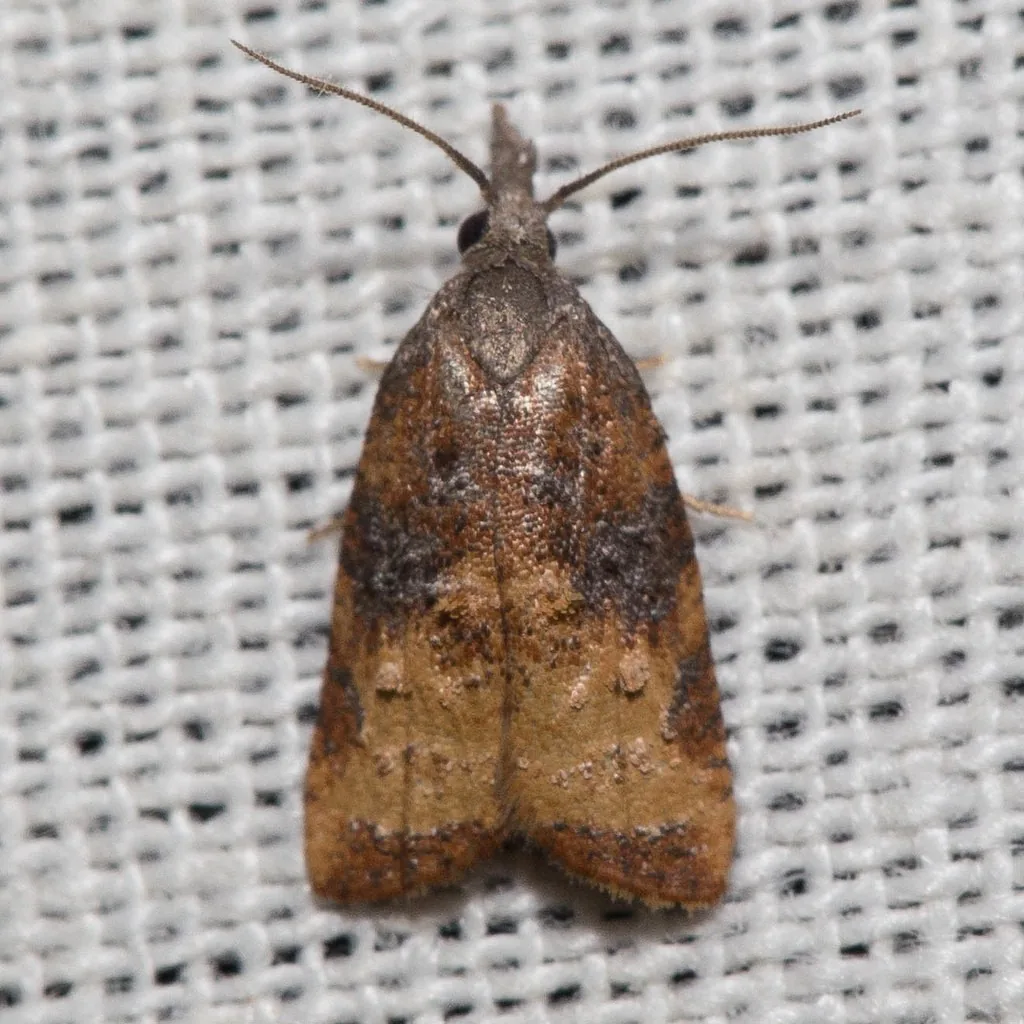
- Adults are small, up to about 1/2 inch, with a long snout and a bell shape at rest. Males' forewings are dark brown at the base and golden brown toward the tips; females are more uniform.[1][4][3]
Look-alikes
| Look-alike | How to tell them apart |
|---|---|
| Grape leaffolder | Grape leaffolder larvae also fold grape leaves. UC IPM says omnivorous leafroller larvae have whitish bumps on the body and, when disturbed, usually drop to the ground on a silk thread; grape leaffolder larvae drop straight down.[3][2] |
Where it lives
Sources disagree on where it lives. TortAI records it from California, Arizona, Hawaii, Texas, Florida and Mexico and calls eastern U.S. records questionable. EPPO lists it in 19 states and DC, including New York, Pennsylvania and Massachusetts, though it says a 1930s find in Virginia and DC didn't establish. Abroad it has settled in Spain, and a 2026 study found it established in southern Italy.[4][2][5]
Biology and life cycle
Each caterpillar may build several nests and pupates inside one or on bark. TortAI says third to fifth instars spend the winter in webbed nests; EPPO adds that in California they keep feeding slowly through winter in leaf nests, litter and dried grape clusters.[1][4][2]
Females lay overlapping eggs in masses like fish scales, about 97 eggs on average according to TortAI. Newly hatched larvae can drift on silk threads to new plants.[1][4][2]
Counts of generations vary: UC IPM gives up to five or six in warm interior valleys, TortAI four to six, and UC's grape guide four flights plus a partial fifth. Over much of its range adults fly year-round.[1][4][3]
EPPO lists more than 100 host plants in 30 families, including cotton, citrus, grapes, roses, carnations and peppers.[2][4]
Damage and signs
- Larvae chew leaves inside their nests, and feeding where a leaf touches fruit leaves big scars.[1]
- In grapes most of the harm comes after veraison, when larvae feed in clusters and open them to bunch rot. UC's grape guide says populations may jump in late summer as weeds dry up and moths move into vineyards.[3][2]
Health risk
It feeds on plants. UC IPM, EPPO and TortAI describe crop damage only and don't mention any risk to people or pets.[1][2][4]
Control
Prevention
Growers watch for moths with pheromone traps, and EPPO notes mating disruption has been used.[3][2]
Sanitation
Clear weeds and plant debris where larvae shelter. In vineyards that means winter weed control and removing old dried clusters.[1][3][2]
Traps and physical control
On small plants, pull off webbed leaves and pick out the caterpillars.[1]
Biological control
Parasitic wasps, tachinid flies, Trichogramma egg parasites, lacewings, assassin bugs and spiders all attack it. UC's garden page says they can keep numbers low, but EPPO and UC's grape guide say parasitism seldom tops 10 percent.[1][2][3]
Pesticides
Low numbers don't call for a spray. If needed, Bt only kills larvae that eat treated leaves, so a follow-up spray about a week later may help. Spinosad is toxic to bees until it dries, so keep it off plants in bloom.[1][3]
History and spread
EPPO says it has no true winter dormancy in California: from November to February larvae shelter in webbed leaf nests, litter or dried grape clusters and keep feeding slowly. The first moths can appear in early March.[2]
EPPO says it was described from Sonora, Mexico, in 1884 and was probably introduced to southern California, where it was first collected in 1898 and had spread widely by the 1960s. Moths and larvae move long distances in plant shipments, and it has been intercepted on Mexican peppers.[2]
Europe lists it as a quarantine pest. The Italian study found three DNA types, two matching moths from Florida, which suggests more than one introduction.[5]
Common questions
- What's rolling up leaves with silk on my plants?
- Leafrollers such as this one tie leaves together with silk and feed inside. Look inside the nest for a cream to greenish-brown caterpillar with a dark head.[1][3]
- Do I need to spray?
- Usually not. UC IPM says low numbers don't warrant insecticide, and hand-picking nests works on small plants.[1]
Sources
- University of California Statewide IPM Program, “Omnivorous Leafroller (Pests in Gardens and Landscapes).” ipm.ucanr.edu/PMG/GARDEN/VEGES/PESTS/omnileafroller.html (accessed 2026-11-13)
- European and Mediterranean Plant Protection Organization (EPPO Global Database), “Platynota stultana (PLAAST) datasheet.” gd.eppo.int/taxon/PLAAST/datasheet (accessed 2026-11-13)
- University of California Statewide IPM Program, “Omnivorous Leafroller, UC IPM Pest Management Guidelines: Grape.” ipm.ucanr.edu/agriculture/grape/omnivorous-leafroller/ (accessed 2026-11-13)
- USDA APHIS PPQ Identification Technology Program, “Platynota stultana (TortAI: Tortricids of Agricultural Importance, Gilligan & Epstein).” idtools.org/id/leps/tortai/Platynota_stultana.htm (accessed 2026-11-13)
- Insects 2026;17(1):122, via PubMed, “The Invasive Nearctic Pest Platynota stultana Walsingham (Lepidoptera: Tortricidae) Is Established in Southern Italy (Goglia et al., 2026).” pubmed.ncbi.nlm.nih.gov/41598976/ (accessed 2026-11-13)
- Global Biodiversity Information Facility (GBIF), “Platynota stultana Walsingham, 1884 (GBIF Backbone Taxonomy).” api.gbif.org/v1/species/1741820 (accessed 2026-11-13)
- iNaturalist, “Platynota stultana taxon page (order and family).” www.inaturalist.org/taxa/258623 (accessed 2026-10-06)