On this page
How to identify it
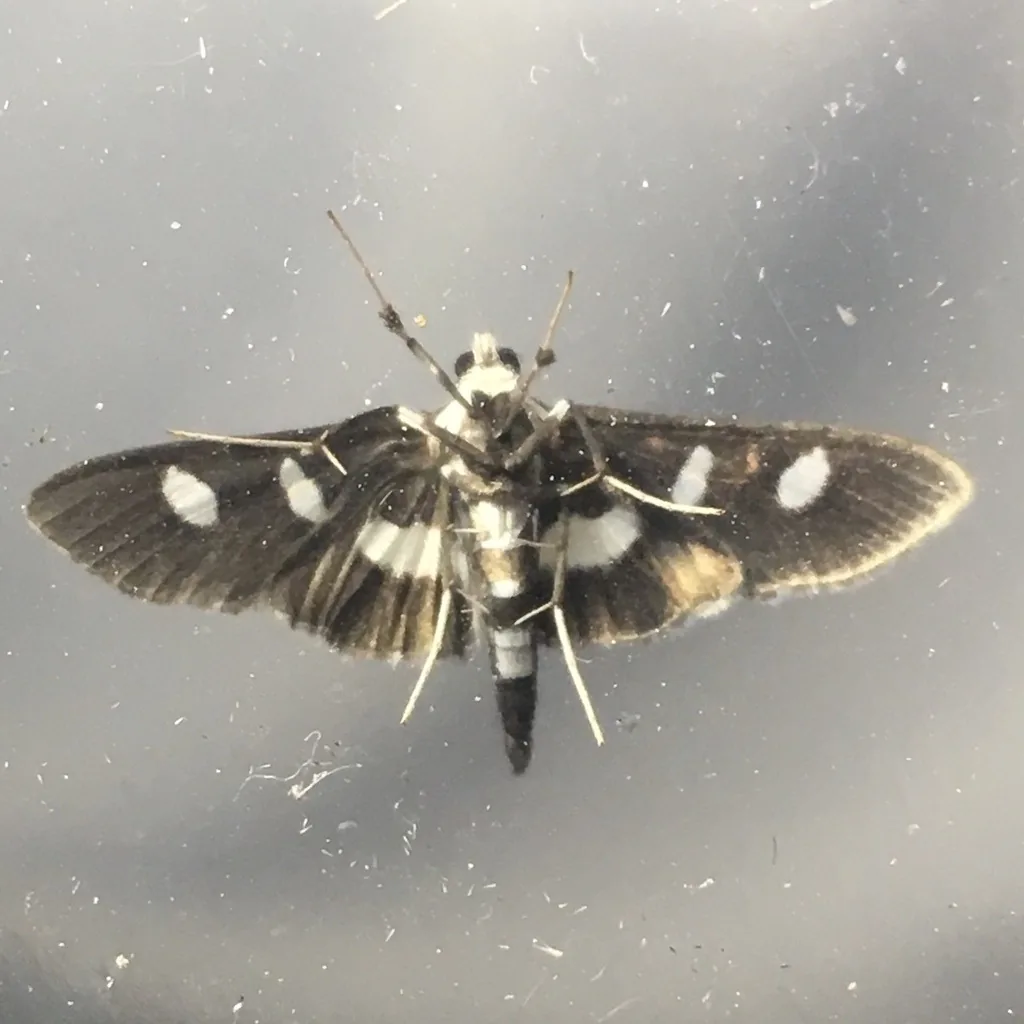
- Adults are very dark brown, almost black, with a silvery or bluish sheen and a wingspan of about 4/5 inch to nearly 1 1/4 inches. Each forewing has two nearly oval white spots.[6][1][2]
- On the hind wings, males have a single white bar, which in females is partly or completely divided into two spots. Two white stripes cross the abdomen.[6][1][2]
- Caterpillars are translucent but look green because the leaf tissue they eat shows through, and they grow to about 3/4 inch (2 cm). Later-stage larvae have small black spots above the second pair of legs. UF/IFAS adds scattered fine yellow hairs on each segment and a light brown head and neck shield.[1][2][6]
- Disturbed larvae wriggle hard and drop to the ground without spinning a silk thread.[2]
- Eggs are flat and elliptical and laid one at a time on the leaves, often in the angle between a vein and the leaf surface. UF/IFAS describes them as about 1/32 inch long and iridescent.[1][2][6]
- Male antennae look thickened and notched near the middle; female antennae are uniform and threadlike.[6]
- Pupae average a little over 1/2 inch long; they are light brown at first and soon turn dark.[6]
Look-alikes
| Look-alike | How to tell them apart |
|---|---|
| Omnivorous leafroller | Another caterpillar pest of grapes. UC IPM separates grape leaffolder larvae by the small black spots above the second pair of legs on later-stage larvae.[2] |
| Other Desmia moths | UF/IFAS says other Desmia species and certain similar moths in Florida have much more linear white wing spots, or a clearly different number of spots.[6] |
Where it lives
Virginia Tech has seen it commonly in some Virginia vineyards, and UC IPM covers it as a pest of California vineyards. GBIF holds about 7,050 records: 5,863 from the United States and 1,079 from Canada, the most from Texas (1,354), Ontario (810) and Virginia (476), with 21 from California. UF/IFAS covers it in Florida, where adults have been taken in every month except January, with the earliest records in mid-February around Sarasota.[1][2][5][6]
Biology and life cycle
It spends the winter as a pupa inside folded leaves that have dropped to the ground.[1][2]
Moths emerge in spring, in April or May in California and in late May or June in Virginia, and lay their eggs on the leaves and canes.[2][1]
Young larvae feed between two leaves webbed together for about two weeks. Each then rolls or folds a leaf edge and feeds from inside, making two or more rolls before it is grown. Leaves are rolled in thin-leaved varieties.[2][1]
A mature larva builds a separate leaf envelope on the edge of a leaf and pupates inside it.[2]
California has three generations a year (about April to May, mid-June to mid-July, and August). In Virginia a second generation appears in August and September.[2][1]
In Virginia, larvae feed for about a month and the pupal stage lasts about ten days.[1]
UC Riverside researchers identified the female sex pheromone in 2002 as a blend of three compounds; two were essential to attract male moths, and in field tests the lures stayed attractive for at least 5 weeks.[4]
In Florida larval records run from May to December, with peak numbers from July into October. First-brood larvae are few compared with the second brood, and in the southern United States a third brood leads into the overwintering pupae.[6]
At Fresno, California, egg to moth took 6 1/2 to 7 1/2 weeks for the first brood and four to five weeks for the second; third-brood larvae took three to five weeks to grow and their pupae overwintered.[6]
Moths of the second and third broods lay most of their eggs on leaves already rolled by earlier larvae, but moths can also fly into an uninfested vineyard as late as midsummer and start a problem there.[6]
Larvae pull a leaf together with silk strands that contract and pull it closed; each bunch holds 200 to 300 filaments and about 10 ties go into a roll. Larvae fold the thicker leaves of bunch grapes and roll the thinner leaves of muscadines.[6]
Larvae stay inside their rolls or between leaves except when moving to a new spot at night, and in California the moths were most active from midnight into the early morning.[6]
Damage and signs
- Infestations are often patchy within a vineyard and usually show up first along the borders. The second generation does more damage than the first.[1]
- Heavy third-generation feeding can defoliate vines completely, leading to sunburned berries, soft fruit and larvae feeding directly on the berries.[2]
- Vines tolerate a fair amount of leaf loss: UC IPM puts it at about 20 percent one month after fruit set in the San Joaquin Valley, and more later in the season.[2]
- Folded leaves show their pale undersides, so a vine with many larvae looks patchy even from a distance. Inside the fold the larva skeletonizes the leaf.[6]
- In Florida the grape leaffolder has done substantial damage in September and October, after growers stopped spraying for the season, and heavy defoliation can deplete the vine's reserves enough to shrink the next crop.[6]
- Wild and cultivated grapes are the main hosts; redbud, Virginia creeper and Oenothera have been reported as occasional hosts. Varieties with thinner, more tender, hairy leaves are attacked more.[6]
Health risk
It feeds on grape leaves. UF/IFAS, Virginia Tech and UC IPM describe damage to vines only and don't mention any risk to people or pets.[6][1][2]
Control
Prevention
Watch for young larvae feeding in groups between webbed leaves, and once rolls start appearing, check every 2 to 3 days for a jump in numbers. UC IPM rarely finds the first generation worth treating and judges each later brood on its own.[2]
Sanitation
The pupae spend the winter in fallen leaves, so rake up and destroy grape leaves after they drop.[6][1]
Traps and physical control
In a home planting, go over the vines when folded or rolled leaves appear and crush the larvae by hand. UF/IFAS says gardeners who prefer not to use insecticides may get good results this way.[6]
Biological control
Parasites play a major part in keeping grape leaffolder below damaging levels. The wasp Bracon cushmani often holds second- and third-generation numbers below economic levels, other wasps and at least two kinds of flies attack the larvae, and lacewings and spiders prey on them. Unroll a few leaves to check for parasitism before deciding to treat. UF/IFAS cites a study that reared three species of tachinid flies and several wasps (three braconids, two ichneumonids and one eulophid) from grape leaffolder larvae.[2][6]
Pesticides
If treatment is needed, apply it as soon as a few rolls appear in that generation, since small larvae are easier to kill. Bacillus thuringiensis and an organically acceptable spinosad formulation are options for organic plantings; Bt works only against young larvae, must be eaten, and needs good coverage. UC IPM says treatments applied for grapeleaf skeletonizer and omnivorous leafroller usually control grape leaffolder too. UF/IFAS reports that Bt and carbaryl gave similar, good control in California and Florida tests, and lists methoxyfenozide, chlorantraniliprole, spinosad and spinetoram as effective; check current state recommendations before applying any insecticide.[2][6]
Where the sources disagree
Generations: UC IPM gives three a year in California (about April to May, mid-June to mid-July, and August), while Virginia Tech describes a second generation in August and September.[2][1]
Moth emergence: UC IPM says moths emerge in April or May, Virginia Tech that they appear in late May or June.[2][1]
Caterpillar color: Virginia Tech calls them light green with dark markings near the head, while UC IPM says they are translucent and only look green from the leaf tissue inside, turning darker green as they feed.[1][2]
Where eggs go: Virginia Tech says on canes and leaves, especially in the angle of the leaf vein and surface; UC IPM says singly on either leaf surface, many against the veins on the underside. UF/IFAS says singly on the underside of a leaf, often in the angle between a vein and the leaf surface.[1][2][6]
Worst generation: Virginia Tech calls the second generation more damaging, while UC IPM says third-generation damage can be severe enough to defoliate vines. UF/IFAS reports the heaviest Florida damage in September and October, after growers stopped spraying.[1][2][6]
Family: GBIF's backbone places it in Crambidae, while the 2002 pheromone paper lists it under Pyralidae. The current UF/IFAS profile also uses Crambidae.[3][4][6]
Common questions
- What is rolling up the leaves on my grapevine?
- Grape leaffolder injury is distinctive: leaves folded or rolled with a translucent green caterpillar inside. Omnivorous leafroller larvae can look similar, but later-stage leaffolder larvae have small black spots above the second pair of legs.[2]
- Do I need to spray grape leaffolders?
- Often not. Parasites keep them in check much of the time, the first generation rarely needs treatment, and vines tolerate moderate leaf loss. Judge each later brood on its own. In a home planting, UF/IFAS says crushing larvae in rolled leaves and raking up fallen leaves can give good results.[2][6]
- Why does the damage get worse late in the season?
- Parasites cannot always hold the later broods down. In Virginia the second generation does more damage than the first, and in California third-generation feeding can be heavy enough to defoliate vines. UF/IFAS adds that later-brood moths lay most of their eggs on leaves already rolled, and in Florida the worst damage has come in September and October after spraying stopped.[2][1][6]
Sources
- Virginia Tech Department of Entomology (Virginia Fruit), “Grape leaffolder, Desmia funeralis (from D. G. Pfeiffer and P. B. Schultz, Major Insect and Mite Pests of Grape in Virginia, VCE 444-567).” www.virginiafruit.ento.vt.edu/leaffolder.html (accessed 2026-11-14)
- University of California Statewide IPM Program, “Grape Leaffolder, UC IPM Pest Management Guidelines: Grape.” ipm.ucanr.edu/agriculture/grape/grape-leaffolder/ (accessed 2026-11-14)
- Global Biodiversity Information Facility (GBIF), “Desmia funeralis Hübner (GBIF Backbone Taxonomy).” api.gbif.org/v1/species/5126517 (accessed 2026-11-13)
- Journal of Economic Entomology, 2002 (via PubMed), “Unusual acetylenic sex pheromone of grape leaffolder (Lepidoptera: Pyralidae) (Millar J et al.) (abstract).” pubmed.ncbi.nlm.nih.gov/12216808/ (accessed 2026-11-13)
- Global Biodiversity Information Facility (GBIF), “Desmia funeralis: occurrence records by country and state (GBIF occurrence search).” api.gbif.org/v1/occurrence/search?taxonKey=5126517&hasGeospatialIssue=false&occurrenceStatus=PRESENT&facet=country&facet=stateProvince&facetLimit=15&limit=0 (accessed 2026-11-13). Exact count at access: 7,052 records (United States 5,863; Canada 1,079; Mexico 17). Texas 1,354; Ontario 810; Virginia 476; California 21 (separate query with stateProvince=California). Records reported, not abundance.
- University of Florida IFAS Extension (EDIS), “Grape Leaffolder, Desmia funeralis (Hübner), Featured Creatures EENY-192/IN349 (O. E. Liburd, F. W. Mead, S. E. Webb and E. M. Rhodes).” ask.ifas.ufl.edu/publication/IN349 (accessed 2026-11-14)