On this page
How to identify it
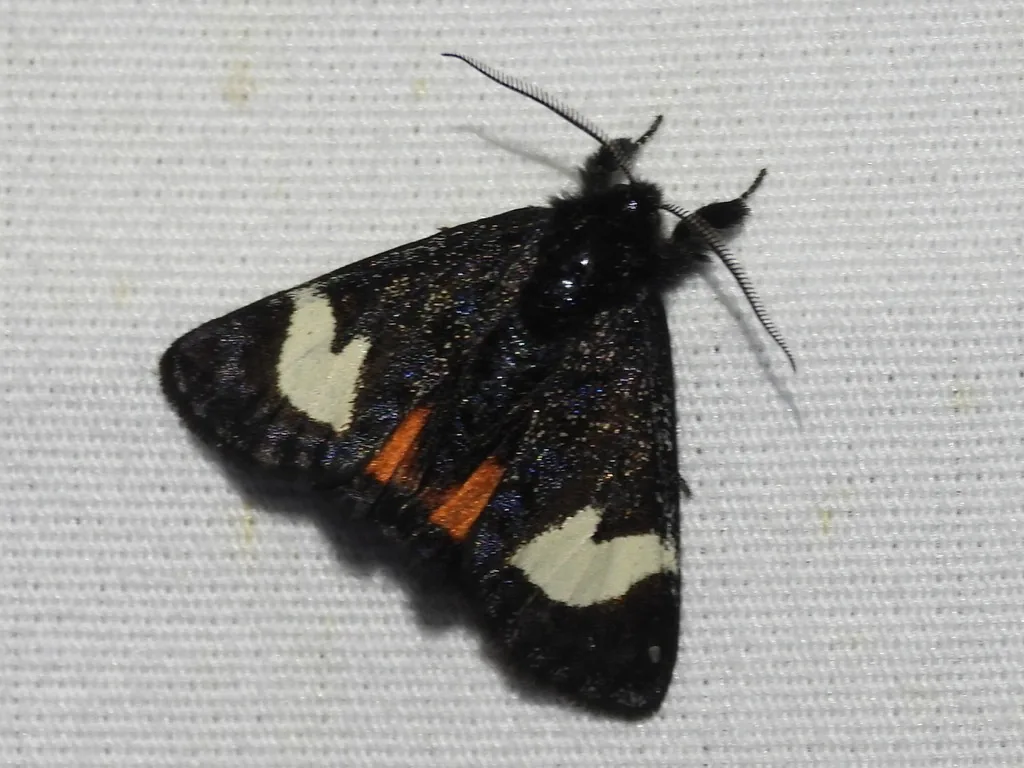
- The adult is velvety black on the body and wings, with a wingspan of about 3/4 to 1 inch. Each forewing has a large white patch, usually notched on its inner edge, and each hindwing has a large red to orange patch. In good light the forewings show metallic highlights.[1]
- It is a moth, not a butterfly: butterflies have club-tipped antennae and usually thinner bodies.[1]
- The caterpillar is whitish with many thin black bands around the body and is humped at the rear. It reaches about 3/4 inch. The head, the plate just behind it and the plate on the rear hump are rusty or reddish with black spots, and there is a single rusty or reddish band near the hind end. The USDA Forest Service guide Caterpillars of Eastern Forests says it usually has four black bands per segment and lacks most of the orange banding of related moths, with the orange strongest on the head, the plate behind it and the eighth abdominal segment, and a diffuse orange patch with a round black spot above the prolegs.[1][2]
Look-alikes
| Look-alike | How to tell them apart |
|---|---|
| Eight-spotted forester | Another fast, day-flying moth whose caterpillars eat grapes and Virginia creeper. MDC says it is black with two large white spots on each wing and orange on its legs, but no red or orange on the wings. Its caterpillar has a wide orange band on each abdominal segment, with small black bumps that each bear a long white hair. The Forest Service guide counts seven or eight black rings per segment on the forester caterpillar.[1][3][2] |
| Beautiful wood-nymph caterpillar | Also humped at the rear and banded black on white, but it has more black stripes per segment and several extra orange bands along the body rather than a single reddish band near the hind end. The Forest Service guide says the beautiful wood-nymph caterpillar has orange on the plate behind the head and one black spot on each proleg, and feeds on the grape family, buttonbush and hops.[1][2] |
Where it lives
MDC describes it as widespread in the eastern United States and statewide in Missouri, in woodlands, woodland borders and hedgerows. BAMONA gives the range as Massachusetts to northern Florida, west to Iowa and Texas. GBIF holds about 3,300 U.S. records since 1990 from 40 state-level areas, the most from Texas (635), Ohio (381) and Virginia (196).[1][4][5]
Biology and life cycle
There is one generation a year. Adults fly in early spring, usually from late March to early May with a peak in April; the Ohio guide calls it one of the earliest moths on the wing, often out while the trees are still leafless. They take nectar from wild plum blossoms and may also visit hawthorns, swamp privet and redbud, and they reportedly sip moisture and minerals from damp soil near puddles.[1][6]
Females lay their eggs on grapevines. The caterpillars eat the young leaves of grapes, including wild grapes, and Virginia creeper, and shelter in leaves they fold over and tie shut with silk, or in a few leaves tied together. The Forest Service guide describes the shelter as a leaf with its edges drawn up, and gives the caterpillar season as late April to June, with one generation.[1][2]
By late spring or early summer the caterpillars are full grown and move into soft wood or other secure plant material to pupate. They overwinter as pupae, and the adults emerge the next spring.[1]
Its fast, erratic flight helps it escape birds and other predators that hunt by sight. MDC notes that it is apparently not toxic or distasteful, so its bold colors may be a bluff.[1]
Damage and signs
- The caterpillars eat young grape and Virginia creeper leaves in spring. MDC says it does not seem to be a major pest of cultivated grapes: wild grapes are plentiful, and the short, early caterpillar season leaves vines all summer to grow new leaves.[1]
Health risk
Its caterpillars eat grape and Virginia creeper leaves. MDC notes that moths don't sting, and MDC and the Ohio guide don't mention any risk to people or pets.[1][6]
Control
Prevention
Neither MDC nor the Ohio guide recommends any control. MDC describes the grapevine epimenis as a well-established breeding resident and a welcome sign of spring rather than a major grape pest.[1][6]
Where the sources disagree
Hosts: MDC lists grapes and Virginia creeper; BAMONA lists grapes; the Ohio guide says probably any of Ohio's five native grapes, especially riverbank grape. The Forest Service guide lists grapes.[1][4][6][2]
Wingspan: MDC says about 3/4 to 1 inch; the Ohio guide says 0.9 to 1.1 inches; BAMONA says 2.2 to 2.7 cm.[1][6][4]
Common questions
- Is the black, white and orange insect on my plum blossoms a butterfly?
- In early spring it may well be the grapevine epimenis, a day-flying moth. Unlike butterflies it lacks club-tipped antennae, and it usually has a thicker body.[1]
- Will grapevine epimenis caterpillars ruin my grapevines?
- MDC says it does not seem to be a major pest of cultivated grapes. The caterpillars feed for a short time early in the season, which leaves the vines the summer to grow new leaves.[1]
- Why do I find grape leaves folded over and tied with silk in spring?
- Grapevine epimenis caterpillars make shelters by folding a leaf over and tying it shut with silk, or by tying a few leaves together, and feed from inside. The Forest Service guide says the caterpillar draws up the edges of a leaf to make its shelter; look for them from late April to June.[1][2]
- When are grapevine epimenis caterpillars on the vines?
- The USDA Forest Service guide gives late April to June, with one generation a year, and MDC says the caterpillars are full grown by late spring or early summer.[2][1]
Sources
- Missouri Department of Conservation, “Grapevine Epimenis (Field Guide).” mdc.mo.gov/discover-nature/field-guide/grapevine-epimenis (accessed 2026-11-14)
- USDA Forest Service, Forest Health Technology Enterprise Team (scan at Internet Archive), “Caterpillars of Eastern Forests, FHTET-96-34 (D. L. Wagner, V. Giles, R. C. Reardon and M. L. McManus, November 1997).” archive.org/details/caterpillarsofea001997 (accessed 2026-11-14). Read from the Internet Archive's full text of the scanned publication.
- University of Missouri Extension (Caterpillars in Your Yard and Garden, IPM1019), “Caterpillars in Your Yard and Garden, page 14: Eight-spotted forester.” extension.missouri.edu/publications/ipm1019/14 (accessed 2026-11-14)
- Butterflies and Moths of North America (BAMONA), “Grapevine Epimenis, Psychomorpha epimenis Drury.” www.butterfliesandmoths.org/species/Psychomorpha-epimenis (accessed 2026-11-14)
- Global Biodiversity Information Facility (GBIF), “Psychomorpha epimenis: U.S. occurrence records since 1990 by state (GBIF occurrence API).” api.gbif.org/v1/occurrence/search?taxonKey=1784688&country=US&hasGeospatialIssue=false&occurrenceStatus=PRESENT&year=1990%2C2026&facet=stateProvince&facetLimit=400&limit=0 (accessed 2026-11-14). 3,272 records from 40 state-level areas; Texas 635, Ohio 381, Virginia 196; fetched 2026-11-13.
- Ohio Department of Natural Resources, Division of Wildlife, “Moths of Ohio Field Guide (Publication 5467).” dam.assets.ohio.gov/image/upload/ohiodnr.gov/documents/wildlife/backyard-wildlife/Moths%20of%20Ohio%20Field%20Guide%20pub5467.pdf (accessed 2026-11-14)
- Global Biodiversity Information Facility (GBIF), “Psychomorpha epimenis Drury, 1782 (GBIF Backbone Taxonomy).” api.gbif.org/v1/species/1784688 (accessed 2026-11-14). ACCEPTED; order Lepidoptera, family Noctuidae