On this page
How to identify it
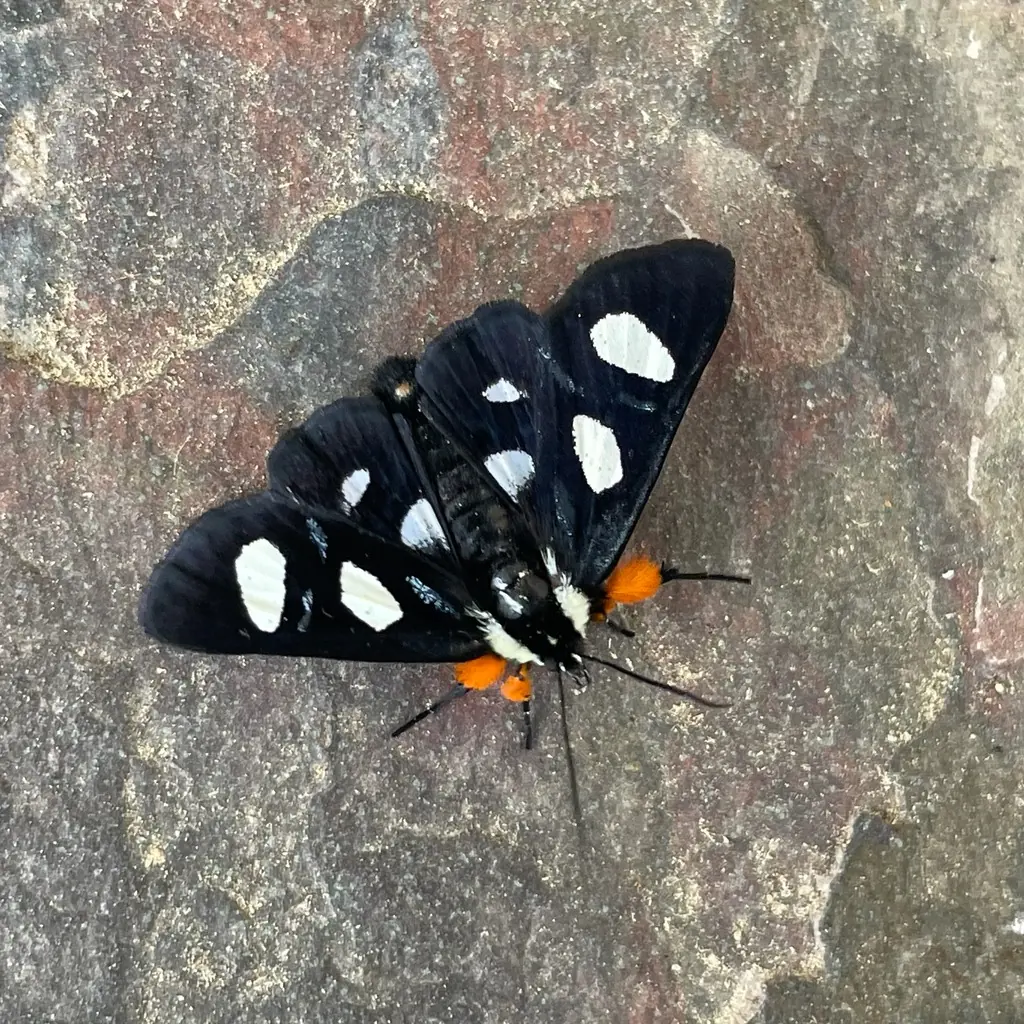
- Adults are black with two pale yellow spots on each forewing, two white spots on each hindwing and bright orange hair tufts on the front and middle legs; they fly fast and darting in daylight. The Ohio guide says the wings beat so fast the spots blur into white lines.[2][3]
- Missouri gives the wingspan as 1 to 1 1/2 inches, the Ohio guide as 1.2 to 1.5 inches, and BAMONA as 3 to 3.7 cm.[2][3][4]
- The sources differ on the antennae: Missouri says they are thickened at the tips like a butterfly's, while the Ohio guide says the lack of knobs on the antennae marks it as a moth.[2][3]
- Caterpillars are banded with narrow black and white lines and a wider orange band on each segment, with small black bumps that each bear a long white hair, and an orange head with black spots. Missouri describes the ground color as whitish lavender. The USDA Forest Service guide Caterpillars of Eastern Forests separates it from related moths by its long white hairs and counts seven or eight black rings per segment. The plate behind the head is orange with black spots, the second and third thoracic segments have no orange band, and a conspicuous creamy patch on the side runs across the seventh abdominal segment and onto the eighth.[1][2][5]
Look-alikes
| Look-alike | How to tell them apart |
|---|---|
| Grapevine epimenis | Another day-flying moth whose caterpillars eat grapes and Virginia creeper, but its forewing has one large white patch and its hindwing a large red to orange patch. It flies only in early spring, usually late March to early May, with one brood a year. Its caterpillar has a single rusty or reddish band near the hind end and hides in leaves folded over and tied with silk. The Forest Service guide adds that the epimenis caterpillar lacks most of the orange banding, with orange mainly on the head, the plate behind it and the eighth abdominal segment, usually four black bands per segment, and a diffuse orange patch with a round black spot above the prolegs.[6][5] |
| Grape leaffolder | A small black and white moth that suggests the forester but is smaller with narrow, pointed wings and is active day and night.[3] |
| Pearly wood-nymph | Its caterpillar also feeds on the grape family, but the Forest Service guide describes a pale thoracic shield with black spots, six or seven black rings of fairly even width per segment, and hairs scarcely longer than the black bases they grow from, instead of the forester's long white hairs. It also eats evening primrose and willow-herb.[5] |
| Beautiful wood-nymph | Another banded caterpillar of the grape family. The Forest Service guide says it is larger than the pearly wood-nymph's, with orange on the plate behind the head and one black spot on each proleg, and it also feeds on buttonbush and hops.[5] |
Where it lives
Missouri reports it statewide where woods border open areas, and the Ohio guide calls it commonly seen. BAMONA gives the range as Maine and southern Quebec to Florida, west to South Dakota and Texas. GBIF holds about 11,800 U.S. records since 1990 from 46 state-level areas, the most from Texas (2,219), Ohio (1,115) and Tennessee (636). The Forest Service guide notes that other closely related Alypia species are found in Florida and across the northern United States.[2][3][4][7][5]
Biology and life cycle
It overwinters as a pupa in soil or wood crevices, and adults appear in spring and again in August.[2]
Generations differ by region: MU reports one to two a year, with caterpillars from spring to early fall, and BAMONA gives one flight from April to June in the north and two in the south, with one brood in August. The Forest Service guide gives two generations in the South and one in the North, with caterpillars from May to September.[1][4][5]
Adults drink flower nectar like butterflies and are often seen hovering around the host plant.[2][3]
Damage and signs
- Caterpillars eat the leaves of wild and cultivated grapes and Virginia creeper; they can be a pest on grape leaves, though damage to wild vines bothers few people. The Forest Service guide also lists grapes and Virginia creeper as its food.[1][2][5]
- The Ohio guide says larvae occasionally defoliate the host, but populations are cyclic and repeated defoliation is rare.[3]
Health risk
Its caterpillars eat grape and Virginia creeper leaves. MU, MDC and the Ohio guide don't mention any risk to people or pets. MDC notes that adults play a role in pollination.[1][2][3]
Control
Prevention
Control is rarely needed: MU notes that caterpillars in this family that feed on tree foliage are not considered serious pests, MDC says feeding on wild vines bothers few people, and the Ohio guide says repeated defoliation is rare.[1][2][3]
Traps and physical control
MU says the caterpillars are present from spring to early fall, so on a few grapevines check the leaves for the boldly banded caterpillars from spring on.[1]
A moth that looks like a butterfly
Because it flies by day, visits flowers and is common, the eight-spotted forester is often mistaken for a butterfly.[3][2]
Its black and white pattern is an example of disruptive coloration: in flight the spots flicker like a strobe light.[3][2]
Where the sources disagree
Wingspan: Missouri says 1 to 1 1/2 inches; the Ohio guide says 1.2 to 1.5 inches; BAMONA says 3 to 3.7 cm.[2][3][4]
Antennae: Missouri says they are thickened at the tips like a butterfly's; the Ohio guide says the lack of knobs on the antennae marks it as a moth.[2][3]
Generations: MU says one to two a year; Missouri describes adults in spring and a second brood in August; BAMONA says one flight in the north and two in the south. The Forest Service guide gives two generations in the South and one in the North.[1][2][4][5]
Hosts: MU, Missouri and BAMONA list grapes and Virginia creeper; the Ohio guide adds English ivy.[1][2][4][3]
Common questions
- What is the black moth with white spots flying in daytime?
- Likely an eight-spotted forester, a day-flying moth often mistaken for a butterfly.[2][3]
- What is the striped orange-and-white caterpillar on my grapes?
- Probably an eight-spotted forester caterpillar.[1][2]
- Is it a pest?
- Occasionally on grape leaves; on wild vines it rarely matters, and repeated defoliation is rare.[2][3]
- How do I tell an eight-spotted forester caterpillar from other banded caterpillars on grape?
- Look for long white hairs. The USDA Forest Service guide says those set it apart from related banded caterpillars, along with seven or eight black rings per segment and a creamy patch on the side near the rear.[5]
Sources
- University of Missouri Extension (Caterpillars in Your Yard and Garden, IPM1019), “Caterpillars in Your Yard and Garden, page 14: Eight-spotted forester.” extension.missouri.edu/publications/ipm1019/14 (accessed 2026-11-14)
- Missouri Department of Conservation, “Eight-Spotted Forester (Field Guide).” mdc.mo.gov/discover-nature/field-guide/eight-spotted-forester (accessed 2026-11-14)
- Ohio Department of Natural Resources, Division of Wildlife, “Moths of Ohio Field Guide (Publication 5467).” dam.assets.ohio.gov/image/upload/ohiodnr.gov/documents/wildlife/backyard-wildlife/Moths%20of%20Ohio%20Field%20Guide%20pub5467.pdf (accessed 2026-11-14)
- Butterflies and Moths of North America (BAMONA), “Eight-spotted Forester, Alypia octomaculata (Fabricius, 1775).” www.butterfliesandmoths.org/species/Alypia-octomaculata (accessed 2026-11-14)
- USDA Forest Service, Forest Health Technology Enterprise Team (scan at Internet Archive), “Caterpillars of Eastern Forests, FHTET-96-34 (D. L. Wagner, V. Giles, R. C. Reardon and M. L. McManus, November 1997).” archive.org/details/caterpillarsofea001997 (accessed 2026-11-14). Read from the Internet Archive's full text of the scanned publication.
- Missouri Department of Conservation, “Grapevine Epimenis (Field Guide).” mdc.mo.gov/discover-nature/field-guide/grapevine-epimenis (accessed 2026-11-14)
- Global Biodiversity Information Facility (GBIF), “Alypia octomaculata: U.S. occurrence records since 1990 by state (GBIF occurrence API).” api.gbif.org/v1/occurrence/search?taxonKey=1776476&country=US&hasGeospatialIssue=false&occurrenceStatus=PRESENT&year=1990%2C2026&facet=stateProvince&facetLimit=400&limit=0 (accessed 2026-11-14). 11,841 records from 46 state-level areas; Texas 2,219, Ohio 1,115, Tennessee 636; fetched 2026-11-13.
- Global Biodiversity Information Facility (GBIF), “Alypia octomaculata Fabricius, 1775 (GBIF Backbone Taxonomy).” api.gbif.org/v1/species/1776476 (accessed 2026-11-14). ACCEPTED; order Lepidoptera, family Noctuidae