On this page
How to identify it
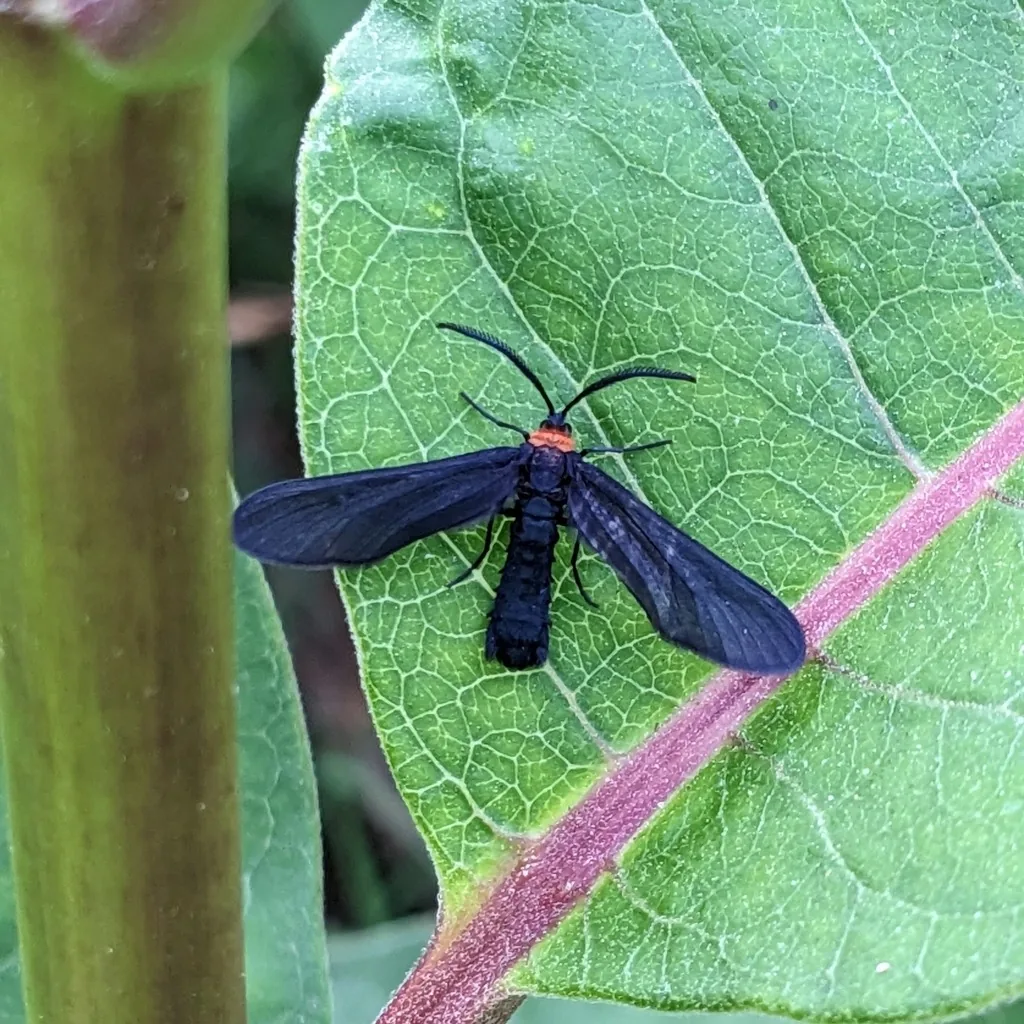
- Adults are small, narrow-winged, all-black moths with an unbroken red or orange collar behind the head and comb-like antennae. The tip of the abdomen curls upward and ends in a fan-shaped, two-part tuft. UF/IFAS adds that the moth is 8 to 12 mm long and its forewings are four times as long as wide.[3][1][5][7]
- Wingspan: Missouri's field guide gives ¾ to 1¼ inches; Florida's Division of Plant Industry gives 22-28 mm.[3][5]
- Caterpillars are yellow with black markings on each segment, described as four black bumps (Virginia Tech), a black band (Missouri) or bands of black dots (Kentucky); young caterpillars have spots rather than bands. Grown caterpillars are about ½ inch long. UF/IFAS notes skeletonizer caterpillars have a dark head capsule.[1][3][4][7]
- Eggs are yellow and laid in clusters on the undersides of leaves. UF/IFAS describes them as lemon yellow, capsule-shaped and slightly over 1/2 mm long.[1][5][7]
Look-alikes
| Look-alike | How to tell them apart |
|---|---|
| Western grapeleaf skeletonizer | A closely related, very similar species that replaces it in the West; UC IPM notes its caterpillars' hairs irritate skin. UF/IFAS says it is slightly larger and ranges from California to Texas and south to Mexico.[1][6][7] |
| Yellow-collared scape moth | Also black with a yellow collar, but thicker-bodied, with more angular wings usually folded down over the body and no fan-shaped tuft at the abdomen tip. UF/IFAS adds that its hind wings are relatively larger, more triangular and clear in the middle rather than evenly dark.[3][5][7] |
| Virginia ctenucha | Larger, with a metallic blue body and an orange collar that widens onto the shoulders.[3] |
| Acoloithus moths | Two related small moths in Florida, Acoloithus falsarius and A. rectarius, are smaller and lack the abdominal tuft. A. falsarius caterpillars also eat grape leaves, especially wild muscadine, but have an off-white or yellow head capsule instead of a dark one. A. falsarius males are most active in the afternoon heat, skeletonizer males mostly around dawn.[7] |
Where it lives
Widespread in the eastern United States and into Canada; Florida's Division of Plant Industry calls it common throughout Florida except possibly the Keys. In Missouri it occurs statewide.[1][3][5]
Biology and life cycle
It spends the winter as a pupa. Virginia Tech says the cocoons lie in debris on the ground; Missouri's guide says the caterpillar spins its cocoon on the back of a leaf.[1][3]
Adults appear in late spring and lay egg clusters under the leaves. Eggs hatch in about a week, caterpillars feed for about 6 weeks, the pupal stage lasts about 2 weeks, and adults live only about 4 days, sipping flower nectar.[1][3]
Virginia Tech gives two generations a year; Missouri's guide says there are likely 2 or more broods there.[1][3]
Caterpillars start out in a tight group, then feed in smaller and smaller groups and finally disperse to pupate.[3][5]
In Florida, UF/IFAS reports moths on the wing from March to September, pheromone-trap catches in Gainesville from late March to mid-October, and larvae collected from May to November 14, with at least two and possibly three generations a year.[7]
An early study cited by UF/IFAS gave an average life cycle of 66.7 days: nearly eight days as an egg, 40 as a caterpillar, 15 as a pupa and 3.5 as an adult moth.[7]
Damage and signs
- Young caterpillars eat only some leaf layers, leaving brown, dead, skeletonized patches. Older ones eat almost the whole leaf except the large veins.[4][3][1]
- Hosts are plants in the grape family, including grapes, Virginia creeper, raccoon grape and peppervine; Missouri's guide says it has also been recorded on redbud and is said to prefer the most delicate cultivated grape varieties.[3]
- It is mainly noticed for stripping home-garden grape vines. Kentucky says it rarely reaches damaging levels, and Missouri calls it less of a problem than some other grape pests. UF/IFAS calls it a minor pest in Florida and says vineyards treated regularly for the important grape pests are not troubled by it; among cultivated grapes it seems to prefer exotic or choice, tender varieties.[5][4][3][7]
Health risk
Don't handle the caterpillars bare-handed: Missouri's guide warns their bristles can cause a skin rash, and UC IPM says hairs on the related western species exude a chemical that irritates skin. The moths and caterpillars also contain hydrocyanic acid as a defense against predators.[3][6]
Control
Prevention
Because the caterpillars spin their cocoons in leaves and trash at the bottom of the vines, UF/IFAS recommends clean culture under grapevines.[7]
Traps and physical control
Handpick the caterpillars while they are still small and clustered together, before they spread out. UF/IFAS explains why: all the caterpillars from one egg cluster stay in a single group at first, so waiting until they separate means much more work.[3][7]
Biological control
Bacillus thuringiensis (Bt) is the usual alternative to handpicking. UF/IFAS also lists Bacillus thuringiensis for this and other caterpillar pests.[3][7]
Pesticides
Kentucky's scouting guide suggests insecticides only if populations are high, pointing especially to the early-season sprays used against the main grape pests.[4]
Why the caterpillars line up
The bright colors warn birds and other predators. Moths in this family make their own hydrocyanic acid from their food rather than taking it from toxic plants, and it is found in the adults, caterpillars and eggs.[3]
Feeding shoulder to shoulder makes the warning colors more visible and lowers the odds that any one caterpillar is the one a predator tastes. Missouri's guide says these are said to be the only caterpillars that feed on grape leaves in groups.[3]
Where the sources disagree
Where it pupates: Virginia Tech says cocoons lie in debris on the ground, Missouri's guide says the caterpillar spins its cocoon on the back of a leaf, and UF/IFAS says cocoons are spun in leaves and trash at the bottom of the vines.[1][3][7]
Generations: Virginia Tech gives two a year, Missouri's guide likely 2 or more, and UF/IFAS at least two and possibly three in Florida.[1][3][7]
Adult life span: Virginia Tech and Missouri say about 4 days; the early study cited by UF/IFAS gives 3.5 days.[1][3][7]
Common questions
- What are the yellow caterpillars lined up on my grape leaves?
- Grapeleaf skeletonizer caterpillars, which feed side by side in a row under the leaves.[3][1]
- How do I control them?
- Pick off the groups early while they are still together, or use Bt.[3]
- Do they eat Virginia creeper?
- Yes. Virginia creeper and wild grapes are among its native hosts.[3]
- Can I touch them?
- Better not: their bristles can cause a skin rash.[3]
- Is it a problem in commercial vineyards?
- Rarely. UF/IFAS says vineyards treated regularly for the important grape pests are not troubled by skeletonizers; it is mostly noticed on home garden vines.[7]
Sources
- Virginia Tech Department of Entomology (Virginia Cooperative Extension), “Grapeleaf skeletonizer, Harrisina americana (Virginia Fruit pages, from Va. Coop. Ext. Serv. 444-567).” www.virginiafruit.ento.vt.edu/grapeskel.html (accessed 2026-11-11)
- iNaturalist, “Harrisina americana taxon page (order and family).” www.inaturalist.org/taxa/126905 (accessed 2026-11-11)
- Missouri Department of Conservation, “Grapeleaf Skeletonizer (Field Guide).” mdc.mo.gov/discover-nature/field-guide/grapeleaf-skeletonizer (accessed 2026-11-11)
- University of Kentucky College of Agriculture, Food and Environment, “Grapeleaf Skeletonizer on Grapes (Scouting Guide for Problems of Fruit).” fruitscout.ca.uky.edu/grapeleaf-skeletonizer-grapes (accessed 2026-11-11)
- Florida Department of Agriculture and Consumer Services, Division of Plant Industry (hosted by the Florida State Collection of Arthropods), “Grape leaf skeletonizer, Harrisina americana (Guerin-Meneville), a minor pest of grape in Florida (Entomology Circular 92, F. W. Mead, January 1970).” thefsca.org/wp-content/uploads/2025/02/ent092.pdf (accessed 2026-11-11). Scanned 1970 circular; read from the PDF text layer.
- University of California Statewide IPM Program, “Western Grapeleaf Skeletonizer (Pests in Gardens and Landscapes).” ipm.ucanr.edu/PMG/GARDEN/FRUIT/PESTS/wesgrskeleton.html (accessed 2026-11-11)
- University of Florida IFAS Extension, EDIS (Featured Creatures), “Grapeleaf Skeletonizer, Harrisina americana (Guerin-Meneville), EENY191/IN348 (Featured Creatures).” ask.ifas.ufl.edu/publication/IN348 (accessed 2026-11-14)