On this page
How to identify it
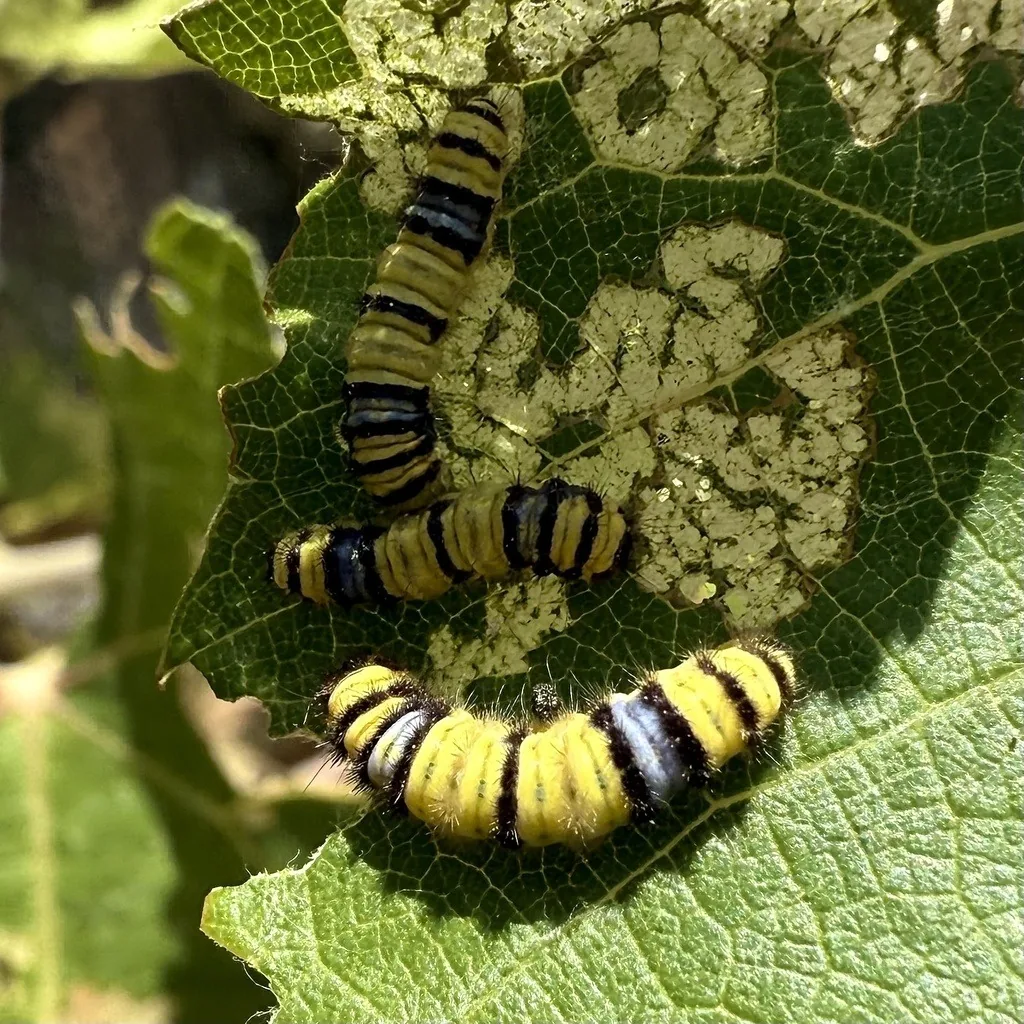
- Older larvae are yellow with two wide purple bands and several narrow black bands, reaching about 2/3 inch.[1]
- Young larvae feed in a tight side-by-side row on the leaf underside.[1]
- Adults are metallic bluish or greenish black moths with a wingspan of 1 to 1-1/3 inches, active day and night.[1]
- Eggs are pale to translucent yellow, about 1/40 inch (0.6 mm) long, and laid in clusters on leaf undersides with the eggs not quite touching.[1][5]
- At rest the adult holds its narrow wings at an angle to the body rather than folded over it, and it has long, feathery antennae; it can be seen flying in the daytime.[4][5]
Where it lives
Arizona Extension describes it as native to the southwestern U.S., including central California, Arizona, New Mexico, Texas, Utah and Colorado, and into northern Mexico; in Utah it is only an issue around St. George. It feeds on grapevines, Boston ivy and Virginia creeper, and UC IPM adds occasional almond, apricot, cherry and rose.[4][2][1]
Biology and life cycle
In California's Central Valley, moths emerge in April and May; there are three generations there and two on the cooler coast.[1]
Females lay groups of several dozen eggs under grape leaves, and egg to adult takes about two months.[1]
Pupae form in grayish cocoons in bark crevices and ground litter.[1]
In Arizona there can be up to three generations a year, with adults emerging starting in May. Adults live about a week; eggs hatch in 7-10 days, larvae take 30-45 days to reach pupation, and the pupal stage lasts about 15 days. The winter is spent as a pupa.[4]
Larvae go through five instars; young ones feed in groups and older ones feed alone. In New Mexico there are two to three generations a year and damaging numbers are often seen by midseason, before the grapes start to ripen.[5][1]
Damage and signs
- Young larvae leave a papery, skeletonized leaf; older ones chew through all but the large veins and can defoliate vines by July.[1]
- On stripped vines they feed on clusters, leading to bunch rot and sunburned fruit.[1]
- When larvae are numerous they can cause severe defoliation, and damage to developing fruit can lead to bunch rot or sour rot; leaf loss also exposes fruit to sunburn and weakens vines.[4][1]
Health risk
The caterpillars' hairs exude a stinging chemical that irritates skin on contact, and Utah State notes the spines can cause skin welts, so wear gloves when you handle infested vines or pick off larvae.[1][2][4]
Control
Prevention
Start checking leaf undersides in late spring (April), beginning at the edges of the planting where skeletonizers usually show up first. Pheromone traps and corrugated cardboard bands around trunks help monitor adults and pupae, but traps alone don't control the pest. Mild infestations are tolerated by the vines and may not need treatment.[4][2]
Sanitation
In small plantings, remove and discard severely infested leaves, and periodically clear fallen leaves and debris from the base of the vines, since they serve as pupation sites.[4]
Traps and physical control
Hand-pick larvae or egg clusters, wearing gloves to protect your skin from the stinging hairs.[4]
Biological control
A granulosis virus commonly keeps populations low. Infected females scatter their eggs instead of laying neat clusters, and infected larvae turn sluggish, feed singly in random patches, darken and leave black liquid trails. If you see these signs, hold off on spraying.[1][4]
The wasp Apanteles harrisinae and the tachinid fly Ametadoria misella are important parasites of the larvae. To help them, control ants, reduce dust and avoid broad-spectrum, persistent insecticides on the vines.[1][4]
Pesticides
If larvae are abundant and parasitism and virus symptoms are scarce, spray Bacillus thuringiensis (the kurstaki strain) or spinosad to cover the undersides of the leaves while larvae are in the first to third instars. UC IPM notes that adding horticultural oil to either also kills eggs.[1][4][2]
More from Utah State University Extension
Eggs are laid in clusters of 10 to 200 on leaf undersides, and the adults are wasp-like, blackish metallic-blue moths; in Utah the pest is only an issue around St. George.[2]
Where sources disagree
Origin: UC IPM calls it an introduced moth, while University of Arizona Extension says it is native to the southwestern U.S. and northern Mexico.[1][4]
Host plants: UC IPM says it uncommonly feeds on almond, apricot, cherry and rose, while Arizona Extension says it has been recorded only on plants in the grape family (Vitaceae).[1][4]
Size of full-grown larvae: about 2/3 inch (UC IPM), about 5/8 inch (Utah State, New Mexico State) or about 3/4 inch (Arizona). Egg clusters: several dozen (UC IPM) vs 10-200 (Utah State, New Mexico State).[1][2][5][4]
Common questions
- Do grapeleaf skeletonizer caterpillars sting?
- Yes. Their hairs exude a chemical that irritates the skin on contact.[1]
- Why are my grape leaves papery and brown?
- Young skeletonizer larvae scrape the undersides, leaving only veins and the upper cuticle.[1]
- Is it safe to pick the caterpillars off by hand?
- Yes, if you wear gloves. Hand-picking larvae or eggs works well in small plantings, but the hairs irritate bare skin.[4][1]
- What is the virus that kills skeletonizer caterpillars?
- It is a granulosis virus (HbGV) that occurs naturally in skeletonizer populations. Lab work shows it attacks only the lining of the caterpillar's midgut.[4][1][6]
Sources
- University of California Statewide IPM Program, “Western Grapeleaf Skeletonizer (Pests in Gardens and Landscapes).” ipm.ucanr.edu/PMG/GARDEN/FRUIT/PESTS/wesgrskeleton.html (accessed 2026-11-12)
- Utah State University Extension, “Western Grapeleaf Skeletonizer.” extension.usu.edu/planthealth/ipm/ornamental-pest-guide/arthopods/moths/western-grapeleaf-skeletonizer.php (accessed 2026-11-12)
- iNaturalist, “Harrisina metallica taxon page (order and family).” www.inaturalist.org/taxa/209426 (accessed 2026-11-12)
- University of Arizona Cooperative Extension, “Understanding the Western Grapeleaf Skeletonizer: Management in Commercial Vineyards (2023).” www.extension.arizona.edu/sites/default/files/2024-09/Understanding%20the%20Western%20Grapeleaf%20Skeletonizer_Management%20in%20Commercial%20Vineyards.pdf (accessed 2026-11-12)
- New Mexico State University Cooperative Extension Service, “Grape Integrated Pest Management (IPM) in New Mexico (Circular CR-705).” pubs.nmsu.edu/_circulars/CR705/index.html (accessed 2026-11-12)
- Archives of Virology (2000), via PubMed, “Molecular characterization and phylogenetic analysis of the Harrisina brillians granulovirus granulin gene.” pubmed.ncbi.nlm.nih.gov/11043952/ (accessed 2026-11-12). Cited from the PubMed abstract.