On this page
How to identify it
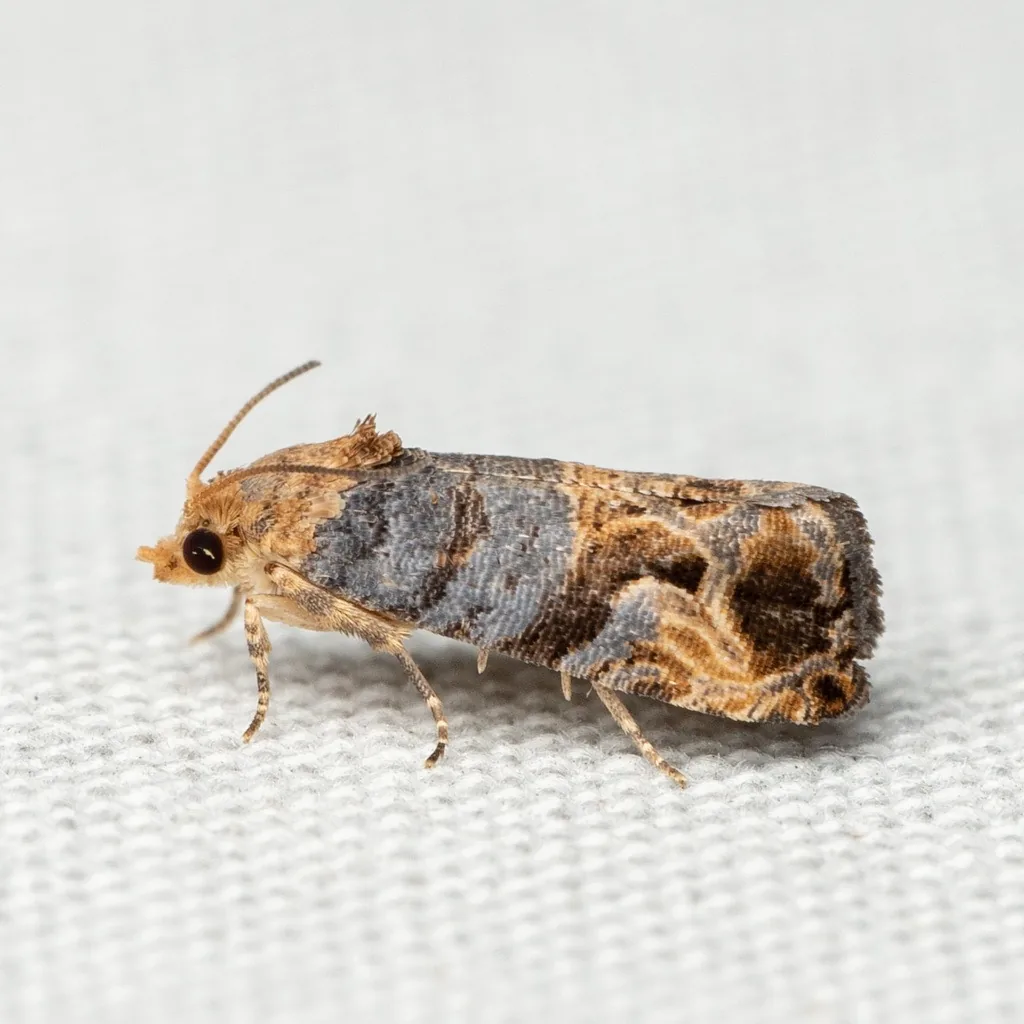
- Adults are small, active moths about 1/4 inch long. At rest a brown band crosses the middle of the folded wings; behind it the wings are gray-blue with brown markings, and in front gray-blue without markings. Ohio State describes the moth as mottled brown with bluish gray on the inner halves of the front wings.[1][4][2]
- Young larvae are creamy and turn green or gray-green, then nearly purple; Kentucky says the purplish tinge comes from what they have eaten. Full-grown size is given as 2/5 inch (Kentucky), about 3/8 inch (Ohio State) or nearly 10 mm (Virginia Tech).[5][1][4][2]
- The pupa is about 1/5 inch long, greenish brown to dark brown, and sits under a flap cut in a leaf.[1]
- Larvae that bore into green berries leave a conspicuous reddish spot at the entry point. Growers call these "stung" berries.[2][4][5]
Look-alikes
| Look-alike | How to tell them apart |
|---|---|
| Redbanded leafroller | Its sex pheromone overlaps with the grape berry moth's, so redbanded leafroller moths sometimes turn up in grape berry moth traps. Virginia Tech also notes a sumac-feeding moth, Episimus argutanus, that comes to the same traps and can outnumber grape berry moths.[5] |
Where it lives
Kentucky Extension places it in the United States east of the Rocky Mountains, on wild and cultivated grapes, and a 2010 study describes a range from southern Canada to the southern United States. It co-evolved with wild grapevines long before grape growing began, and a 2025 modeling study predicts more suitable area for it and its wild grape hosts in the Northeast, the Midwest and eastern Canada as the climate warms.[1][6][3]
Biology and life cycle
It spends the winter as a pupa in a cocoon in fallen leaves on the vineyard floor and in nearby woodlots; Virginia Tech says it is more common in damp material. Later in the season, grown larvae cut a semicircular flap in a leaf, fold it over themselves and pupate inside.[1][2][5]
The number of generations varies with region. Kentucky says 2 or 3 a year; Ohio State says 2 to 3 are typical, with up to 4 in southern areas; Virginia Tech reports 3 to 4 in Virginia, with a possible fifth in some seasons. Larvae of later generations enter berries and move from one to the next under webbing.[1][4][5]
Females lay eggs singly on flower stems, blossom clusters or berries. Virginia Tech gives an average of 20 eggs per female, laid at dusk and hatching in about 4 to 8 days; Kentucky says about 5 days.[5][1]
Shortening days after the summer solstice trigger winter dormancy. In a 2010 study, populations from Michigan, New York and Pennsylvania responded to day length differently from those in Arkansas, Texas and Virginia.[6][5]
Damage and signs
- Damaged berries shrivel under fine webbing and attract mold, rot and fruit flies. A single larva can destroy 2 to 6 berries, several larvae often share a cluster, and badly infested bunches at harvest may be hollowed out. Ohio State says unmanaged vineyards can lose up to 90 percent of the fruit to the moth and the bunch rots that follow.[1][2][4]
- Vineyards bordering woods are most at risk, and infestations are usually worst along vineyard edges.[2][4][5]
Health risk
It feeds on grapes. The Kentucky, Ohio State and Virginia Tech pages describe crop damage only and don't mention any risk to people or pets.[1][4][5]
Control
Prevention
Pheromone traps hung on the top trellis wire before bloom show when males start flying. Ohio State's grape IPM page warns not to rely on traps alone for the late-season generation and to scout weekly after bloom.[2][4]
To decide whether to treat, check 100 clusters at random. Ohio State's grape IPM page suggests action when more than 5 percent are injured; its 2024 fact sheet gives 5 to 15 percent, with lower thresholds for higher-value grapes.[2][4]
Mating disruption, which fills the vineyard with synthetic pheromone so males can't find females, works where moths aren't flying in from outside. Ohio State says it suits low to moderate pressure and blocks larger than about five acres.[1][4]
Sanitation
Rake up and destroy fallen leaves under the vines, or bury them, to kill overwintering pupae. In a Michigan State study, one pass of a rotary cultivator buried three-quarters of the pupae under at least 1 cm of soil, and burial, not mechanical injury, was what killed them.[1][2][7]
Biological control
Bt can kill larvae, but only if timed to reach them before they bore into the berries. A Penn State survey of Concord vineyards found eight species of larval parasitoids, with parasitism up to 52 percent in early August 2024, though Ohio State says biological control is limited.[2][8][4]
Pesticides
Timing matters more than the product. Kentucky says first-generation sprays go on when berries are the size of small peas and second-generation sprays at veraison, and Ohio State calls the late July and August flight the most important period to manage. Spraying only the perimeter rows may be enough.[1][4][2]
Why vineyard edges matter
Trap catches can mislead. Virginia Tech notes that vineyards surrounded by open land may catch many moths but see little injury, while vineyards next to woods with wild grapes may catch few moths and still suffer heavy damage. A New York risk scheme it cites rates history of injury, wooded margins and long snow cover as high-risk factors.[5]
Common questions
- What's webbing my grape clusters?
- Probably grape berry moth larvae, which feed under flimsy webs in the clusters. Leaf-flap cocoons and red spots on green berries are other signs.[1][2]
- Where does it spend winter?
- As pupae in cocoons in the leaf litter under the vines and in nearby woods.[1][2]
- Does Bt work on grape berry moth?
- It can, but the timing is tight. Ohio State says it has to reach the larvae before they start feeding inside the berries.[2]
Sources
- University of Kentucky Entomology (ENTFACT), “Grape Berry Moth (ENTFACT-221).” entomology.mgcafe.uky.edu/ef221 (accessed 2026-11-13)
- Ohio State University, College of Food, Agricultural, and Environmental Sciences, “Grape Berry Moth, Paralobesia viteana (Ohio Grape IPM).” ohiograpeweb.cfaes.ohio-state.edu/ipm/insects/grape-berry-moth (accessed 2026-11-13)
- Ecol Evol 2025;15(12):e72612, via PubMed, “Pest and Host Associations That Transcend Time: Assessing the Impact of Climate Change on Grape Berry Moth (Paralobesia viteana) and Its Hosts Vitis riparia and Vitis labrusca in North America (Gomez-Llano et al., 2025).” pubmed.ncbi.nlm.nih.gov/41377732/ (accessed 2026-11-13)
- Ohio State University Extension (CFAES Knowledge Hub), “Grape berry moth (ENT-0097, April 2024).” cfaes-contenthub.org.ohio-state.edu/fact-sheet/grape-berry-moth (accessed 2026-11-13)
- Virginia Tech Department of Entomology, “Grape berry moth, Paralobesia viteana (Clemens) (Virginia Fruit).” www.virginiafruit.ento.vt.edu/GBM.html (accessed 2026-11-13)
- Environ Entomol 2010;39(6):1751-5, via PubMed, “Geographic variation in diapause induction: the grape berry moth (Timer, Tobin & Saunders, 2010).” pubmed.ncbi.nlm.nih.gov/22182539/ (accessed 2026-11-13)
- Environ Entomol 2017;46(1):100-106, via PubMed, “Tillage Reduces Survival of Grape Berry Moth (Lepidoptera: Tortricidae), via Burial Rather Than Mechanical Injury (Matlock, Isaacs & Grieshop, 2017).” pubmed.ncbi.nlm.nih.gov/28025219/ (accessed 2026-11-13)
- PLoS One 2025;20(5):e0317274, via PubMed, “Exploring natural allies: Survey and identification of larval parasitoids of the American grape berry moth, Paralobesia viteana, in northwestern Pennsylvania (Gomez-Llano, Khanal & Acevedo, 2025).” pubmed.ncbi.nlm.nih.gov/40388440/ (accessed 2026-11-13)
- Global Biodiversity Information Facility (GBIF), “Paralobesia viteana (Clemens, 1860) (GBIF Backbone Taxonomy).” api.gbif.org/v1/species/1746586 (accessed 2026-11-13)
- iNaturalist, “Paralobesia viteana taxon page (order and family).” www.inaturalist.org/taxa/334338 (accessed 2026-10-06)