On this page
How to identify it
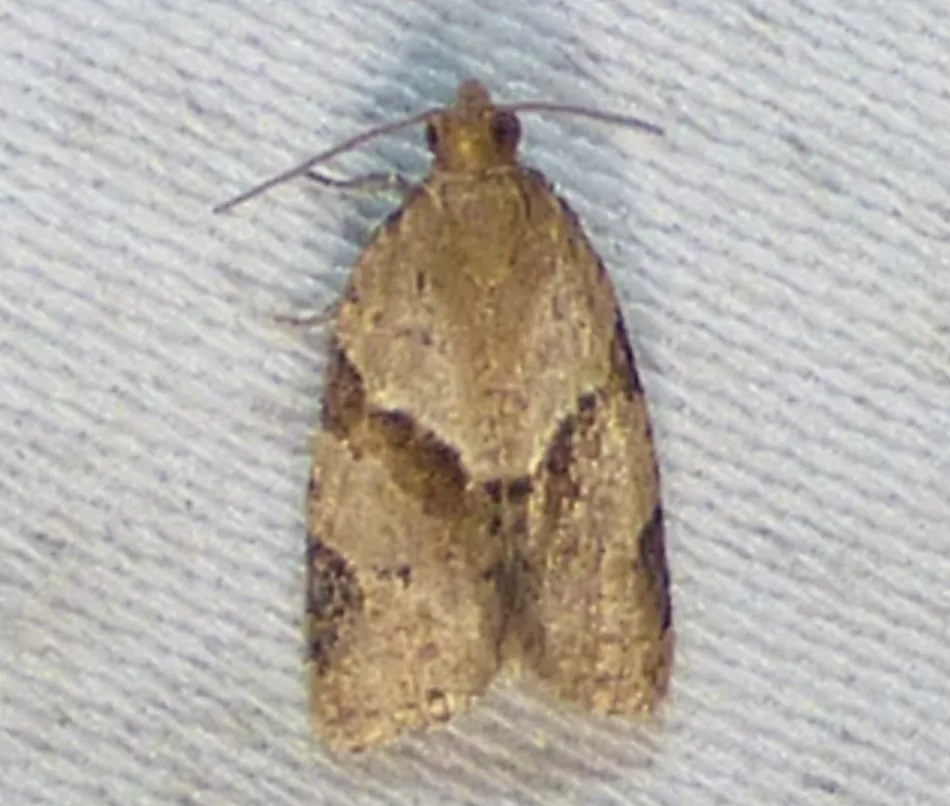
- The moth is small, about 1/4 inch (6 mm) long, with a forewing 4.5 to 7.5 mm long. The forewings are tan to buff-brown.[2][1]
- Each forewing has a dark brown diagonal band and a dark spot on its front edge, which together form a chevron when the moth is at rest, and a faint whitish line runs along the front edge of the band. Females carry the same markings, usually fainter than the males'.[2][1]
- Grown caterpillars are slender and about 1/2 inch (13 to 14 mm) long, light green to light brown depending partly on what they eat, with a yellowish to light brown head marked by a small, distinct dark brown spot on each side.[2][1]
- Like other leafroller caterpillars in strawberries, they wriggle vigorously when disturbed.[2]
Look-alikes
| Look-alike | How to tell them apart |
|---|---|
| Orange tortrix | Garden tortrix moths are lighter overall and have a faint whitish line along the front edge of the dark wing band.[2] |
| Other Clepsis moths | Clepsis fucana is generally larger and found only on the West Coast, C. virescana is larger, more northern and absent from the Southeast, and C. penetralis is recorded only from Colorado, Utah and Vermont.[1] |
| Corn earworm, armyworm and cutworm damage | Damage these caterpillars do to strawberry fruit can look like garden tortrix feeding.[2] |
Where it lives
It is one of the most common and widespread tortricid moths in North America, found throughout southern Canada and the continental United States, from British Columbia to Nova Scotia and south to Florida and California, and it has become established in Denmark. GBIF holds 9096 U.S. records since 1990, most from Texas (2746), California (821) and Alabama (757).[1][3][5]
Biology and life cycle
There are several generations a year, from 2 to 4 in the North to 6 or 7 in the South, and in some places the moths are around most of the year. In Alberta moths fly from mid-June to mid-August; elsewhere they are reported from March to November with many broods.[1][3]
Eggs are laid in small masses of about 10 to 20. The caterpillars live in silk tubes on the surface of leaves and feed mainly on dead or decaying leaf litter; they have even been reared from fungus, and only now and then feed in the buds or fruit of living plants.[1]
In strawberry fields, caterpillars and pupae spend the winter in the debris around the base of the plants; the University of Alberta museum likewise says it overwinters as a larva or pupa.[2][3]
It is probably a generalist. Confirmed hosts include strawberry, citrus, Chrysanthemum, cardoon, stinking willie (Senecio jacobaea), hedgenettle, California figwort and turkey berry.[1]
A name puzzle solved: a 2020 revision of Caribbean leafroller moths found that a species described in 2010 as Clepsis pinaria was really the garden tortrix, and folded the name into Clepsis peritana.[4]
Damage and signs
- Early in the strawberry season the caterpillars are useful, breaking down old leaf and fruit litter, and they generally do no significant damage while the plants are small.[2]
- As their numbers build and the canopy closes, more ripening berries touch the litter. The caterpillars then spin nests in creases on the berries and chew small, shallow holes as they scavenge, and losses from contaminated fruit and from rots that enter the holes can be significant by late spring and early summer.[2]
- In California's south coast fields, caterpillars contaminating fruit just before it goes to processors in late June and July can be a serious problem.[2]
- In citrus groves, the caterpillars feed on decaying leaves until their numbers are high, then may switch to the fruit; significant damage happens only to fruit close to the ground or already dropped.[1]
- A 1958 study from southern California reported serious losses to citrus, lima beans and strawberries in the nine years after the garden tortrix was first told apart from the orange tortrix, which it closely resembles. The caterpillars fed mainly on decaying plant matter, built up to high numbers on it, and then moved to sound citrus fruit and foliage, lima bean blossoms and leaf buds, and strawberry plants and fruit.[8]
Health risk
Neither UC IPM nor the USDA fact sheet mentions any risk to people; both treat it as a crop pest.[2][1]
Control
Sanitation
Where garden tortrix is a chronic problem, clear the accumulated leaf and fruit trash from around strawberry plants in spring to keep numbers from building, especially in summer plantings and second-year beds. Removing dead vegetation also cuts down the population that overwinters.[2]
Traps and physical control
Before harvest, check plants for leaf rolls, usually one or more middle-aged leaves webbed together, and search the area around any you find, because leafrollers tend to cluster. Webbing under the calyx, frass or holes in fruit also point to leafrollers; destroy infested fruit and the caterpillars in it.[2]
Home strawberry patch, step by step (Washington State, for leafrollers on strawberry in general): pick out and destroy rolled leaves and caterpillars, or pinch rolled leaves to kill the caterpillar inside, and clean up leaf debris on and under the plants.[7]
Biological control
Encourage natural enemies of caterpillars, including birds, parasitic wasps and flies, and predatory beetles, and avoid broad-spectrum insecticides that kill these beneficial insects.[7]
Pesticides
Garden tortrix caterpillars are especially hard to reach with sprays because they live in the litter under the leaf canopy, so sprays need to be directed to penetrate it. UC IPM lists spinosad, chlorantraniliprole, Bacillus thuringiensis ssp. kurstaki (Bt) and methoxyfenozide for strawberry leafrollers; Bt and an organic-approved spinosad formulation can be used on organic strawberries, and Bt works better applied several times at short intervals. Spinosad is highly toxic to bees, so keep it off blooming crops and weeds where bees are foraging. The University of Alberta museum rates it only a minor pest in some areas.[2][3]
Washington State suggests treating only when there are more than two caterpillars per plant, and applying Bt only while the caterpillars are feeding. Its examples of home products legal in Washington are Bonide Captain Jack's Deadbug Brew (spinosad) and Bonide Thuricide BT Concentrate (Bacillus thuringiensis subsp. kurstaki). Always read and follow the label.[7]
Where sources disagree
How serious a pest: the 1958 southern California study described serious economic damage to citrus, lima beans and strawberries; the University of Alberta museum calls it a minor pest in some areas; and Washington State says leafrollers in general are seldom serious pests on strawberry, which tolerates some damage.[8][3][7]
What works: the 1958 study found chemical applications only slightly effective at the time, with cultural practices giving effective, practical control; UC IPM today lists several insecticides but notes the caterpillars are hard to reach in the litter and puts litter cleanup first.[8][2]
Common questions
- What is chewing small holes in strawberries that touch the ground?
- In California strawberries, garden tortrix caterpillars are a likely cause: they live in the litter under the plants, spin nests in creases on ripening berries that touch the trash, and chew small, shallow holes. Corn earworm, armyworms and cutworms can cause similar fruit damage.[2]
- Is the garden tortrix bad for my garden?
- Mostly not. Its caterpillars mainly eat dead and decaying leaves and help recycle litter; problems come when large numbers meet ripening fruit lying on the ground.[1][2]
- How many generations does the garden tortrix have?
- From two to four a year in the North to six or seven in the South, and in some places the moths are around most of the year.[1]
- How do I get rid of leafrollers in my home strawberry patch?
- Start without sprays: pick or pinch rolled leaves, clean up dead leaves and fruit under the plants, and leave natural enemies alone. If more than two caterpillars per plant remain, Washington State lists Bt and spinosad products for home use.[7][2]
Sources
- USDA APHIS PPQ Center for Plant Health Science and Technology, with Colorado State University, “Clepsis peritana fact sheet, Tortricids of Agricultural Importance (T. M. Gilligan and M. E. Epstein; last updated August 2014).” idtools.org/id/leps/tortai/Clepsis_peritana.htm (accessed 2026-11-12)
- University of California Statewide IPM Program, “Leafrollers, UC IPM Pest Management Guidelines: Strawberry (UC ANR Publication 3468; F. G. Zalom, M. P. Bolda, S. K. Dara and S. V. Joseph).” ipm.ucanr.edu/agriculture/strawberry/leafrollers/ (accessed 2026-11-12)
- University of Alberta Museums, E.H. Strickland Entomological Museum, “Species Details: Clepsis peritana (Garden Tortrix).” search.museums.ualberta.ca/g/2-28535 (accessed 2026-11-12)
- ZooKeys 2020;982:33-147, via PubMed, “A taxonomic revision of the Archipini of the Caribbean (Lepidoptera, Tortricidae, Tortricinae).” pubmed.ncbi.nlm.nih.gov/33239955/ (accessed 2026-11-12)
- Global Biodiversity Information Facility (GBIF), “Clepsis peritana: U.S. occurrence records since 1990 by state (GBIF occurrence search).” api.gbif.org/v1/occurrence/search?taxonKey=4530608&country=US&hasGeospatialIssue=false&occurrenceStatus=PRESENT&year=1990%2C2026&facet=stateProvince&facetLimit=400&limit=0 (accessed 2026-11-12)
- iNaturalist, “Clepsis peritana taxon page (order and family).” www.inaturalist.org/taxa/132789 (accessed 2026-11-12)
- Washington State University Extension (HortSense), “Strawberry: Leafrollers.” hortsense.cahnrs.wsu.edu/fact-sheet/strawberry-leafrollers/ (accessed 2026-11-12)
- Journal of Economic Entomology 1958;51(5):596-598, “The Garden Tortrix, Clepsis peritana (Clemens): A New Economic Pest in Southern California.” doi.org/10.1093/jee/51.5.596 (accessed 2026-11-12). Cited from the published abstract.