On this page
How to identify it
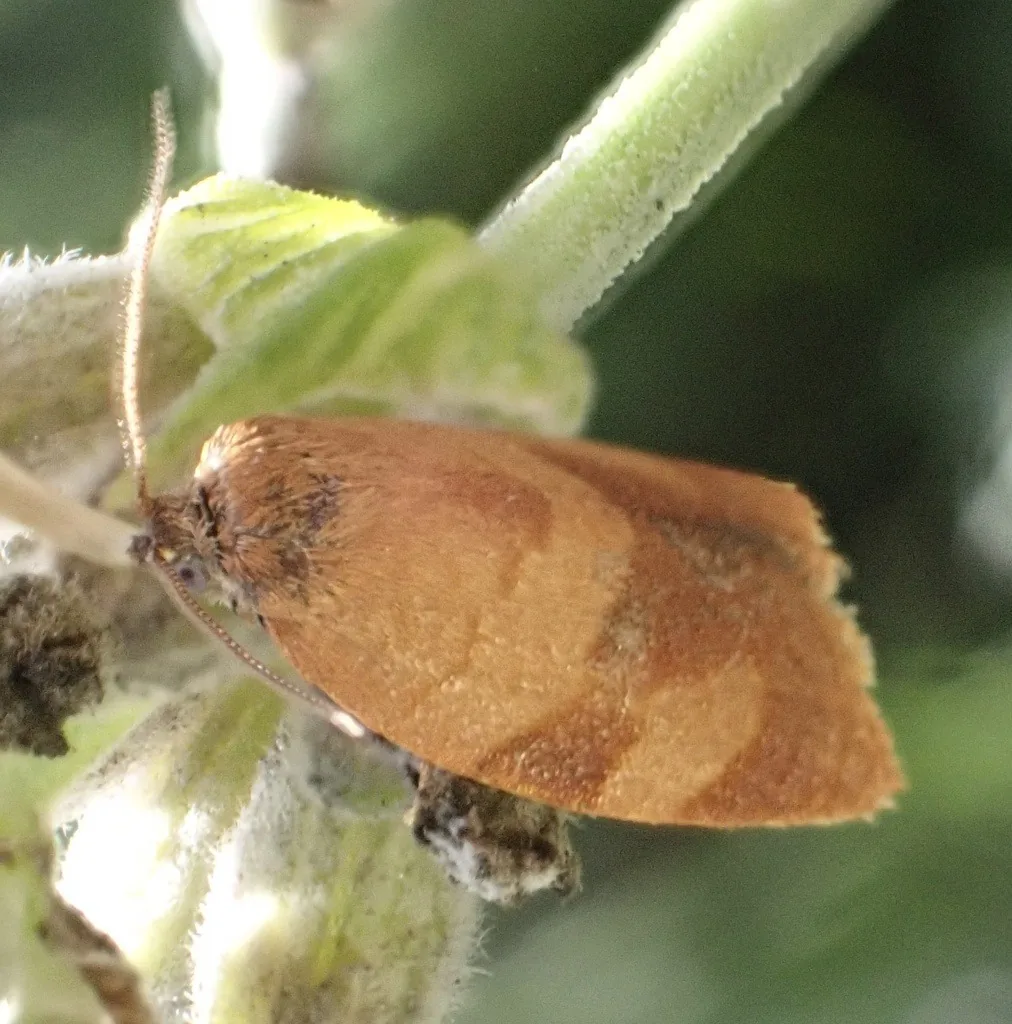
- Moths are small and bell-shaped, brown with darker bands on the forewings, with a wingspan of 0.5 to 0.9 inch.[1]
- Caterpillars are light brown or greenish with brown heads, 3/8 to 1/2 inch long when grown.[1]
- Disturbed caterpillars are very active and often wriggle backward.[1]
- The hindwings are bright orange and black (some females lack the black), which EPPO says sets it apart from most similar leafrollers.[5][1]
Look-alikes
| Look-alike | How to tell them apart |
|---|---|
| Epichoristodes acerbella | Its eggs, caterpillars and pupae are hard to tell from carnation tortrix, but the adults separate easily by forewing pattern and hindwing color.[5] |
Where it lives
CDFA and Canada's CFIA call it native to northern Africa, while EPPO describes it as Mediterranean. It was introduced to Oregon in 1964 and Washington in 1974, is confirmed in British Columbia's Fraser Valley, and has been reported from a Colorado nursery and the Denver Zoo.[3][4][5]
Biology and life cycle
Eggs are laid in flat clusters of 10 to 200 that turn from green to yellow. Totals differ by source: the PNW handbook says 500 to 700 per female, while CDFA and EPPO give an average of about 430, with up to 700.[1][3][5]
Larvae can be active all year and spread by ballooning on the wind; adults fly only locally, and long-distance spread comes from eggs and larvae on nursery stock.[1][3][5]
Hatching takes from 5 to 55 days in the PNW handbook (8 to 51 days per EPPO), and pupation 10 to 15 days.[1][5]
Warm regions can have four to six generations a year. In England it spends the winter as larvae, and up to 90% may die.[3][5]
Host plant matters: in a UK study, females laid far more eggs on Photinia than on Pyracantha, and larvae developed faster on Photinia than on cherry laurel.[6]
Damage and signs
- Young larvae mine leaves or buds; older ones roll or web leaves together and may bore into buds. It has been recorded on more than 160 plants in 42 families, from carnation, rose and fuchsia to holly, laurel and citrus.[3][5][1]
- Serious damage is mostly limited to carnations in the Mediterranean and greenhouse flower crops. CDFA notes no significant economic damage in about 60 years in the Pacific Northwest, while UK researchers count it among the most important horticultural insects there.[5][3][6]
Health risk
It feeds on plants; none of the extension or agency sources lists a risk to people.[1][3]
Control
Prevention
CDFA and EPPO point to nursery stock as the way it moves long distances, so check new plants for rolled or webbed leaves. Pheromone traps help growers detect the moths.[3][5][2]
Traps and physical control
Pick off rolled leaves holding caterpillars or pupae, and clear rolled leaves from the ground and trunks where leafrollers spend the winter.[2]
Biological control
Spiders, parasitic wasps and predators such as the brown lacewing keep leafroller numbers down, and very cold winters kill many overwintering larvae.[2]
Is it in California?
Sources disagree. EPPO's datasheet lists California among its North American introductions, but CDFA's pest rating says it has never been found in California's environment; the two California records were interceptions on holly and winter daphne shipped from Oregon nurseries in 2010 and 2011.[5][3]
CDFA rates it an A pest. EPPO, which had it on its A2 quarantine list from 1975, dropped it from that list in 2026.[3][5]
Common questions
- What caterpillar rolls and webs the leaves of my Portuguese laurel?
- Often the carnation tortrix, a leafroller that attacks many broad-leaved plants.[1]
- Why does the caterpillar wriggle backward when I touch its rolled leaf?
- Carnation tortrix larvae are very active when disturbed and often wriggle backward.[1]
- Why is it called carnation tortrix if it's on my laurel?
- Carnation is its main host in Europe, but it feeds on well over 160 plants. A 2021 Greek report even added showy stonecrop (sedum) to the list.[5][3][7]
Sources
- Pacific Northwest Pest Management Handbooks (OSU, WSU, University of Idaho), “Laurel, Portuguese (Prunus): Carnation tortrix (Insect Management Handbook).” pnwhandbooks.org/insect/hort/landscape/hosts-pests-landscape-plants/laurel-portuguese-prunus-carnation-tortrix (accessed 2026-11-12)
- Pacific Northwest Pest Management Handbooks (OSU, WSU, University of Idaho), “Landscape pests: Leafroller and leaftier (Insect Management Handbook).” pnwhandbooks.org/insect/hort/landscape/common/landscape-leafroller-leaftier (accessed 2026-11-12)
- California Department of Food and Agriculture (Pest Ratings), “California Pest Rating for Cacoecimorpha pronubana (Hübner): Carnation tortrix.” blogs.cdfa.ca.gov/Section3162/?p=3006 (accessed 2026-11-12)
- Canadian Food Inspection Agency, “Carnation tortrix, Cacoecimorpha pronubana Hubner.” inspection.canada.ca/en/plant-health/invasive-species/insects/carnation-tortrix (accessed 2026-11-12)
- European and Mediterranean Plant Protection Organization (EPPO Global Database), “Cacoecimorpha pronubana (TORTPR) datasheet.” gd.eppo.int/taxon/TORTPR/datasheet (accessed 2026-11-12)
- Bulletin of Entomological Research, 2022 (via PubMed), “Effect of host plant on the life history of the carnation tortrix moth Cacoecimorpha pronubana (Lepidoptera: Tortricidae) (abstract).” pubmed.ncbi.nlm.nih.gov/34229772/ (accessed 2026-11-12)
- Insects, 2021 (via PubMed), “Hylotelephium spectabile, a New Host for Carnation Tortrix Moth (Cacoecimorpha pronubana) and Molecular Characterization in Greece (abstract).” pubmed.ncbi.nlm.nih.gov/33804021/ (accessed 2026-11-12)
- Global Biodiversity Information Facility (GBIF), “Cacoecimorpha pronubana (Hübner, 1796-1799) (GBIF Backbone Taxonomy).” api.gbif.org/v1/species/8094357 (accessed 2026-11-12)